By Shor M. Masori

SAN DIEGO — At Comedy Central’s celebration of adult animation, Comic-Con brought together some of the genre’s most influential voices for a raucous conversation and reflection.
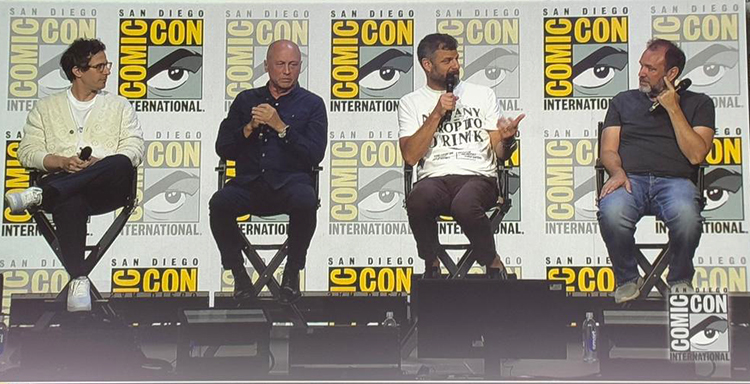
South Park creators Trey Parker and Matt Stone, Beavis and Butt-Head mastermind Mike Judge, and Digman! co-creator Andy Samberg joined moderator Josh Horowitz (MTV, Happy Sad Confused Podcast) on Thursday for a fast-moving hour of behind-the-scenes insight, generational whiplash, and the kind of deeply unserious storytelling that built empires.
If the lineup felt like a Mount Rushmore of misbehavior, the vibe onstage was more comedy writers’ room than walk of fame. Samberg, the youngest of the crew, said his comedy inspirations were literally sitting next to him. “(In middle and high school) We used to have South Park watch parties,” he said. “Now I’m on a panel with them.”
That full-circle moment speaks to the panel’s deeper thread: legacy in a world where animation and comedy have changed completely…again.
The conversation opened with a faux-apologetic nod to South Park’s Season 27 premiere, which aired last night. The episode, which depicted a fully naked Donald Trump in bed with Satan, satirized the normalization of antisemitism, repentant MAGA whiplash, pushing Christianity in public schools, NPR’s defunding, and even South Park’s own $1.5+ billion-dollar deal with Paramount. It included a line about how “everyone rips on the Jews and it’s totally fine,” delivered more with cultural exhaustion than comedic glee. The image of Trump’s uncensored penis reportedly prompted a four-day debate inside the South Park offices with censors. This culminated in the creators giving the micropenis little cartoon eyes, or was it only one?
“We’re terribly sorry,” Stone joked as the panel began.
That episode was the kickoff to South Park’s first season under its new five-year streaming contract with Paramount+. As of July 2025, the series is exclusively streaming to the platform and streams alongside 26 previous seasons and original movies- it’s still on Comedy Central though, so you can still see it on regular tv. Stone and Parker now produce the entire show in-house, writing, animating, and editing episodes in the same building. “It’s like a band,” Parker said. “We go into the studio with no idea what we’re doing.”
Parker also mentioned how the animation tools have evolved to allow for nearly instant changes, sometimes adding edits in under two hours. But this style has worked for them since inception. Their mentality is ‘If we’re not all in, we get lazy.’ When asked about how they promote a show that doesn’t exist yet, the creators admitted that one of South Park’s summer promos was made entirely of fake footage. They needed something in February, so they just made it up. And yes, they confirmed they still don’t know what next week’s episode will be.
It was mentioned South Park has over 60 billion views this year, while I couldn’t confirm that I can confirm that South Park has over 53 billion streaming minutes in 2021 alone (according to Puck.), more than Friends or The Office, with audience demand still outpacing almost every show on TV.
Long before billion-dollar deals or the internet-era social exposure, South Park went viral the old-fashioned way. Their holiday short, The Spirit of Christmas, became an underground VHS hit in the mid-1990s. At the same time, Mike Judge was finalizing the Beavis and Butt-Head movie. Judge recalled when he first saw the short he quickly recognized Parker and Stone’s talent and encouraged them early on.
That support stuck. Stone and Parker still talk about Judge’s influence on their work. And while the long-hoped for crossover between South Park and Beavis and Butt-Head hasn’t materialized, the creators admitted they’ve joked about it long ago: “The boys (Beavis and Butt-Head) should have to babysit Cartman,” one of them offered. Judge, Stone, and Parker were all influenced by Monty Python, which they saw weekly on PBS, which may explain their love for public-funded content.
The pioneers of adult animation spoke candidly about the ways young creators are rewriting the rules. “The fearlessness is great,” Stone said. “People just grab a phone, do something crazy in their kitchen, and it’s funny.” He added, “Now we’re competing with everyone.” Samberg added that comedy today moves faster than ever, with a “Generation Sponge Bob” pace. “If it makes us laugh in the room, we do it,” he said. That’s the only rule. The comics all agreed that much of what they watched now was the short form content that has taken over social media. Stone, who has kids, put it bluntly: “You’ve got 40 seconds max to grab their attention.”
Parker described how they use the internet as their show bible, often pitching storylines in the writers’ room, only to look online and see that they already did them. “We’ll come up with something and someone says, ‘Didn’t we already have him fall in love with a robot?’ Turns out, yeah.”
The panel wasn’t all chaos and nostalgia. There were also reflections on missed connections, surprising redemption arcs, and the long tail of creative work.
Judge admitted that Office Space or Idiocracy flopping at first stung, especially after he fought for every detail. “It sucked,” he said. “Now that it’s a cult hit, it feels good—but also, I’m sorry.” He spoke about Idiocracy being labeled “prophetic,” a label he receives with mixed feelings. “It wasn’t supposed to be a documentary.” Samberg remarked that he and his friends comment on how much the world is like Idiocracy at least once a week. Judge also joked that he got into animation because he couldn’t pitch anything in person: “Thousands of drawings just to avoid social interaction.”
As for fame, each panelist handles it differently. Samberg, best known for live action roles, gets recognized often. Stone joked that he’s disappointed as only guys ever recognize him. Parker said he gets the best of both worlds: he can walk Comic-Con with his daughter and everyone’s respectful, but can still get a table when he needs to by dropping his name.
And while Judge once considered adapting Beavis and Butt-Head to live action, the pandemic disrupted casting plans. Then Ryan Gosling did it on SNL to great success.
Samberg explained how Digman! was born from a Nic Cage impression he used to do on SNL. Wanting to keep the character alive, he and his team reverse-engineered an archaeologist in the mold of National Treasure-era Cage. The show’s first season was made remotely during the pandemic and showcases the fast-cut pace that now defines modern animation.
As the panel wound down, the tone shifted from irreverent to reflective.
Stone and Parker were awarded the Inkpot Award by Comic-Con’s director of programming, Eddie Ibrahim – a nod to their decades of creative impact.
When asked what still makes them laugh, Parker said the dumbest stuff on YouTube reminds him of college. Judge shouted out a TikTok impressionist who reads Dr. Dre lyrics in a Tucker Carlson voice. Though they’ve never been approached to do a live-action version of South Park, Parker and Stone said they’ve seen AI-generated clips of it circulating online. “Some of it’s pretty funny,” Stone admitted
And when asked for advice to young creators, Stone demurred: “It’s a different world now. We had to get in a car and drive to L.A. That’s not true anymore – and that’s great.” Samberg added.
They don’t know why their shows work. They’re not sure they’d work if launched today. But they’re still here, still making each other laugh and still showing up in rooms where that’s the only metric that matters. As Samberg said, “The only thing that hasn’t changed is: if you want to make something, make it. No one knows you’re funny until you show them.”
*
Shor M. Masori is a San Diego-based freelance writer.