By Alex Gordon
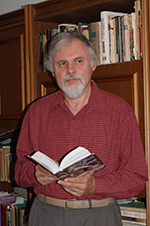
HAIFA, Israel — Semyon Frank, a Russian religious philosopher and baptized Jew, was born in Moscow in 1877 into a family of a physician who graduated from the medical faculty of Moscow University. Frank’s mother, Rozaliya Rossiyanskaya, was of German Jewish descent on her mother’s side.
Her father, Moisei Rossiyskiy, was a rabbi and one of the founders of the Jewish community in Moscow. He spoke poorly and couldn’t write in Russian at all, but he taught little Semyon to read the Torah and Talmud and to attend the synagogue. Semyon grew up in his house.
The philosopher recalled: “The reverent feeling with which I kissed the Bible cover when the ‘scrolls of the covenant’ were carried around the synagogue became, in a genetically-psychological sense, the foundation of the religious feeling that defined my entire life (except for the period of unbelieving youth, approximately from 16 to 30 years old).
“The stories of my grandfather about the history of the Jewish people and the history of Europe became the first foundation of my intellectual horizon. As he was dying, he asked me – then a 14-year-old boy – not to stop studying the Jewish language and theology. I did not literally fulfill this request; however, I think that in a general sense, both by converting to Christianity and losing my connection with Judaism, I somehow remained true to my grandfather’s covenant, because I remained faithful to the religious foundations he instilled in me; or rather, I returned to them in my mature years. I have always perceived my Christianity as an overlay on the foundation of the Old Testament, as a natural development of the religious life of my childhood.”
In 1891, Frank’s long-widowed mother married the Narodnik Vasily Zak, a baptized Jew. Due to the expulsion of Jews from Moscow organized by the government of Tsar Alexander III, the family moves to Nizhny Novgorod. There, under the influence of his stepfather, Semyon became close to the participants of circles of budding Marxists.
In 1894, Frank enrolled in the Faculty of Law at Moscow University, but he hardly attended lectures; instead, he engaged in theoretical debates in Marxist circles and even propagated social-democratic ideas in a working-class environment that was foreign to him. Since 1896, Frank distanced himself from revolutionary activities and engaged in scientific criticism of Marx’s economic theory.
In 1899, Frank was arrested for participating in student riots and was exiled from Moscow for two years without the right to reside in university cities. Frank first went to his relatives in Nizhny Novgorod, and then to Germany, where he attended lectures on political economy and philosophy at the universities of Heidelberg and Munich.
In Germany, Frank wrote the book Marx’s Theory of Value and Its Significance: A Critical Study (1900), which attracted the attention of economist scholars. Frank was offered preparation for a professorship at the newly established St. Petersburg Polytechnic Institute; however, Frank rejected this offer as it was contingent upon his acceptance of Christianity. In the spring of 1901, Frank returned to Russia and obtained a Candidate of Sciences degree at Kazan University,
In 1908, Frank married Tatyana Bartseva, who, in order to marry a Jew, was forced to convert from Orthodoxy to Lutheranism. In the collection Landmarks (1909), which became an important event in the history of Russian philosophical thought, Frank published an article The Ethics of Nihilism, where he criticized the “nihilistic moralism” characteristic of the Russian radical intelligentsia and opposed it with a call for “creative, culture-building religious humanism.”
Frank criticized the radical Russian intelligentsia for their belief in the omnipotence of human rationality and for viewing service to the people as the only possible goal. He wrote: “We can define the classical Russian intelligentsia as a militant monk… of the religion of earthly well-being.”
In 1915, Frank’s book The Object of Knowledge was published. His book The Soul of Man on philosophical psychology, published in 1918, was presented by him as a dissertation for a doctoral degree, but due to the Civil War, its defense did not take place. This book immediately placed Frank among the prominent Russian philosophers. Alongside the formation of Frank’s philosophical views, there was also the process of his religious self-identification. If earlier ethical considerations had prevented Frank from accepting Christianity, in 1912 he “became a Christian, believing that this does not sever, but rather strengthens the spiritual connection with his past.”
With the onset of World War I, the Frank family—Semyon, his wife, and three small children—fled from Germany, where they were living at the time, to Russia. During the years of World War I, Frank spent time in Petrograd (since 1912, Frank had been an associate professor at the university).
Frank did not accept the Bolshevik Revolution of 1917. His wife later recalled in her diary about the October Revolution: “It was the collapse of the great colossus of Russia – and we are all under its ruins. Rescue and flight began—some to foreign lands, some to the countryside, some with the White Army, some to wherever. Russia was hiding, scattering, darkness descended!”
In the revolutionary chaos, members of the Frank family found themselves in Saratov. Work at Saratov University, where Frank became the dean of the Faculty of Philosophy and an ordinary professor at the Faculty of History and Philosophy, barely saved the family from starvation. At this time, Frank has his fourth child.
In the fall of 1921, he moved to Moscow, where he was a professor at the Institute of Philosophy, which had separated from Moscow University to become a special educational institution. In 1922, the philosopher Semyon Frank was expelled from Russia on one of the infamous “philosophers’ ships.” Along with Frank, more than two hundred representatives of the Russian intelligentsia were forced to leave their homeland at that time.
Having settled in Berlin, Frank became one of the founders of the Russian Scientific Institute, and in the last year of the institute’s existence (1932), he was its director. In 1926, Frank delivered a lecture titled New Barbarism to the Union of Russian Jews in Berlin, in which he warned about the vulgarization of modern culture. Initially, the philosopher did not feel threatened by the Nazi regime and “approached the noticeable rise of anti-Semitism in Berlin, including among the Russians, with considerable irony.”
In 1933, Hitler came to power in Germany. Frank, as a Jew, was deprived of the opportunity to teach at the University of Berlin. The atmosphere was gradually thickening, anti-Jewish demonstrations were taking place in the streets, and Jewish shops were being vandalized. Before Frank’s eyes, the great culture of Germany was collapsing. He watched with bitterness and astonishment as it turned towards the totalitarian ideology of National Socialism.
In 1934, Frank published an article titled The Religious Tragedy of the Jewish People in a German magazine. The article was published anonymously, with a note stating “written by a Jew-Christian.” In it, Frank most vividly expresses his attitude towards both Judaism and Christianity, emphasizing that the significance of the religious guilt of the Jews, which lies in the fact that they did not recognize, exiled, and killed their own Messiah and Son of God, foretold by the prophets, can only be truly understood by a “Jewish-Christian.”
“Christianity,” Frank wrote, “is the divine revelation in Israel and through Israel” and “is born from the deepest depths of the Jewish religious spirit (although in its later formulation of the doctrine of faith, the Greek spiritual heritage also played a role). The fact that the Jewish people did not accept Christ is a mystery, and any manifestations of antisemitism only testify to its misunderstanding.” Frank indirectly implies that after his baptism, he not only did not renounce his belonging to the chosen people but also directly contributed to the fulfillment of its mission, waiting for “all Israel to be saved.”
In 1936, Frank was summoned to the Gestapo. A wave of arrests and raids was sweeping across the country. Staying in Germany was becoming life-threatening. At the end of 1937, Frank and his family left Germany, trying to find refuge in France. Since 1940, France had been a zone of German occupation. There were constant roundups of Jews and their deportation to death camps, in which the Vichy French government aided the Nazis. The Franks move to a village near Grenoble. “We were like hunted animals, hungry, lonely,” recalled Tatiana Frank. Frank’s emotional state was catastrophic. He carried a capsule of poison with him. The rise of the Nazis to power in Germany made him feel a connection to Judaism, but he survived and immersed himself in Christianity again.
In 1945, Frank moved to England. He died in a suburb of London in 1950.
*
Alex Gordon is professor emeritus of physics at the University of Haifa and at Oranim, the Academic College of Education, and the author of 11 books.