Letters from the Afterlife: The Post-Holocaust Correspondence of Chava Rosenfarb and Zenia Larsson edited by Goldie Morgentaler with translations by Krzysztof Majer and Sylvia Söderlind; © 2025; Montreal, Canada: McGill-Queen’s University Press; ISBN 9780228-024668; 315 pages plus appendix and index; $34.95

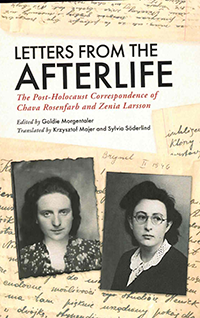 SAN DIEGO — This book captures 26 years of correspondence, from 1945 to 1971, between two Holocaust survivors who both wrote trilogies about their experiences of Lodz, Poland before, during, and after World War II.
Goldie Morgentaler, the editor, is the daughter of one of the correspondents, Chava Rosenfarb, who made her way in 1950 along with physician husband Henry Morgentaler to Canada. Zenia Marcinkowska, a girlhood friend of Chava who shared terrifying ordeals at the Auschwitz Concentration Camp, was the other correspondent. In Sweden, Zenia married Per-Axel Larsson and thereafter sculpted and wrote under the name of Zenia Larsson.
As might be expected, the two correspondents occasionally touched on their shared Holocaust experiences. But they also wrote about their post-Holocaust lives in Canada and Sweden, hampered by needing to write in their once common language, Polish, which they were fast forgetting. Chava wrote poetry and books in Yiddish, later translated by her daughter to English; while Zenia wrote her books in Swedish. Zenia understood popular Yiddish but was a stranger to its more literary form.
Chava exemplified Holocaust memories in August 1947 with this passage in her correspondence: “You know what it means to be swimming in the sea, carried by waves of sun-dazzled water, and to be suddenly visited by painful memories of the past. My body experiences joy and delight – and all of a sudden my mind hears the whispers of loved ones who are gone. How that hurts! How everything shrinks. How the bronzed, healthy chest, glittering with the sun’s gold, suddenly heaves with a helpless whimper. – I’m strolling the beach, my feet sinking into the hot sandy dunes and I see before me my father, or Shayevitch [a former boyfriend]. I know Zenia that they will never leave me now. I am luckier than others who have lost everything, but no one can replace those whom I have lost, and my longing for them will last as long as I live. No joy of mine will ever be complete because they are not here.”
Zenia responded the following month: “Wherever I am, whether at work, during a walk in the woods, or across the fields, in the streets, at home or away – I suddenly see my stepmother Eva’s gaze, hear her low voice, and everything around me vanishes. I stop living in the present, am thrown back to the past, only to suffer again. I see the suffering of my loved ones without being able to help or interfere. Again and again I am pierced by my father’s painful, distant gaze as his eyes followed me before his death. I hear his last words – among greenery, trees, and flowers in the land I now live. Even here the scourge of the past reaches me, everything around me wilts, freezes to ice…”
In January 1949, Zenia put into words the nature of her relationship with Chava: “In spite of all the changes and the passing of time, {I am} the same old friend you once had. From Ulica Piotrowska and Ulica Zermskiego, from the ghetto and darkened streets, from one of the five in the roll calls in the concentration camps. Those ties nobody can sever; nor can distance or time make a dent in them.”
(Nazi concentration camp guards had prisoners line up five across for roll calls, which sometimes took hours. Zenia, Chava and three other young women tried to always stand together.)
Had their correspondence dwelled on the Holocaust, it would not have been so enduring. In December 1946, Chava wrote to the 24-year-old Zenia warning about the two sides of sexual intimacy: “There are moments that might trigger feelings of disgust and revulsion if they don’t love each other. A woman is especially sensitive to such moments. But if one loves, then there is nothing disgusting. If he is close to you, you could kiss his entire body; you would be able to suffer anything.”
In June 1948, now 26, Zenia pondered whether she should marry her future husband, Per-Axel, a non-Jew. “I will not speak of any overwhelmingly passionate love! It is enough that in him I find so much beauty and warmth, so much self-evident human dignity and purity, so much confidence, that whatever may be lacking is fully recompensed by these feelings. Are they, then, a crime against my loved ones who perished because they were Jews? These are questions, Ewa, questions I constantly ask myself without finding the answer.”
(“Ewa,” equivalent to the English “Eve,” is how the Hebrew name “Chava” translates into Swedish.)
The correspondents also traded thoughts about their workaday schedules, work-life balance, Chava’s two children Goldie and Abraham, Chava’s divorce from Henry, and about the customs of their adopted countries, Canada and Sweden.
Zenia, writing in June 1959, described the Swedish celebration of “Midsummer” evocatively: “On that day people build structures that look like high and narrow crosses – they are called maypoles – cover them with green leaves, all kinds of flowers, and giant flower wreaths, and then raise them wherever possible: in the yards, on the meadows, on the lawns, and in the parks. Whoever is able – and they are many since the love of the country’s traditions is very strong here – dresses in folk costume and in the evening everyone gathers around the beautifully decorated maypole. They play folk music, and sing old, well-known songs; young and old, men, women and children all hold hands and dance around in a circle – evening approaches night but the twilight remains a long time. According to a very old legend, young girls, if they want to see their future husbands, must pick seven kinds of wildflowers after midnight, and put them under their pillows. If they then dream about a young man; he is the one they will marry. What does it matter if they pick the flowers without believing in the magic of midsummer night? It is wonderful anyway!
Two very creative authors trusted each other sufficiently to confide their intimate thoughts.
We are privy to them through the efforts of Polish translator Krzysztof Majer and Swedish translator Sylvia Söderlind, and the sensitive editing of Goldie (who might have squirmed reading some passages about her own childhood). The book captures an historic era through two very personal perspectives and experiences.
*
Donald H. Harrison is publisher and editor of San Diego Jewish World.