By Bruce Lowitt
 If you were a Jewish boy growing up in Flatbush or Midwood or Borough Park or one of the other shtetls of Kings County in New York City in the 1950s and your parents emigrated from eastern Europe, your mother probably covered the couch in plastic, your father impressed upon you education above everything, one or both of them spoke Yiddish (especially when talking to your aunts and uncles and got to the good parts) and you tried to hit two or three sewers playing stickball with a Spaldeen.
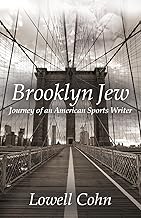
And even if none of that was true – if you were a Christian girl growing up in the Midwest where Jews were not only a minority but often a novelty – you will appreciate and enjoy Brooklyn Jew: Journey of an American Sports Writer, Lowell Cohn’s warm, nostalgic, and often smartass memoir.
If you know what a Spaldeen is, mazel tov! You’re ahead of the game. If you don’t, Chapter 42 will introduce you to one of the artifacts of our second, or maybe third, religion after Judaism. (Reviewer’s Note: I grew up in the 1950s in Bensonhurst, a Brooklyn community with a mix of Jews and Italians.)
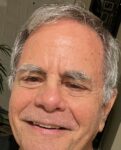
Cohn spent nearly four decades covering sports for the San Francisco Chronicle and Santa Rosa Press Democrat and his columns were notable for his fearlessness in going after anyone – team owners, coaches and players. In 2022 he was inducted into the Northern California Jewish Sports Hall of Fame.
But Brooklyn Jew is not a sports book. He devotes barely one chapter to it, and that one (Chapter 32) is devoted to baseball and the difference between the definitions of horse***t and bull***t. It’s a very accurate explanation. He previously wrote a memoir, Gloves Off, which covers his life as an award-winning sports columnist.
This time, Cohn is writing about how he got there, emerging from a childhood and a neighborhood in which he believed that Judaism was the world’s largest religion because that’s all he knew – until he discovered the truth as an 8-year-old, reading an Encyclopedia Britannica Junior pie chart.
Beginning with his departure from Brooklyn, first at Lafayette College in Easton, Pennsylvania, and then to Stanford University, where he discovered the striking difference between California and New York Jews, Cohn takes us on a fascinating journey, including his own marriage to a “shiksa,” a love affair that could have devastated his family but didn’t, and his own encounters with antisemitism, both subtle and blatant.
The best thing about Brooklyn Jew is that 60 years after leaving Flatbush for good, he still writes with an unmistakable Brooklyn Jewish attitude and accent – explicit, emphatic and often funny as hell.
*
Bruce Lowitt is a retired sportswriter for the Associated Press and the St. Petersburg Times, among other publications.