Jews vs. Rome: Two Centuries of Rebellion Against the World’s Mightiest Empire by Barry Strauss; New York: Simon & Schuster; (c) 2025; ISBN 9781668-009598; 384 pages; $25.76 on Amazon
By Rabbi Dr. Israel Drazin

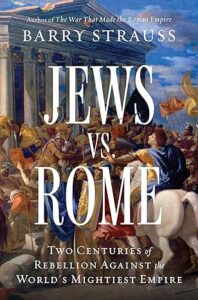 PIKESVILLE, Maryland — Barry Strauss’s book, Jews vs. Rome: Two Centuries of Rebellion Against the World’s Mightiest Empire, will surprise most readers and give them much fascinating information. We learn, for example, that Jews did not need to engage in long-lasting battles against Rome, lose sovereignty over their country, and have many of its citizens expelled from their country for 2,000 years, had it not been for sinat chillum, “baseless hatred” of some Jews against other Jews.
Barry Strauss is a Senior Fellow at the Hoover Institution and Professor at Cornell University. He is considered a leading expert on military history. He wrote 14 other books on ancient wars before this 359-page volume, with an index of 19 pages in two columns per page. He wrote several on Rome and Greece, as well as on comparing ancient and modern battles. His books are in easy-to-read English, without any attempt to use scholarly language to impress readers. An added treat, thanks to his deep knowledge of the subject, is a wealth of fascinating details about events and people, including their impact on the past, present, and future.
In tractate Yoma 9b, the Talmud states that the destruction of the Second Temple in 70 CE and its bloodshed were due to sinat chinam, “baseless hatred,” of some Jews against fellow Jews. The Talmud explains that even while Judea’s inhabitants were engaged in Torah study and proper acts of kindness, the destruction occurred because of their internal hatred for one another.
Strauss does not mention this talmudic observation because this is not his field of interest. Still, he shows the terrible mistreatment of groups of Jews fighting each other numerous times during the two centuries they also fought for and against Rome. This situation still exists today, leading me to think that some of the worst antisemites are Jews.
In Jews vs. Rome: Two Centuries of Rebellion Against the World’s Mightiest Empire, Strauss tells the history beginning in 63 BCE, when the Roman general Pompey (106-48 BCE) was able to conquer and take control of Judea because of Jewish rivalry in Judea, the name Israel had at that time, to 136 CE when the Bar Kokhba Revolt was crushed. This was a turbulent period in Jewish history, marked by political resistance and religious fervor, clashes of internal Jewish hatreds, and opposition to the might of the Roman Empire.
The book is filled with fascinating information presented in a balanced tone. Strauss does not romanticize rebellion, nor does he demonize Rome. Instead, he presents a clear-eyed view of the motivations, missteps, and consequences on both sides, offering a portrait of an ancient, long-lasting struggle that echoes in other struggles, both ancient and recent.
To understand the significance of this 200-year series of wars between a small country and a world power, one needs to compare the Judean two-century battles with the American fight against the then world power, England, in 1775.
In 1775, the war between America and England started with the Battles of Lexington and Concord in April. The British attempted to seize colonial military supplies in Massachusetts, but colonial minutemen intercepted them. This led to armed conflict that spread throughout the year, including the significant engagement at the Battle of Bunker Hill in June. The Second Continental Congress formed the Continental Army and appointed George Washington as its commander.
If the founders of America had been forced to surrender in 1775, as the Judeans were in 63 BCE, and had continued to fight for two centuries, as the Judeans did, the American fight would not have ended until 1974.
The two centuries were marked by Judean hatred toward Rome due to its conquest and control of Judea in 63 BCE. There were three pivotal violent rebellions against Rome: the Great Revolt of 66 to 74 CE, which resulted, among other calamities, in the destruction of the Second Temple in 70 CE; the Diaspora Revolt of 116 CE; and the Bar Kokhba Revolt of 132 to 136 CE. There were also many more minor battles before and sandwiched within these three. In each struggle between Judeans and Rome, thousands of Judeans fought alongside the Romans against their brothers.
Strauss breathes new life into these ancient events. For example, he doesn’t just recount the destruction of the Temple or the mass suicide at Masada. He places these ancient events in a broader geopolitical and human context. As a result, readers gain insight into the internal divisions within the Jewish world since the beginning of time, the often-overlooked roles of women such as Queen Helena (died around 60 CE), who converted to Judaism, Berenice, the Jewish daughter of King Agrippa (born 28 CE), who supported the Romans, as well as the repetitive clashes between empires.
He challenges older narratives found in other histories and brings fascinating nuances to familiar stories. His prose is both scholarly and accessible, making this book valuable for academics, students, and general readers alike. His portrayals of figures like Simon Bar Kokhba, who was killed in 136, are complex and evocative, capturing both heroism and hubris.
Strauss’s book is a masterful addition to the literature of ancient history and a powerful reminder that the past is a mirror image and snapshot of current struggles, and what motivated the past continues to shape the world we live in.
While the Judeans physically lost the final battle in 136, they left their descendants with a sense of pride and nobility that is reflected in modern Israel, not in ancient Rome, which no longer exists.
*
Rabbi Dr. Israel Drazin is a retired brigadier general in the U.S. Army Chaplain Corps and is the author of more than 50 books.