By Kerry Schlossberg

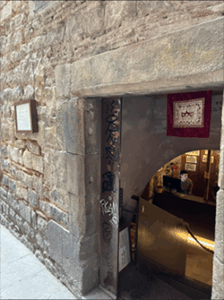
BARCELONA, Spain — To the Sephardic Jewish communities across America, the Sinagoga Major de Barcelona stands as a quiet yet powerful link to our shared heritage. This ancient sanctuary, one of Europe’s oldest synagogues, is nestled in the heart of Barcelona’s Gothic Quarter.
Today, it serves as a museum and archaeological site, persisting as an indispensable landmark of the once-thriving Jewish community of Europe. However, the ancient synagogue where our ancestors prayed is currently half-occupied by a privately-owned restaurant. We can all play a small part in a decades-long recovery mission, by raising awareness and sending donations to the nonprofit Associació Call de Barcelona as it works to restore the synagogue.
A brief history
The Sinagoga Major, located on Carrer de Sant Domènec del Call in Barcelona’s historic Call Jueu (Jewish Quarter), dates back to the 3rd or 4th century CE and was built atop Roman-era foundations, a testament to the enduring Jewish presence there since the days of the Second Temple. By the 11th to 13th centuries, the Sinagoga Major served as the grand central synagogue for Barcelona’s thriving Jewish community—up to 4,000 people, comprising nearly 20% of the city’s population. Here, Shlomo ben Adret (the Rashba) led prayers and scholarship that illuminated Sephardic thought across the Diaspora.
Tensions erupted in 1391, when antisemitic riots devastated the Call Jueu, killing thousands and forcing conversions. The 1492 Alhambra Decree, issued by King Ferdinand and Queen Isabella, expelled 200,000 Sephardic Jews, following centuries of increasing hostility, including the Spanish Inquisition’s brutal persecutions. The decree was not revoked until 1968.
The synagogue fell silent, repurposed over the centuries as a warehouse and residence, its sacred purpose nearly forgotten. Rediscovered through the meticulous research of historian José Luis Riera and Argentine-Jewish philanthropist Miguel Iaffa, the site was purchased by Mr. Iaffa before the city could proceed with its plan to demolish the building in the 1990s. In 2002, the site was partially restored and opened as a museum and archaeological center by the nonprofit Associació Call de Barcelona.
Today, the Sinagoga Major’s prayer hall, adorned with Hebrew inscriptions and artifacts including a centuries-old Torah scroll, welcomes about 20,000 visitors annually for guided tours, bar mitzvahs, and cultural events.
Attempt to revive
Despite ongoing attempts to revive it, the Sinagoga Major remains incomplete. Nearly half of the original structure, including the women’s section of the synagogue (ezrat nashim), is privately owned and operates as a restaurant. This commercial use of a sacred space feels like a lingering wound, reflecting a broader challenge in preserving Jewish heritage in Spain.
The nonprofit Associació Call de Barcelona dreams of acquiring this space to restore the synagogue’s full footprint, creating room for expanded exhibits, prayer spaces, and Sephardic archives. Such a project would require significant funding, but it offers a chance to strengthen the Jewish community at a time when antisemitism is once again on the rise in Europe.
Antisemitic incidents have surged in Barcelona, with vandalism and swastika graffiti scarring the Gothic Quarter’s walls. Local authorities have been criticized for slow responses to vandalism, and dismissing hateful graffiti as mere urban expression. The Federation of Jewish Communities of Spain has called for stronger protections, highlighting a gap between Spain’s acknowledgment of past wrongdoing and its questionable efforts to combat hate.
An Invitation to Connect and Support
The Sinagoga Major is more than a historical site protecting our ancestors’ legacy—it’s a living testament to the resilience of the Jewish people. Visiting the museum (sinagogamayor.com) offers a chance to walk where our ancestors prayed. The Associació Call de Barcelona welcomes support to preserve and expand the site, including efforts to acquire the restaurant-occupied section of the synagogue. Contributions, however modest, can help—donations can be made at sinagogamayor.com/en/support
*
Kerry Schlossberg is a freelance writer based in San Diego.