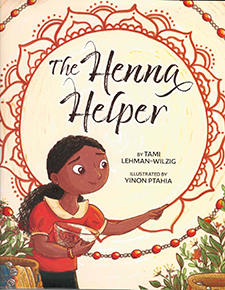
The Henna Helper by Tami Lehman-Wilzig with illustrations by Yinon Ptahia; Milburn, New Jersey: Apples & Honey Press, an imprint of Behrman House Publishers; © 2025; ISBN 9781682-156520; 31 pages; $19.95.

 SAN DIEGO – In Yemen and other Middle Eastern countries, some brides participate in an ancient henna ceremony one week before their weddings.
Yemenite Jews continued to observe this custom in Israel. In this book, written for children 4 to 8 years old, a young girl, Gali, believes the henna tradition is “silly” and old-fashioned. She is more impressed that at the wedding itself, she will be a flower girl – a more modern tradition. Galis’ grandma agrees to sew a dress suitable for a flower girl.
However, grandma, a talented seamstress in a Yemenite neighborhood in Tel Aviv, must first sew a dress and fashion a headpiece and jewelry for the henna ceremony for Gali’s cousin, Yael – causing Gali to become impatient. After Gali is enlisted as a helper in preparing the henna costume, she becomes fascinated by the beauty of the ancient tradition. Among other tasks, grandma and Gali pick out the material for the bride’s henna dress and string beads and pieces of silver for the 13 necklaces Yael will wear at the ceremony.
Artist Yinon Ptahia, who is of Yemenite descent herself, has drawn rich illustrations of the henna ceremony. Author Tami Lehman-Wilzig narrates an absorbing description of the ceremony that involves a fanfare for the bride in her costume and presentations of gifts. The highlight of the ceremony is the drawing with henna paste of a good luck symbol on Yael’s right palm, as the proud groom looks on. Henna paste is made from henna plant powder and tea essence.
After the ceremony, grandma fulfills her promise to Gali by sewing a Yemenite-styled flower girl dress made from the same material as Yael’s ceremonial henna dress. It has puffy sleeves and Yemenite embroidery around the neck and waist. Gali is delighted at the mixture of an ancient tradition with a more modern one.
In the back of the book comes more information about the henna ceremony. I was fascinated to learn that the 13 necklaces worn by the bride symbolize the 13 core beliefs of Judaism articulated by Maimonides, whom Yemenite Jews particularly admire because he intervened in their behalf in the 12th century.
This book provides insights into Yemenite Jewish customs and is a delight for the eyes.
*
Donald H. Harrison is publisher and editor of San Diego Jewish World.