By Mark D. Zimmerman

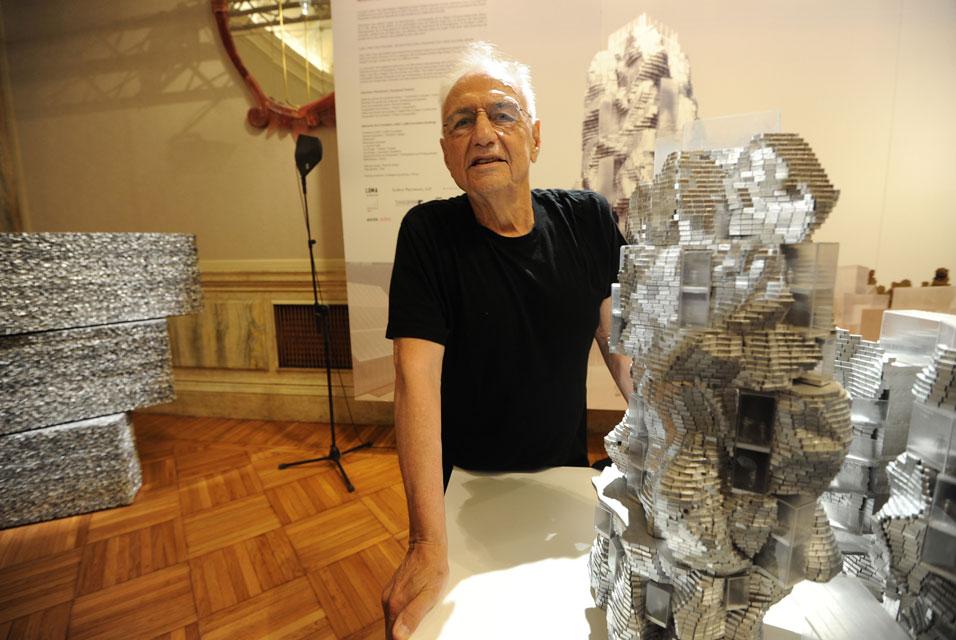
MELVILLE, New York — Renowned architect Frank Gehry (née Goldberg) died last week at the age of 96. While best known for designing buildings such as the Guggenheim Museum Bilbao and private residences such as that of Michael Eisner, Gehry also designed sculptures, theater stage sets, jewelry, and furniture, as well as the World Cup of Hockey.
Gehry was the son of Irving Goldberg, a first generation American whose family emigrated from Russia, and Sadie Kaplanski Goldberg, an immigrant born in Łódź. Gehry, having suffered from antisemitism as a child, decided to change his last name in college at USC so that he would be accepted into the university’s architectural fraternity. He graduated in 1954 from USC’s School of Architecture, briefly studied at Harvard University’s Graduate School of Design, and then apprenticed at an architectural firm in Los Angeles.
He eventually established his own firm, Frank Gehry and Associates, and went on to a highly successful career with worldwide fame. Among his other well-known designs were the California Aerospace Museum, the Cinémathèque Française in Paris, and the Walt Disney Concert Hall in Los Angeles. In 2010, Gehry designed the Beekman Tower in Manhattan, which was next door to the Trump World Tower, and which was a few centimeters taller, surpassing the Trump building to become the tallest residential building in New York, leading Trump to criticize the Beekman, noting that “it’s always very tough to make something successful at the high-end level with a public school in the building.”
While Gehry’s Judaism was not a primary part of his identity, what is one creative design that he noted was inspired by his religious background?
A. Banneker Fire Station in Columbia Maryland, which includes a torch sculpture that was inspired by the eternal flame which Gehry saw in his synagogue when growing up.
B. Dancing House in Prague, which includes a bas relief over the main entrance which features dancers from different cultures including some inspired by Gehry’s vision of Israeli chalutzim (pioneers) performing Jewish folk dances.
C. The Museum of Tolerance Jerusalem, which features two copper pillars by the entrance, representing the Boaz and Jachin pillars of the first Temple.
D. The Walt Disney Concert Hall which features a series of sculptures of musical instruments throughout history, the oldest of which is a sculpture of Miriam and her timbrel leading the Israelite women in dance across the Red Sea.
E. Gehry’s Fish Lamps sculptures, which were inspired by the carp which his grandmother would put in her bathtub in preparation for making Passover gefilte fish.
*
Link to answer: https://rrrjewishtrivia.com/frank-gehry-z-l-answer.html