By Alex Gordon in Haifa, Israel
The first terrorist acts against the leaders of the newly established Soviet government were carried out on August 30, 1918, by Jews Leonid Kannegiesser and Fanny Kaplan. Kannegiesser killed the chairman of the Petrograd (St. Petersburg) Cheka (secret police), the Jew Moisei Uritsky, and Kaplan wounded the chairman of the Council of People’s Commissars (council of ministers), Vladimir Lenin. In response to this “White Terror,” on September 5, 1918, the Bolsheviks declared the “Red Terror.”
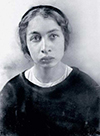
Fanny Kaplan (born Feiga Roitblat) was born on February 10, 1890, in Volhynia Governorate, in the family of a teacher (melamed) at a Jewish elementary school (heder). Beside her, there were seven children in the family. She was homeschooled and became a seamstress.
During the 1905 Revolution, 15-year-old Fanny joined the anarchists under the name “Dora.” In 1906, she was preparing a terrorist act in Kiev – an assassination attempt on the local governor-general, Vladimir Sukhomlinov. During the preparation for a terrorist act planned by her lover, Viktor Garsky (Yakov Shmidman), a homemade explosive device accidentally detonated in a hotel room, and Kaplan was wounded in the head and partially lost her sight and hearing. She was arrested by the police (Garsky fled).
On January 5, 1907, a military district court in Kiev sentenced her to death, which was commuted to life imprisonment due to Kaplan’s minority. She arrived at the prison on August 22nd of the same year, in handcuffs and leg irons. Her accompanying documents noted her tendency to run away. In 1907, she was examined by a prison doctor who found that she needed surgery to remove bomb fragments from her arm and leg, and that she was deaf and suffered from chronic joint rheumatism. On May 20, 1909, she was declared completely blind.
In 1913, Kaplan’s prison sentence was reduced to 20 years. Before 1917, while still in prison, she met Maria Spiridonova, a prominent figure in the revolutionary movement, whose influence led her views to shift from anarchist to SR (SR – Socialist-Revolutionaries, one of Russia’s revolutionary parties). Kaplan did not write a single clemency request. She was ill, was hospitalized several times, and went blind.
In 1917, after the February Revolution, Kaplan was amnestied by the Provisional Government. The Provisional Government opened a sanatorium in Crimea for former political prisoners, and Kaplan went there in the summer of 1917 to improve her health. There she met Lenin’s younger brother, the doctor Dmitry Ulyanov, with whom she had a romance. The younger Ulyanov gave her a referral to the eye clinic of Professor Leonard Hirschman at Kharkiv University. She had a successful operation in Kharkiv – her vision partially returned. Of course, she couldn’t work as a seamstress again, but she could distinguish silhouettes and orient herself in space. She lived in Crimea, had her eyesight treated, and taught courses to prepare local government workers.
In May 1918, SR Nikolai Alyasov brought Fanny Kaplan to a meeting of the 8th Council of the Socialist-Revolutionary Party. It was at this meeting that Kaplan, through Alyasov, met former Constituent Assembly deputy Vladimir Volsky and other SRs from the Combat Organization, which was responsible for carrying out terrorist acts under the Tsarist regime.
Although she was given the Browning by Grigory Semyonov, the head of the Combat Organization, she prepared the assassination attempt on Lenin herself and, to avoid casting a shadow on other SRs, left their party shortly before it was carried out.
On August 30, 1918, a workers’ meeting was held at the Michelson factory in Moscow. Vladimir Lenin spoke there. After a meeting in the factory yard at eight o’clock in the evening, Kaplan shot him three times with a pistol. She was arrested right here, at the tram stop. She told the worker Ivanov who arrested her that she was the one who shot Lenin. According to Ivanov, when asked who ordered it, she replied, “At the suggestion of the Socialist Revolutionaries. I have done my duty with valor and will die with valor.” During the search of Kaplan, a Browning M1900 No. 150489, a train ticket, money, and personal belongings were found.
During interrogations, Kaplan stated that she had a very negative attitude toward the October Revolution and stood then and still stands for the convocation of the Constituent Assembly (Russia’s parliament). She decided to attempt to assassinate Lenin in Crimea in February 1918 (after the Bolsheviks dissolved the Constituent Assembly); she considers Lenin a traitor to the revolution and is convinced that his actions “set back the idea of socialism by decades”; she carried out the assassination “on her own initiative,” not on behalf of any party.
Immediately after the assassination attempt, an appeal from the All-Russian Central Executive Committee was published, signed by its chairman, the Jew, Yakov Sverdlov, who served as chairman of the Council of People’s Commissars (the council of ministers) after Lenin was wounded.: “A villainous attempt was made on Comrade Lenin’s life a few hours ago. Upon leaving the rally, Comrade Lenin was wounded. […] We have no doubt that traces of the Right Socialist Revolutionaries, traces of English and French mercenaries, will be found here as well.”
No investigation was actually conducted. Fanny Kaplan was shot on September 3, 1918, at 4 PM in the Kremlin courtyard on the oral order of Sverdlov. Amid the noise of running cars, the order was carried out by the commandant of the Kremlin, former Baltic sailor Pavel Malkov, in the presence of the well-known proletarian poet Demyan Bedny.
Commandant Malkov shot Kaplan in the back of the head. The Jew Sverdlov forbade the burial of the Jewish woman Kaplan. The body was desecrated: Malkov and Demyan Bedny stuffed her body into a tar barrel, doused it with gasoline, and burned it near the walls of the Kremlin. Upon smelling burnt human flesh, Demyan Bedny, the “poet of socialism,” fainted.
On the morning of Kaplan’s assassination attempt on Lenin, August 30th, in Petrograd, the Jewish chairman of the Petrograd Cheka, Moisei Uritsky, was killed by the Jewish SR terrorist Leonid Kannegiesser. Kannegiesser said during the interrogation: “I am Jewish. I killed a Jewish vampire who was drinking the blood of the Russian people drop by drop. I know what awaits me, but I wanted to show the Russian people that for us, Uritsky is not a Jew. He’s an outcast. I killed him in the hope of restoring the good name of Russian Jews.”
Neither Kannegiesser nor Kaplan restored the “good name of Russian Jews,” which could not have existed in anti-Semitic Tsarist Russia. The assassination attempt on Lenin and the murder of Uritsky served as a pretext for the start of the “Red Terror” on September 5th, the Bolsheviks taking hostages and executing them. It wasn’t just Petrograd and Moscow that responded to the assassination attempt on Lenin and the murder of Uritsky with hundreds of killings. A wave of “Red Terror” swept across Soviet Russia – through large and small cities, towns, and villages.
The actions of Kannegiesser and Kaplan became the main trigger for the “Red Terror,” in which thousands of people, both Jews and non-Jews, were killed. In the first list of 130 people shot by the Bolsheviks during the “Red Terror,” there were 12 Jews.
Leonid Kannegiesser and Fanny Kaplan, who were Jewish, carried out terrorist acts against the new Russian government, against leading Bolsheviks. They were brutally murdered without investigation or trial on the orders of the Jew Yakov Sverdlov. They declared themselves servants of the revolution, saviors of the Russian people. By fighting for someone else’s revolution, they created a colossal threat to the Jewish people. Jews found themselves on both sides of the “Red Terror”: they were both executioners and victims.
“The Jews’ reckoning for Bolshevism has already begun,” noted Jewish historian Simon Dubnov on multiple occasions, who was in Petrograd during the October Revolution and the Civil War. – “We are dying at the hands of the Bolsheviks and will die for them. […] How many innocent Jewish heads will fall later at the hands of the Black Hundreds (the Black Hundreds were members of Russian nationalist, monarchist, ultra-religious, and antisemitic organizations) who will avenge the activities of their fellow Jews, the Bolsheviks!”
The historian prophetically emphasized: “The Jews will not be forgiven for the participation of Jewish revolutionaries in Bolshevik terror. Lenin’s associates: Trotskys, Zinovievs, Uritskys, and others will shield him. […] Later, this will be discussed loudly, and Judeophobia will become deeply ingrained in all strata of Russian society.”
But Dubnov did not expect that revenge against the Jews for Bolshevism would come from the Nazis and that he would become their victim: he was killed on December 8, 1941, in the second action to destroy the Riga Ghetto. The largest anti-Jewish pogroms and acts of state antisemitism in Russia occurred shortly after the end of World War II. They began in 1948 with the arrest (and in 1952, the execution) of members of the Jewish Anti-Fascist Committee, followed by the “rootless cosmopolitans” case (1949) and the “poisoner doctors” case (1953). These were acts of state-sponsored antisemitism in the spirit of German National Socialism.
*
Alex Gordon is professor emeritus of physics at the University of Haifa and at Oranim, the Academic College of Education, and the author of 12 books.