A Call at 4 AM: Thirteen Prime Ministers and the Crucial Decisions that Shaped Israeli Politics by Amit Segal; Wicked Sun publisher; (c) 2025; ISBN 9798895-652022; 229 pages; $29.82.
By Rabbi Dr. Michael Leo Samuel in Chula Vista, California

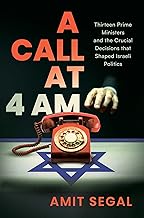 This is not just a book—it’s a ticking bomb disguised as history. Segal possesses the unusual ability of situating the reader into the flow of his story. From the moment you crack the cover, you’re plunged into the suffocating darkness of a Jerusalem bedroom at 4 a.m., where the shrill ring of a phone shatters the silence like a gunshot.
Golda Meir, drenched in cold sweat, knows exactly what that call means: war is coming, lives are hanging by a thread, and the weight of a nation rests on one trembling hand reaching for the receiver. Do you answer? Or do you let it ring, pretending the nightmare hasn’t begun?
Amit Segal, Israel’s most feared and respected political journalist—chief analyst for Channel 12 News, columnist for Yedioth Ahronoth, the man who has spent decades lurking in the corridors of power—doesn’t merely recount history. He drags you inside it.
This English edition (revised and expanded from his 2021 Israeli blockbuster The Story of Israeli Politics) is a masterclass in suspenseful nonfiction, structured around thirteen prime ministers whose midnight decisions defined the nation’s survival. Each chapter builds like a thriller: the slow burn of coalition intrigue, the sudden jolt of betrayal, the heart-stopping pause before the strike order is given. You feel the pulse quicken as Segal peels back the layers of backroom deals, whispered threats, and existential dread that make Israeli politics feel less like governance and more like a high-stakes game of Russian roulette.
His book would make a wonderful mini-series for television.
The suspense is relentless. Segal opens with Golda Meir’s pre-Yom Kippur War terror—the intelligence warnings ignored, the hesitation that cost thousands of lives—and the tension never lets up. You turn pages waiting for the next crisis: Will Menachem Begin bomb the Iraqi reactor? Will Ehud Barak pull out of Lebanon in the dead of night? Will Ariel Sharon survive the political firestorm of disengagement?
Segal’s insider access—earned through years of scoops and relationships—delivers revelations that feel stolen from classified files. He doesn’t tell you what happened; he makes you live the moment when a prime minister stares at maps stained with potential blood, knowing one wrong word could end everything.
What elevates this from excellent political history to gripping drama is Segal’s narrative voice: witty, fast-paced, almost cinematic. He compares Israel’s chaotic parliamentary system to a “House of Cards” on steroids—proportional representation that fragments power into tiny factions, forcing endless coalitions where ideology bends to survival. Every prime minister, left or right, becomes a prisoner of the same merciless logic: compromise or collapse.
The book pulses with this irony. Benjamin Netanyahu, the longest-serving leader, emerges as both master manipulator and ultimate victim of the system he perfected. Naftali Bennett, the tech-savvy disruptor, finds himself entangled in the same web. Even the briefest tenures, like Yair Lapid’s caretaker stint, carry the weight of impending doom.
Segal’s prose crackles with urgency. Sentences are short, sharp, like urgent dispatches from the war room. He weaves personal anecdotes—Moshe Arens calling security “the beating heart of Israeli politics”—with granular detail: the exact hour a cabinet vote was called, the tone of a late-night phone call from Washington, the flicker of doubt in a leader’s eyes.
The result is claustrophobic immersion. You aren’t reading about decisions; you’re in the room, heart hammering, as the fate of millions hangs on whether one man says yes or no.
Yet the suspense builds to something darker. The book culminates in the lead-up to October 7, 2023—the tragic massacre that shattered illusions of security. Segal ends there, deliberately unfinished, leaving the reader with a chilling void. The phone is ringing again, but this time, the answer remains unwritten. It’s a narrative choice that haunts: history doesn’t conclude; it waits in the shadows for the next 4 a.m. call.
*
Rabbi Dr. Michael Leo Samuel is spiritual leader of Temple Beth Shalom in Chula Vista, California.