Choosing to Be Chosen: From Being an Atheist Non-Jew to Becoming an Orthodox Jew by Kylie Ora Lobell; Wicked Son; (c) 2026; ISBN 9798895-653487; 320 pages; $19.99. Publication date: Feb. 17, 2026.
By Michael R. Mantell, Ph.D. in El Cajon, California
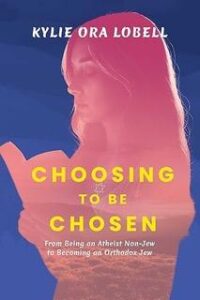 This heartfelt work is a candid, absorbing memoir that explores how faith is shaped not only by belief, but by resistance, inheritance, and choice. Rather than presenting a straight line toward Judaism, Lobell offers readers a textured journey, one that includes being pulled toward a faith that ultimately was not hers.
A particularly revealing thread in the book centers on Lobell’s grandmother, a devout Catholic who played a significant role in her upbringing. Lobell describes being taken to church, encouraged, at times even insistently, to embrace Catholic beliefs and practices, and made to feel that salvation depended on adherence to a system she did not intuitively trust. These experiences are written without mockery or bitterness, but with clarity about the discomfort they caused. The pressure to accept Catholicism sharpened her early skepticism toward religion altogether and helped solidify her atheist identity for many years.
Yet these vignettes are essential to understanding the depth of Lobell’s eventual choice. Her resistance was not to faith itself, but to being told what to believe without space for questioning or consent. She writes of feeling that religion, as she first encountered it, demanded submission before understanding, an experience that left her wary of all spiritual systems.
Ironically, it is this early exposure that later heightens the contrast she experiences when encountering Judaism. Lobell notes that Judaism did not ask her to believe first, but to learn, to question, and to practice. Where Catholicism had been imposed, Judaism was discovered. Where faith once felt compulsory, it now felt invitational.
As she begins engaging with Jewish life, Lobell recounts moments of quiet recognition: Shabbat observed not as obligation but as refuge; mitzvot experienced as grounding rather than coercive; halacha embraced not as control, but as structure infused with meaning. The vulnerability of immersion in the mikveh and the long, demanding conversion process stand in stark contrast to her childhood religious experiences, this time, every step is chosen.
For Jewish readers, Choosing to Be Chosen offers a powerful reminder of what distinguishes Jewish tradition: its reverence for questioning, its emphasis on action over abstraction, and its insistence that covenant must be entered freely. Lobell’s story invites born Jews to see these qualities anew, through the eyes of someone who once rejected religion entirely.
Ultimately, this memoir is about agency. Lobell does not drift into Judaism; she arrives after resisting, testing, and choosing with full awareness of the cost. Her journey affirms that Judaism is not only a heritage passed down by birth, but a living covenant that can be embraced with intention, courage, and love.
*
Michael R. Mantell, Ph.D., is a freelance writer specializing in interpretation of the Torah.