
By Jerry Klinger in Boynton Beach, Florida
Down a narrow alleyway, sandwiched between two row houses on an obscure street in the northern city limits of Canterbury, England, is the entrance to the “Old Jewish Canterbury Cemetery.” At first glance, with rubbish strewn along the access, the time/mildewed decaying gateway feels like a dark, dark gothic novel, spooky, scary, lying beyond its almost forgotten walls.
An old friend, since passed, Emily Sue Pike – whose family traversed the Great American Plains in a covered wagon on their way to settle in Spokane, Washington- told me, Cemeteries are Outdoor Museums. Cemeteries are windows into a world that was. The world that was shapes our world today and will shape it tomorrow. Don’t be afraid. Enter and learn.
I had not known about the Old Canterbury Jewish Cemetery until I read a fascinating review of a recently published book by Adam Rovener. The article appeared in the Times of Israel, How a 19th-century British Jew became a Zulu chieftain and slaveholding warlord;
https://www.timesofisrael.com/how-a-19th-century-british-jew-became-a-zulu-chieftain-and-slaveholding-warlord/ Isaacs, a white man, a Jew, fought alongside and for the near mythological great Black African King Shaka Zulu as a War Chieftain. The story must have been invented, except it was true.
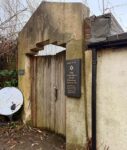
The gate opened. I chose to go in. Nathaniel Isaacs led me to Alan Barnett, the Chairman of the Canterbury Jewish Historical Society. The gate opened wider. I encountered Henry Hart, Jacob the Jew, and Isaac Nathan in political and social controversy. I encountered P.C. challenges, sadly not overcome, and opportunities to respond to antisemitism by doing what the Jewish American Society for Historic Preservation does best: creating and placing permanent Jewish historical markers that affirm Jewish presence, contributions, and commonality.
Nathaniel Isaacs and members of his family are buried in the Old Canterbury Jewish Cemetery. His gravestone is time-worn, almost illegible. I asked the obvious question: Can I upgrade and interpret his story with a footnote of a plaque?
Partnering with Alan Barnett, we approached the Canterbury City Council since they, not the Jews, control the old Jewish cemetery. The offer to add any stone of memory near or adjacent to Isaacs was P.C. charged.
It did not matter that Isaacs’ story was historically unique and important to preserve. It did not matter that he was among the founders of British Natal, South Africa, or that he was a major factor in the economic development of South Africa. They did not care that he integrated his life into and as part of Black African society, even bringing the first narratives of Shaka Zulu to the West.
What mattered to them was that Isaacs had become, as many whites and Black natives had become, enmeshed in a normal African reality, Slavery. For a short period of his later African life, he had engaged in Slave trading for economic gain at the urging of his Black African wife.
The linkage of Slavery, the British, and the Jews was too much for the sensibilities of the Canterbury City Council. The request to preserve Isaacs’ story for posterity in a stone marker behind the high brick walls of the regularly locked gates of the Old Canterbury Jewish Cemetery was rejected.
Disappointed yes. Defeated no. Canterbury is one of the Oldest Cities in the U.K., where Jews were permitted to live. I learned of another incredible story, Jacob the Jew. As a kid, I watched and loved the serialized Adventures of Robin Hood on T.V. Every kid knew the theme song.
Robin Hood, Robin Hood, riding through the Glenn
Robin Hood, Robin Hood with his band of men
Feared by the bad, loved by the good
Robin Hood, Robin Hood, Robin Hood
He called the greatest archers to a tavern on the green
They vowed to help the people of the King
They handled all the trouble on the English Country scene
And still found plenty of time to sing.
The messaging to young impressionable American minds was fight the evil rich and give to the poor. The storyline developed that the Sheriff of Nottingham supported the evil Prince John. John ruled England in place of his brother, ”Good” King Richard. Richard, on his way home from the Crusade to the Holy Land, was captured and held for ransom in Austria. Robin Hood helped collect money for Richard’s ransom.
Relatively accurate so far, though incomplete. When the enormous ransom was collected, it was stored securely in Canterbury in the home of “Jacob the Jew.” Jacob oversaw the safe transfer of the treasure (1194) to the Holy Roman Emperor Henry VI, securing the release and return of King Richard to England.
Ninety-six years later, in 1290, all Jews were banished from England by King Edward I.
Working with Alan Barnett, Alan applied to the Canterbury Historical Society for a “Blue Historical Disk” to be placed on the Abode Hotel, where Jacob’s home had been. It would be in honored memory for what Jacob the Jew did for England.
A few weeks ago, the Canterbury Historical Society approved the idea. The Jewish American Society for Historic Preservation will fund the marker. The fly in the ointment, will the Abode Hotel permit a public marker to be placed on its building honoring a Jew in a rapidly escalating British antisemitic environment?
In the Old Cemetery, a number of different Nathan families are buried, including the family of Isaac Nathan. Isaac Nathan was literally born in the Canterbury Synagogue in 1790. His father, Menachem, a Polish refugee, was the Cantor. Isaac, a musical prodigy, emigrated to Australia. He became the “Father of Australian Music.” A three-marker interpretive effort is underway in Sydney, led by the Isaac Nathan Historical Society, Chaired by David Crowder. The series is funded by the Jewish American Society for Historic Preservation.
Who was Henry Hart? He is not buried in the Old Cemetery but in the “New” Jewish Cemetery of Dover ~1863. Henry Hart was a major English retailer, a sort of father of the British Department Store Chain concept in Southern U.K. He was a three-time mayor of Canterbury. A major public figure, supporting every effort to benefit Canterbury. Henry’s first wife is buried in the Old Cemetery. She died at 37 after having born ten children.
The memory of the deceased is particularly important to a neighbor on the other side of the Cemetery Walls. A major non-Jewish Temple and religious center is next door. It belongs to the Church of the Latter-day Saints, also known as the Mormons. Memory, honor, and holiness are tied in Mormonism through those who came before.
The text of the dedication of the newly placed stone on the Old Canterbury Jewish Cemetery Wall reads simply,
(Hebrew) Holy Community
Star of David
Old Canterbury Jewish Cemetery
Established 1760
Jewish American Society for Historic Preservation
Canterbury Jewish Historical Society.
Will the stone last? DK. Two previous dedicatory stones have vanished in the past twenty years.
*
Jerry Klinger is the President of the Jewish American Society for Historic Preservation.
Emily was my sister in law and also my 8th grade Social Studies teacher. She was dating my brother when I was in her class.