By Jonathan Greenblatt in New York City
In August 1790, George Washington wrote to the Hebrew Congregation of Newport, Rhode Island. His words were simple, but revolutionary: America would give “to bigotry no sanction, to persecution no assistance.”
Washington wrote that every good citizen should “sit in safety under his own vine and fig tree, and there shall be none to make him afraid.”
It was a promise. A compact between our early nation and its Jewish citizens: equal opportunity and liberty defended for all. I’ve been thinking about this promise as we observe Presidents’ Day this year, especially as antisemitism has intensified these past few years.
Indeed, some prominent commentators have argued that antisemitism is inevitable and that we need not waste any time fighting it. Instead, we must refocus on deepening our Jewish identity and joy.
This is a false choice, one that flies in the face of Jewish-American history and in what we need to survive. Jewish flourishing in an open society depends on two conditions at once: thick internal vitality and a public square where Jews can participate without intimidation or stigma. Either one without the other is unstable.
The challenges our community faces now in America’s 250th year are real and daunting.
In January, an arsonist set fire to Beth Israel Congregation in Jackson, Mississippi—the state’s oldest and largest synagogue. It was the second attack on this house of worship. In 1967, the Ku Klux Klan bombed Beth Israel because its rabbi supported the Civil Rights Movement.
Nearly six decades later, another antisemitic attack. And while fire destroyed the parts of the building, a Holocaust-surviving Torah emerged unharmed—a testament to the fact that while they can burn buildings, they cannot break the Jewish people. But here’s where we are today.
In 2024, ADL recorded 9,354 antisemitic incidents—the highest number recorded since we began tracking incidents in 1979. On college campuses alone, incidents exploded by 84 percent. A recent survey we conducted with Jewish Federations found that more than half of all Jewish Americans experienced antisemitism in the past year. Fourteen percent have developed exit plans in case things get worse.
This isn’t happening to some abstract “Jewish community.” It’s the grandfather walking to synagogue. The parent at work. The college student in class. The teenager scrolling on social media.
Following the attack on Beth Israel Congregation, Jackson Mayor John Horhn declared that targeting people for their faith is “morally wrong, un-American, and completely incompatible with the values of this city.”
These words matter. We rely on allies like Mayor Horhn. Because the truth is that recently, many of our allies vanished when we needed them. Friends went silent. Organizations that claimed solidarity just disappeared. Neighbors who we thought would stand with us instead turned their backs.
So, Washington’s promise — to give bigotry no sanction — feels increasingly hollow as antisemitism flows freely on social media, universities still struggle to protect Jewish students, and Jews are violently assaulted on the street.
What’s at stake here extends far beyond the Jewish community. When antisemitism is tolerated (or disguised as political critique) it sends a clear message: bigotry belongs in America after all.
History shows us where that leads. Antisemitism is rarely contained. And when it gains ground, other forms of hate follow. When institutions fail to protect one vulnerable community, they establish a precedent that no community is truly safe.
In light of this, we cannot just hide or turn inward. We must act and claim the promise of our nation’s Founding Fathers.
At ADL, we’re not waiting for others to act first. We’re filing lawsuits—in 2025, we filed more cases than in our previous 100-plus years combined. We’re training security personnel to protect synagogues and Jewish institutions. We’re monitoring elected officials in cities where antisemitism has been normalized. We’re building coalitions with allies across faiths who are committed to this fight.
Our Campus Report Card grades universities on how well they address antisemitism and support Jewish life—and following ADL engagement, more than one-third of schools strengthened their policies enough to improve by a full letter grade. When Microsoft shareholders faced a BDS-aligned proposal, we mobilized through JLens, leading shareholders to reject discrimination disguised as corporate responsibility.
We’re documenting every incident. Demanding accountability from every institution. Doing what Jewish communities have always done — protecting ourselves when protection isn’t guaranteed.
Of course, Washington’s promise wasn’t just freedom from persecution. It was freedom to build, to contribute, and to flourish—the radical idea that Jews could be fully Jewish and fully American without contradiction.
But we haven’t fully realized that vision yet, which is why our efforts to combat antisemitism remain essential, along with reaffirming Jewish values and building strong communities. We must defend our space in the public square and deepen our attachments in our private gatherings and lives. That is how we protect and deepen Jewish life in America.
*
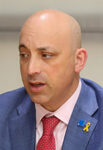
Jonathan A. Greenblatt is CEO and National Director of ADL (the Anti-Defamation League).