By Alex Gordon in Haifa, Israel
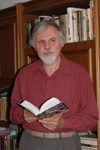
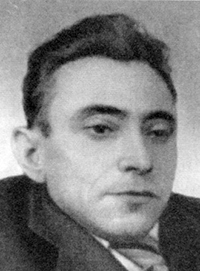
This year marks the 60th anniversary of the death of the remarkable scientist and wonderful person, Dr. David Blifeld (1908-1966), senior researcher at the Institute of Archaeology of the Academy of Sciences of the Ukrainian Soviet Socialist Republic
In the essay Kiev-Town (1923), Russian writer Mikhail Bulgakov wrote: “In spring, the gardens bloomed with white flowers, the Tsar’s Garden donned greenery, the sun broke thru all the windows, igniting fires within them. And the Dnieper! And the sunsets! And the Vydubetsky Monastery on the slopes! The green sea cascaded in terraces to the multicolored, gentle Dnieper. Black-blue dense nights over the water, the electric cross of Saint Vladimir hanging in the heights. […] In short, the city is beautiful, the city is happy. Mother of Russian cities.”
In the novel The White Guard (1925), he wrote: “And there were as many gardens in the City [Kiev] as in no other city in the world. They spread everyplace in vast patches, with alleys, chestnuts, ravines, maples, and linden trees. The gardens adorned the beautiful hills overlooking the Dnieper. […] In the deep of night, coal-black darkness lay on the terraces of the best place in the world — Vladimirskaya Hill.”
Here is what Wikipedia says about the “best place in the world”: ‘Vladymyrskaya Hill is an elevation on the right bank of the Dnieper River in Kiev, a park-monument of garden and park art. The park was established in the mid-19th century.” Vladimirskaya Hill is located much higher than Podol, the low-lying part of the city (Lower Town), the district of craftsmen and merchants, and the compact settlement of Kiev’s Jews. Vladimirskaya Hill rose above Podol, as if looking down on it and its Jews.
In the summer, when the garden city of Kiev was drowning in flowers and greenery, the benches of Vladymyrskaya Hill in the 1960s were filled with Jews. Yiddish could be heard from the benches. On one of the benches, I noticed a boy sitting alone. When I walked past that bench, the boy suddenly waved cheerfully with his little hand and called me by name in the deep voice of an adult man. I looked closely at him and realized that in front of me was a family friend, Dr. David Blifeld, an archeologist.
He was a hunchback, a short man with a large head and disproportionately shortened limbs. He lived near Vladimirskaya Hill and loved to walk there. David was a very kind person, although life’s circumstances should have made him a very bitter person, as he was a cripple and achieved everything in life with great difficulty. He worked physically hard at the archeological digs.
That day, David was unusually cheerful and very excited. I sat down next to him on the bench.
“I just found out that a great archeological discovery has been made,” he began. “Don’t ask how I found out about it. It’s a big secret. Our authorities do not like such stories very much. A letter written in the 10th century in Kiev was discovered in the old Cairo synagogue. The letter was written in Hebrew. It mentioned Kiev for the first time in history. The letter was read by an expert in Hebrew, American historian Norman Nahum Golb. Remember this name.”
(Norman Golb (1928 – 2020) was a scholar of Jewish history and the Ludwig Rosenberger Professor in Jewish History and Civilization at the Oriental Institute of the University of Chicago. Norman Golb discovered the Kiev Letter in the Cairo Geniza in 1962.).
“His parents moved to the USA from Ukraine. His father is my fellow countryman. We survived the pogrom organized by Petliurites in Proskurov in 1919. The Soviet authorities named our Proskurov Khmelnytskyi in honor of one of the biggest pogromists in history, Bohdan Khmelnytskyi. I was ten years old at the time, but I was so small that I managed to hide from the Petliurists. Norman’s father, Joseph, hid in the cellar where his parents stored food, using it as a refrigerator and pantry.
“So, Norman deciphered this letter, which he called the ‘Kievan letter.’ It was a letter of recommendation issued to Yaakov ben Chanukkah by the Jewish community of Kiev to be presented in other Jewish communities. The letter contained a request to the Jews of other cities to donate money for the redemption of Yaakov ben Chanukkah. The letter stated that this person had never been in need before, until he became a guarantor for his brother, who had taken money from foreigners. His brother was killed by robbers, and when it came time to repay the debt, he was taken to prison as the guarantor.
A year later, the community ransomed him for sixty coins, but an additional forty were needed for his full release. He set off with a letter to collect the missing amount. At the end of the letter were the signatures (names) of the authors. A total of eleven people. All the names were Jewish, names from the Tanakh.”
His small, disproportionate body with a deformed spine trembled with excitement.
His large, beautiful brown eyes sparkled with happiness. He looked at me, smiled, and continued his story.
“This is a great scientific achievement, but it’s not just about science. From the letter, it became clear that we, the Jews, lived here as early as the 10th century, from the very founding of Kiev. We are not strangers, not guests, not stepchildren, as the locals believe. We are natives of this place. In the USSR, they are silent about this, just as they are silent about the fact that in Babi Yar, the Nazis and their Ukrainian accomplices killed fifty thousand Jews, specifically Jews, and not, as they prefer to write, Soviet citizens.
“What will future archeological excavations reveal about our time? They will show that in the soil of Kiev lie tens of thousands of executed, unburied Jews.”
His eyes dimmed. Tears welled up in his eyes. He fell silent, turned his large head toward me, and looked intently at me. His face was sad. He raised his small hand and pointed toward the nearby bench, where a group of Jews were animatedly conversing in Yiddish.
“These Jews will soon become part of the forgotten history of Kiev. Please, don’t tell anyone about our conversation. If the authorities learn about my story, I could suffer greatly.”
From the neighboring bench came the laughter and cheerful chatter of Jews. They were enjoying the warm, sunny day, admiring the beautiful gardens of Vladimirskaya Hill, “the best place in the world.”
I didn’t tell anyone anything.
*
Alex Gordon is professor emeritus of physics at the University of Haifa and at Oranim, the Academic College of Education, and the author of 12 books