
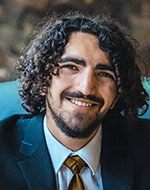
By Shor M. Masori in San Diego
Just days after the attack on Temple Israel in suburban Detroit, guests arriving at Congregation Beth Israel for Talking San Diego’s conversation with Pennsylvania Gov. Josh Shapiro were met with bag checks, wanding, and a visibly increased police and security presence.
Before the interview got fully underway, host Harry Litman acknowledged what everyone in the room already knew: this was not a normal night for a Jewish gathering.
That gave the evening an added charge, and also made Shapiro’s first major point land harder. Given what had happened in Michigan, he said in effect, there was something meaningful about Jews gathering together in a synagogue anyway.
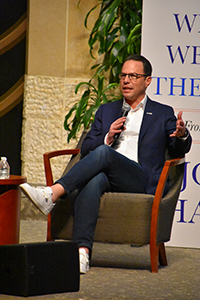
The event was centered on Shapiro’s new memoir, Where We Keep the Light: Stories from a Life of Service. Shapiro went back to childhood, describing how his mother’s involvement in the Soviet Jewry movement introduced him to the plight of refuseniks, Jews trapped in the Soviet Union and denied the freedom to emigrate. As a boy, he became pen pals with a refusenik, Avi Goldstein, and helped organize “Children for Avi,” as a Bar Mitzvah project, a campaign that brought wider attention to the family’s situation. In one of those almost too-neat-for-politics stories that happen to be true, Avi was ultimately able to leave the Soviet Union and attend Shapiro’s 1986 bar mitzvah after a 13-year-old Shapiro met with then senators Joe Biden, Ted Kennedy, and Arlen Specter of Pennsylvania
More than just a ploy for nostalgia, the anecdote allowed Shapiro to present an early lesson in what public life can do when it works: connect moral concern to actual outcomes.
He returned to that same theme when Litman asked him about the I-95 collapse in Philadelphia. Shapiro described seeing the crater left by the collapse and refusing to accept the assumption that Pennsylvanians would be stuck with months of chaos. The now-famous repair project reopened the highway in 12 days, helped along by around-the-clock work, loosened bureaucracy, and even NASCAR track-drying Zambonis brought in when rain threatened to slow the finish line.
The policy takeaway was obvious enough: that government works better when officials trust competent people to move fast. But Shapiro pushed it a step further. Solving people’s actual problems, he argued, does something political too. It lowers cynicism. It creates a little hope. It makes people believe government might still be capable of helping them.
That thread connected directly to another story, this one from his early campaign days. Running in a district that was deeply red, Shapiro said he first approached voters the way a young politician often does: by telling them everything he planned to do for them. It did not go well. The change came when one voter, recognizing his father as her children’s pediatrician, stopped him from delivering a speech and instead started explaining her own problems. That was some of the most valuable education of his life. Before you can govern, you have to listen.
Litman was sharp enough to notice that Shapiro kept coming back to that word, and it may have been the closest thing the night had to a revealing thesis. Listening, in Shapiro’s telling, is the key to one’s ability.
Even his basketball stories fed the same image. Shapiro described himself as the kind of player who wanted the ball, wanted the final shot, and accepted that missing came with the territory. Politics, he said, works like a team on the court. Everybody has a role. Somebody has to take the shot. The better answer would usually be that this is exactly the kind of thing politicians say when auditioning for national office.
The emotional center of the evening came when Litman turned to the April 2025 arson attack on the Pennsylvania governor’s residence, which Shapiro and his family had occupied just hours earlier for Passover. In the book and again in the room, Shapiro described the whiplash of moving from a Passover meal into the terror of being awakened and evacuated after an attacker hurled Molotov cocktails into the residence. The house was damaged. The family survived. The emotional aftershocks did not disappear.
What stayed with him most, he said, was not only the darkness of the attack but the light that followed it. People from across religious and political lines prayed for him and his family. In the aftermath, Shapiro and his family thanked firefighters with a meal supported by celebrity chef Robert Irvine. He spoke movingly about the spiritual force of that response, especially from people outside his own faith tradition.
It was within that turn, from attack to interfaith solidarity, that he drew inspiration for the name of his book: Where We Keep the Light.
The Jewish dimension of the evening was never far from the surface. Litman, whose own childhood synagogue was Tree of Life in Pittsburgh, asked what leaders can realistically do in a country where antisemitic violence has become both more common and more openly rationalized. Shapiro argued that Americans need moral clarity. That means calling antisemitism what it is, not laundering it through geopolitical excuses or deluding oneself into thinking that American Jews somehow answer for events in the Middle East. As the man who rammed his car through the Temple Israel in Michigan did. It also means refusing the old dual-loyalty poison in its latest form.
There were lighter moments too. In the closing lightning round, Shapiro named James Taylor as his first concert, Michael Jordan as the greatest basketball player, Utah’s Spencer Cox as a Republican governor he admires and a personal friend, and San Diego as his favorite Southern California city near the Mexican border. Asked what note he would place today in the stones of the Western Wall, he said he would pray for his family’s health and safety, and for clarity.
What Shapiro offered at Beth Israel was personal and, at least for this audience, more persuasive than normal political rhetoric: the image of a leader formed by Jewish memory, sharpened by public crises, and still insisting that listening, problem-solving, and moral seriousness are not quaint habits from an earlier political age but necessary tools for this one.
On a night when the metal detectors outside the synagogue were part of the story, that argument felt all too real.
Shor M. Masori, who graduated UC Berkeley with a bachelor’s degree in psychology, a master’s degree in conflict resolution from Tel Aviv University, and another master’s degree in international affairs from Johns Hopkins University’s campus in Bologna, Italy, has returned to his family’s home in San Diego.