By Alex Gordon in Haifa, Israel
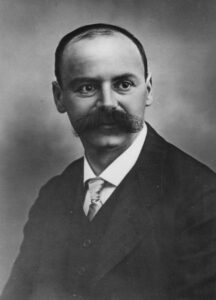
On December 24, 1915, Albert Einstein, who was living at Ehrenbergstraße 33 in the Dahlem district of Berlin, received a field post letter from the German army, which was fighting on the Eastern Front in Russia. The letter was sent by Karl Schwarzschild, an artillery lieutenant, director of the Astrophysical Observatory in Potsdam, and a member of the prestigious Prussian Academy of Sciences.
The letter ended with the words: “As you can see, the war hasn’t worn me down too much. Despite heavy shelling, I managed to carve out a little time and take a stroll through the world of your ideas.” The letter contained the first exact solution to the equations of the general theory of relativity. What Schwarzschild had managed to achieve during the war was astonishing. “I had no idea that an exact solution could … be formulated so simply!” Einstein wrote in his reply, promising to present Schwarzschild’s solution to the Academy of Sciences. He did not know that Schwarzschild was already dead.
Karl Schwarzschild was born on October 9, 1873, in Frankfurt am Main to a Jewish family. He was the eldest of six children. In the environment where Schwarzschild grew up, a well-rounded education with an emphasis on music and the arts was encouraged. Karl was the first in his family to show an interest in the natural sciences. Until the age of eleven, he attended a Jewish elementary school, then the Lessing State Gymnasium in Frankfurt; from that time on, he showed an interest in astronomy, saving his pocket money to buy lenses and build a telescope.
At the age of 16, while still a high school student, Schwarzschild published two short papers on the determination of the orbits of planets and binary stars. After graduating from high school with honors, he studied astronomy at the University of Strasbourg from 1891 to 1893. Then, in 1893, Karl transferred to the University of Munich and graduated in 1896 with highest honors (summa cum laude), earning a Ph.D. (thesis topic: “On Poincaré’s Theory of Equilibrium Figures in Rotating Homogeneous Liquid Masses”).
From October 1896, Schwarzschild worked for two years as an assistant at the Kuffner Observatory in Vienna. There he studied stellar photometry, developed a formula for determining exposure time in astronomical photometry, and discovered the phenomenon of non-reciprocity in photography, later named after him (the Schwarzschild effect). In 1899, he returned to the University of Munich, where he was appointed a Privatdozent after defending his habilitation thesis on measurements of stellar brightness.
In 1901, Schwarzschild became an associate professor (and a year later, at the age of twenty-eight, a full professor) at the University of Göttingen, as well as director of the observatory. He became the youngest university professor in Germany. He was appointed director of the University of Göttingen Observatory even though he refused to be baptized, which was a prerequisite for holding the position. In Göttingen, he worked with the renowned mathematicians David Hilbert and Hermann Minkowski. On June 11, 1909, he was elected to the Royal Astronomical Society (London).
On October 22, 1909, Schwarzschild married Elsa Rosenbach, the daughter of a professor of surgery at the University of Göttingen. Karl and Elsa had three children—Agatha, Martin (later a professor of astronomy at Princeton), and their youngest son Alfred (1914–1944), who was born with a heart arrhythmia and permanently dilated pupils. He suffered several nervous breakdowns and took his own life when the persecution of Jews began. Unlike his sister and brother, he was unable to flee Germany in time.
In late 1909, Karl Schwarzschild became director of the Astrophysical Observatory in Potsdam (a position considered the most prestigious for an astronomer in Germany), and in 1912 he was elected a member of the Prussian Academy of Sciences.
His work on the theory of relativity contained the first exact solutions to the equations of general relativity with spherical symmetry—the so-called Schwarzschild inner solution for a non-rotating spherical body of homogeneous fluid and the Schwarzschild outer solution for static empty space around a spherically symmetric body (the latter is now usually referred to simply as the Schwarzschild solution). His solution showed that if a mass is compressed to a critical radius—the Schwarzschild radius—its gravity becomes so strong that not even light can escape from it, which effectively predicted the existence of black holes. At this point, the quantities describing the gravitational field become infinite or undefined (a singularity). Such quantities include scalar curvature or energy density in the associated coordinate system.
During his short life, Schwarzschild published 112 articles.
When World War I broke out in 1914, Schwarzschild was in his early 40s and served as director of Germany’s most prestigious observatory. He could easily have been exempted from military service, but he was a man of honor, loved his country, and, like many other Jews, wanted to demonstrate his patriotism. He enlisted as a volunteer, ignoring the advice of both his friends and his wife.
He served first in Namur (Belgium) at a military meteorological station; then, after being promoted to lieutenant, he was transferred to the headquarters of a long-range artillery division, initially stationed in France. He served in the Fifth Artillery Regiment, which fought in the Argonne Forest on the French front. As soon as the officers found out who he was, they ordered him to calculate the trajectory of twenty-five thousand mustard gas shells that were to be fired at French positions that night. Mustard gas is a highly toxic chemical weapon first used in the area around the Belgian city of Ypres. The inventor and first-ever user of chemical weapons was Nobel Prize laureate in chemistry, the baptized Jew Fritz Haber, a fervent patriot of the German Empire.
Lieutenant Karl Schwarzschild was transferred to the Eastern Front. The soldiers he met there told him of the brutal murders of civilians, looting, rapes, and the deportation of entire populations from cities of no strategic importance, which were wiped off the face of the earth in a single day. He was there and was awarded the Iron Cross.
He was horrified by the war crimes committed with his participation. In his view, Germany had reached the brink of the abyss. In a letter to a colleague, he wrote: “We have reached the pinnacle of civilization. From here on, there is only decline and decay.”
Schwarzschild may have been punished for his patriotism: on the Eastern Front, he contracted a rare autoimmune disease, pemphigus, which was incurable at the time. Military doctors diagnosed a condition in which the body fails to recognize its own cells and attacks them. Ashkenazi Jews are particularly at risk of developing pemphigus. Doctors told Schwarzschild that he might have contracted the disease due to a gas attack he had survived several months earlier. He suffered from blisters in his throat and could not eat solid food. His mouth burned every time he drank. He was discharged from the army and hospitalized. Karl Schwarzschild died on May 11, 1916, in Potsdam, at the age of forty-two.
At Schwarzschild’s funeral, Einstein said: “He tackled problems that others were afraid to tackle. He enjoyed discovering connections between different aspects of nature. His quest was driven by joy, the ecstasy of an artist, the obsession of a visionary capable of seeing the threads from which the fabric of the future is woven.”
Richard Courant, a young mathematician of Jewish descent and David Hilbert’s assistant, was also drafted into the army of Imperial Germany and sent to the Eastern Front. He was seriously wounded during combat near Rava-Ruska, located 50 kilometers from Lvov. After being wounded, he was sent to a military hospital to recover. There he met Schwarzschild and became one of the last people to speak with him before his death. He recognized Schwarzschild immediately, even despite his disfigured face. Courant could not understand how a scientist of such caliber could have been sent to such a dangerous place.
In his diary, Courant wrote that Lieutenant Schwarzschild’s eyes lit up when he told him about his solution to the equations of general relativity. According to Schwarzschild, the most terrifying thing about the extreme concentration of mass is that a singularity is a blind spot, unknowable by its very nature. Since light cannot escape the singularity, our eyes are unable to see it. Since the laws of general relativity do not apply inside the singularity, our minds are unable to comprehend it. Physics loses its meaning.
Courant listened intently. Schwarzschild asked him: if matter can give rise to such monsters, could a concentration of will—millions of like-minded minds confined within a shared psychic space—give rise to something akin to a singularity? Schwarzschild believed that such a nightmare existed in Germany. Courant tried to reassure him, saying that he saw no signs of an impending apocalypse and that nothing could be more terrible than the war that was already underway. However, Schwarzschild insisted on his point. He spoke of the rise of a black sun capable of engulfing the entire world, and lamented that nothing could be changed. It turned out that events even more terrifying than World War I occurred in Germany 25 years after their meeting. Courant returned to Germany. Schwarzschild died later that day, May 11, 1916.
*
Alex Gordon is professor emeritus of physics at the University of Haifa and at Oranim, the Academic College of Education. He is the author of 12 books.