By Alex Gordon in Haifa, Israel

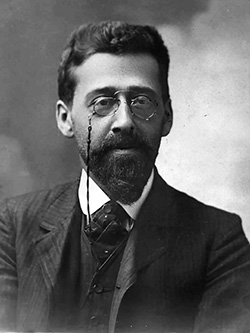
At the end of the 19th century, revolutionary circles began to form in the Russian Empire, aiming to replace the tsarist regime. Jews began to join these forces en masse. On April 20, 1895, Jewish Social Democrats gathered in Vilna (now Vilnius), where 22-year-old Julius Tsederbaum delivered the main speech titled “Turning Point in the History of the Jewish Labor Movement.”
He stated: “Our goal, the goal of the social democrats operating within the Jewish community, is to create a specifically Jewish labor organization that would serve as the leader and educator of the Jewish proletariat in the struggle for economic, civil, and political liberation.” Soon this goal was achieved. In 1897, the political party Bund – General Jewish Labor Union in Lithuania, Poland, and Russia was founded.
How did this young man come to socialism with a Jewish inclination? His grandfather Alexander Tsederbaum was an honorary citizen of Odessa. He was a prominent figure in the Haskalah movement (Jewish Enlightenment) and the founder of the first Hebrew and Yiddish newspapers in Russia. He owned a ready-to-wear clothing store. His father, Joseph, was a second-guild merchant (a middle-class business rank in Russian Empire) and worked as a correspondent for Petersburg Vedomosti (News) and Novoye Vremya (New Time), representing the Russian Society of Steamship and Trade in Constantinople. It was there, in Istanbul, on November 12, 1873, that Julius Tsederbaum was born.
At a young age, the boy fell off the bed and broke his leg. The wet nurse did not report the incident in time, the leg healed poorly, and Julius remained lame for life. Because of this, he did not participate in games with his brothers and sisters during childhood and spent all his free time reading books. The household language in the Tsederbaum family was French, while the servants spoke Modern Greek. The boy spoke these two languages in his early years. But soon Russian was added to them.
In 1877, the Russo-Turkish War began, and the Tsederbaums had to leave Turkey. They settled in Odessa but did not stay there long. In 1881, the Tsederbaums experienced a terrible pogrom. This event, along with the official antisemitism of the Tsarist regime, caused Julius to feel deep alienation from the existing political system. The Tsederbaums moved to Saint Petersburg.
There, Julius attended a gymnasium, but in the capital of the empire, taking a break from the pogroms, he began to succumb to the revolutionary sentiments that were in the air. He began reading banned literature and, at around the age of 15, came to see himself as an opponent of the Tsarist regime not only in the Jewish aspect but also in the all-Russian context.
In 1891, Julius enrolled in Saint Petersburg University, where he organized a secret revolutionary circle, and in 1892, he was arrested for distributing illegal literature. He was exiled to Vilnius under police supervision. There, he became one of the leaders and ideologues of the local social democrats thanks to his theoretical knowledge and oratorical talent. It was there that he began his path as a leader.
At the end of 1895, Julius returned to St. Petersburg, where he met and became friends with Vladimir Ulyanov (Lenin) and became one of the few people and the only revolutionary with whom Lenin was on first-name terms. The friends became members of a new Marxist circle, which Tsederbaum named “Union for the Struggle for the Emancipation of the Working Class.” “Bund” translates from Yiddish as “union.” Tsederbaum had already begun to translate the Jewish struggle into a nationwide one.
Ulyanov was arrested and exiled in December 1895, and Tsederbaum in January 1896. In exile, Tsedersbaum fell ill with throat tuberculosis. The term of exile ended in 1900. In 1901, Tsederbaum left for Germany. In exile, he met with Ulyanov again. They developed a plan to create an illegal Marxist newspaper called Iskra (spark). Tsederbaum became one of the editors and authors of the newspaper. He signed his articles with the pseudonym “L. Martov” – in honor of the month of March, the first spring month, a time of nature’s renewal. Martov became his pseudonym.
The new newspaper was financed by the husband of Julius’ sister, Nadezhda, Sergei Kranikhfeld. Sergei also provided funds for the Second Congress of the Russian Social Democratic Labor Party in 1903, where the party split and the friendly relations between Martov and Lenin broke down. Lenin proposed the following wording: “A member of the party is considered to be anyone who recognizes its program and supports the party both materially and through personal participation in one of its party organizations.”
Martov proposed that a party member be considered “anyone who accepts its program, supports the party with material means, and provides regular personal assistance under the guidance of one of its organizations.” According to Lenin’s idea, the party should consist of a smaller number of members, but all of them should be like-minded individuals and activists. Martov’s formulation would have attracted a larger number of supporters.
Most of the delegates supported Lenin’s formulation. They began to be called “Bolsheviks,” and Martov’s supporters are “Mensheviks.”
During the 1905 Revolution, Martov returned to Russia, was arrested twice, and was first exiled to the Narym region and then abroad. He returned to Russia in May 1917, shortly after Lenin’s return.
In 1908, Martov published a pamphlet titled “The Russian People and the Jews” in St. Petersburg. He argued that antisemitism is not an inherent quality of the Russian people but is imposed “from above” by autocracy and reactionary circles. He saw the solution to the “Jewish question” not in isolation, not in the “separatism” of the Bund or Zionism, but in the joint struggle of the Jewish and Russian proletariat against a common enemy — tsarism and capitalism.
He advocated for the full equality of Jews and their cultural and linguistic integration into a democratic society. Martov renounced the Jewish heritage of his grandfather and father.
Upon coming to power, the Bolsheviks closed “bourgeois” newspapers. The Menshevik newspaper Vperyod (Forward) continued to be published after the October Revolution of 1917. On March 31, 1918, Martov published an article in it, which contained the phrase: “That the Bolsheviks have always been called to various daring expropriatory enterprises is well known, at least to comrade Stalin, who was once expelled from the party organization for participating in expropriations.”
People’s Commissar for Nationalities Affairs Joseph Stalin filed a complaint against Martov with the Moscow Revolutionary Tribunal of the Press. Martov was publicly reprimanded—not for insulting Stalin, but for his overly harsh remarks about the Bolsheviks. He condemned the “Red Terror”: “Shame on a party that tries to sanctify the vile trade of the executioner with the title of socialist!” In April 1918, the newspaper Forward was shut down.
The struggle between the Bolsheviks and the Mensheviks continued. Martov was subjected to brief arrests several times—his acquaintance with Lenin protected him from more serious reprisals.
Martov was repeatedly hinted at leaving for abroad. Finally, the Deputy People’s Commissar for Foreign Affairs, the Jew Maxim Litvinov, told him: “Lenin believes that you are causing a lot of harm here; it would be better if you were abroad.” At the same time, Martov was hinted that in case of his return, Felix Dzerzhinsky (Head of the Soviet Secret Police) had already prepared an order for his arrest.
In September 1920, Martov traveled to Germany—officially to participate in the congress of the left-wing Social Democrats. In Germany, he wrote articles for the Socialist Herald, which he had founded as the organ of the Menshevik Foreign Delegation. He criticized the Bolsheviks but was pleased with Lenin’s introduction of the New Economic Policy, seeing it as an opportunity for a “peaceful transition to socialism.” In his last article, he expressed confidence in the inevitable replacement of “trench-barrack quasi-socialism” with a “legal regime of democracy.”
Unlike Lenin and other Bolsheviks, Martov advocated for the construction of a democratic, rather than a dictatorial, party, supported broad mass participation, and warned against the dangers of the “socialist barracks.” He rejected the idea of a violent power grab by a narrow group of conspirators. He believed that socialism could only be built based on a broad democratic process, developed class consciousness, and freedom of discussion.
After the October Revolution of 1917, Martov was in favor of parliamentarism and harshly condemned the Bolsheviks’ dispersal of the Constituent Assembly (parliament), the Red Terror, and the transition to a one-party dictatorship.
He wrote: “[The Bolsheviks] created a bureaucratic dictatorship based on the ‘atomization of the masses.'” […] A dictatorship carried out not by the proletariat organized into its own independent class organizations, but by a party (or its leadership), inevitably degenerates into a police state.”
Martov believed that Russia was not ready for the immediate construction of socialism. He advocated for a bourgeois-democratic stage, which was to develop the economy and workers’ rights before addressing the question of a proletarian revolution. He wrote: “For me, socialism has always been not a denial of individual freedom and individuality, but, on the contrary, their highest embodiment. And since reality is stronger than any ideology, therefore, under the guise of the “power of the proletariat”, in fact, the worst philistinism is secretly spreading with all the specifically Russian vices of lack of culture, low-grade careerism, bribery, debauchery, irresponsibility, and so on, it is horrifying to think that the idea of socialism will be discredited in the minds of the people for a long time. […] We are undoubtedly moving through anarchy toward some form of Caesarism.”
Martov was a democrat whose worldview was incompatible with the ideology of the new rulers of Russia. His DNA was rejected not only by Lenin and other Bolshevik leaders but also by the broad masses of the new society, for whom democracy was a foreign and hostile form of existence
The information about Martov’s terminal illness reached the gravely ill Lenin. He sadly told the writer Maxim Gorky: “It’s a pity that Martov is not with us, very much so. What an amazing comrade, what a pure person!”
Martov died on April 4, 1923, in one of the Schwarzwald sanatoriums. He was 49 years old. Lenin died near Moscow on January 21, 1924. He was 53 years old.
*
Alex Gordon is professor emeritus of physics at the University of Haifa and at Oranim, the Academic College of Education. He is the author of 12 books.