Hollywood vs. Nazis: How the Movie Studios Took on Nazis Infiltrating Los Angeles by Michael Benson; Citadel Press Books; © 2026; ISBN 9780806-544809; 263 pages; plus epilogue and sources; $29.
By Cailin Acosta in La Mesa, California

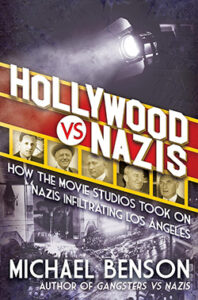 A little-known chapter of American history comes to life in this compelling account of how Hollywood studio heads, producers, actors, and Jewish community leaders fought against Nazi and fascist organizations operating in Los Angeles during the 1930s and 1940s.
From the moment Adolf Hitler came to power in Germany in 1933, Hollywood represented more than entertainment. Los Angeles was the center of the American film industry, and controlling the messages coming out of Hollywood could have given Nazi Germany an extraordinarily powerful propaganda tool. Many of the industry’s most influential figures—including Adolph Zukor, Sam Goldwyn, David O. Selznick, the Warner brothers, and MGM’s Louis B. Mayer—were Jewish, making Hollywood an especially significant target for Hitler and his supporters.
The book explores how American Nazi organizations recruited members, gathered intelligence, and attempted to spread pro-Hitler propaganda throughout Southern California. Rather than standing on the sidelines, however, members of the Hollywood community took action.
Jewish studio executives and other industry leaders pooled their resources to support a clandestine counteroperation. Undercover investigators infiltrated German American pro-Nazi organizations, monitored suspected Nazi agents, and gathered information about activities that threatened the United States. Hollywood also used its most powerful weapon, the motion picture, to help expose the dangers of fascism and influence public opinion.
The result was a fascinating intersection of Hollywood history, espionage, and the American home front. The book reveals a side of Los Angeles during the years leading up to and during World War II that is rarely discussed: the existence of organized Nazi sympathizers operating within the city and the determined efforts of Americans to counter their influence.
One of the book’s greatest strengths is the way it brings together two seemingly unrelated worlds. Hollywood was known for movie stars, premieres, and entertainment, yet behind the scenes, some of the industry’s most powerful figures were confronting a very real political and security threat. Their response demonstrates that the fight against fascism was not limited to the battlefields overseas; it was also being waged within American communities.
For readers interested in espionage, World War II history, the American home front, or Hollywood’s Golden Age, this book offers an intriguing look at a largely overlooked chapter of the period. It serves as a reminder that the struggle against Nazi influence reached far beyond Europe—and that Los Angeles itself became an important battleground in that fight.
*
Cailin Acosta is the assistant editor of the San Diego Jewish World.