Story and photos by Shor M. Masori in Chula Vista, California
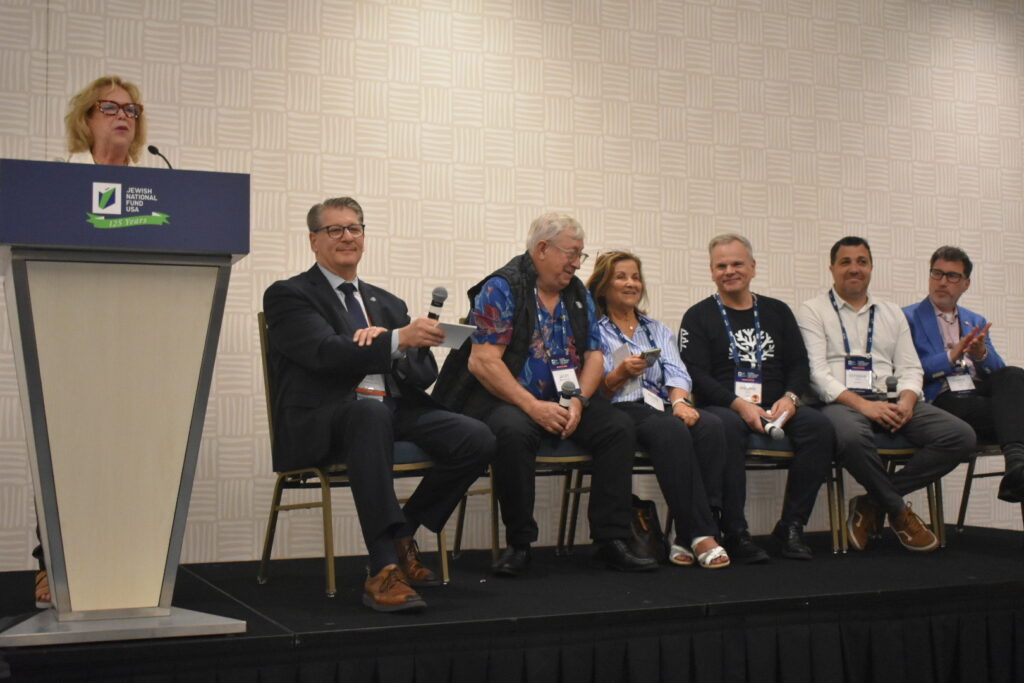
In Paris, Philippe Lévy knew a priest who called him “my brother.” Lévy, a Jewish educator, worked with Christians in an interfaith circle. After Hamas attacked Israel on October 7, 2023, and Israel went to war in Gaza, people in that circle spoke to him about “what you do in Israel.” He lived in France. “I feel the distance,” he told a panel on Jewish communities worldwide on November 15. Many French Jews had relatives in Israel, he explained. He remembered how many of his non-Jewish friends never called to see how he was doing.
Lévy runs youth education for KKL France, the French branch of the Jewish National Fund. Each February he takes French teenagers to Israel. Back in France, some tell him they felt at home there. Lévy knew from his own friendships what it cost to be identified with Israel. For a teenager tired of answering for Israel, it could be tempting to say “Israel is too heavy” and let go. “I understand it, but the Jew cut from Israel is not safer. He is just more alone.”
Lévy worried about what Israel would lose, too, if those teenagers gave up on it. “Israel needs strong diasporas,” he said. At Jewish National Fund-USA’s Global Conference for Israel in Chula Vista, donors met Israelis whose work the American nonprofit supports. What could Lévy’s students in France expect from Israel in return? Gadi Ezra, who once ran Israel’s public diplomacy office, said his country still had to work out “the obligation of the State of Israel for Jews outside of Israel.”
French Jewish Scouts had grown more involved since October 7, Lévy said. In February 2026, Scouts and counselors traveled to southern Israel to remember someone from home. Twenty years earlier, Ilan Halimi, a 23-year-old Parisian Jew, had been kidnapped and murdered in an antisemitic attack. In February 2019, two trees planted for him were vandalized in Sainte-Geneviève-des-Bois, where he had been found dying. In Israel’s Re’im Forest, the Scouts joined a French delegation to dedicate a grove in his name.
Nina Paul was 15 when she spent ten weeks in Israel working and studying at an agricultural school and traveling around the country. “I fell in love with Israel,” she recalled at Sunday’s panel. “I had to go back the next summer.” At 16, she volunteered on a kibbutz and traveled. Her parents, she recalled, had no idea what she was up to. She returned as a UCLA junior. “I went to Hebrew University for a year. It wasn’t enough.” She persuaded UCLA to let her spend a second year in Israel, this time studying psychology in Haifa. Back in Los Angeles, Israeli friends answered her Hebrew in English until “they gave up and they spoke to me in Hebrew.”
As JNF-USA’s ambassador to KKL, Paul uses that Hebrew to work with the fund’s Israeli counterpart. She’d befriended Jacky Benzennou and his wife at a conference in Israel 30 years earlier. In Chula Vista, she introduced him as president of KKL Belgium. He described Belgian Jews buying homes in Israel in case they ever had to leave Belgium. “We are bringing our flag and we are showing it,” he said of the demonstrations. “I think it’s important for us to show it for our youth, for the next generation.”
In American Jewish Committee surveys, 40% of U.S. Jews ages 18 to 29 said in 2024 that caring about Israel was very important to being Jewish, up from 29% a year earlier. In the 2024 survey, 11% of Jewish employees under 50 said they had felt or been excluded at work in the previous 12 months because of an actual or assumed connection to Israel.
What could a co-worker tell about someone’s politics from knowing they were Jewish? Pew Research Center found that among Americans who identified their religion as Jewish, favorable views of Israel’s government fell below the majority, from 54% in 2024 to 47% in 2026. Favorable views of the Israeli people fell from 89% to 83%. Among those under 50, 76% viewed the Israeli people favorably, and only 41% said the same about the government.
In Canada, Lance Davis had spent years asking donors to help people in Israel. Asking him to name one project he could be proud of was like asking, “Which child are you most proud of?” He picked Beit Nova, a proposed center near Netanya for survivors of the October 7 massacre at the Nova music festival and their families. Canadians helped raise money for it. Davis ran Jewish National Fund Canada when the Canada Revenue Agency revoked its charitable registration in 2024. The fund said it relieved poverty by paying people in Israel who otherwise couldn’t find work.
The agency questioned whether all the projects qualified as charitable and how the fund supervised the money. The fund could no longer issue donors the receipts they used to claim a tax credit. Davis called the audit biased. The audit began in 2014, ten years before the decision. JNF Canada challenged the decision in court. As head of Friends of JNF Canada, he rehired staff and found other Canadian charities through which donors could give.
Canadian Jewish schools depended on donors who could claim that credit, too. Enrollment had grown since October 7, Davis said. According to Davis, critics had complained to authorities that Israelis teaching in the schools were recruiting students for the Israeli military. Davis feared a school could lose its charitable status. “A Jewish school without a charitable license will not make it.” Before the attack, Jewish leaders meeting in France had been asked to stand on one side of the room if they felt optimistic about the future of Jews in their countries. Davis and an Australian representative stood there. “If I was put in that room again today, I would go to the pessimistic side.”
Esteban Lasry, executive director of KKL Argentina, had also seen families return to Jewish schools after October 7. Donations to Israel rose, he said. Argentines helped pay for shelters, a fire truck, and two rooms at Benji’s Home in Ra’anana for soldiers serving in Israel without family support. Asked which project made him proud, Lasry named one in Mendoza, on Argentine soil.
Israeli families came to Mendoza for the dedication of a forest in memory of the young people killed at Nova. For Mirta Werber, it was a return to the country where she was born. Her son Alon, from Ra’anana, was 26 when he was killed. The families spent part of their visit telling students who their children had been. According to the city’s account of the dedication, Werber remembered Alon smiling as he said goodbye the night before the festival. “Nos vemos mañana,” he’d told her. See you tomorrow.
Jessica Souss, president of KKL Argentina, promised the families that Keshet, Alon, Eitan, Ilay and Idan would have a place in Argentina, too. Together they planted the last three trees. Lévy had welcomed Israelis to France, too. In 2025, Thalia and Alya, two young women doing national service in Israel, spent a week visiting French Jewish schools with him for Tu Bishvat, the Jewish New Year for trees. Children planted trees and practiced Hebrew with them. In Chula Vista, Lévy asked the people who cared about those children’s ties to Israel to make that trip themselves. “And do not judge us from far. Come, listen and partner with us.”
*
Shor M. Masori is a San Diego-based freelance writer