By Shor M. Masori in Chula Vista, California
After posting about the hostages Hamas had taken on October 7, 2023, Tanya Tsikanovsky noticed that the women who had elected her captain of their basketball team stopped hugging her.
“They didn’t ask me how I’m doing,” she recalled. They’d been to her apartment. They knew she’d lived in Israel. “These people knew this of me. They were my friends.”
“And so what did I do? I tattooed an Israeli flag on my right leg.” Anybody she guarded on the basketball court would have to look at it.
Her teammates knew she’d moved to Iowa to campaign for the Democratic Party. She’d worked for Hillary Clinton in 2016 and was still a Democrat when she got the tattoo. When she announced she would vote Republican, citing the war and the treatment of Jewish students, a league board member called. If he was calling to kick her out, she told him, she’d call the American Civil Liberties Union. He backed off. He allowed her to play but not to attend the social events.
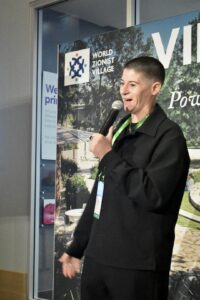
At the Global Conference for Israel, convened in Chula Vista by Jewish National Fund-USA, an American nonprofit that supports projects in Israel, a listener asked whether she caught more flak in West Hollywood for being Jewish or for being a Republican. Tsikanovsky answered with the story of her team. The hugs had stopped before she changed parties. The switch, she believed, gave people permission to tell her she didn’t belong.
Tsikanovsky started a Gay-Straight Alliance in high school when she couldn’t count on being allowed to visit a partner in the hospital. She had since married a woman and gotten divorced. Asked what had happened to the cause she campaigned for, she answered, “We did not have marriage equality when I was growing up.” To her, the movement had won what she’d joined it to fight for.
Her parents came to the United States as Jewish refugees from the Soviet Union in 1979. Growing up in Los Angeles, she learned to say the Shema, the Jewish declaration of faith that opens with a call to the people Israel. She puzzled over how somebody could welcome her as a Jew and ask her to leave the Zionist part at home.
She went to Dyke Day LA, an annual park gathering for queer people and their allies, in a shirt that said “Israel.” “They literally said Zionists not allowed,” she recalled. She took her private security and went anyway. When she ran for West Hollywood City Council this year, she arranged to meet voters at Sweetwater, a lesbian bar. Owner Berni Gambino approved the flyer. As soon as it went up, Tsikanovsky recalled, people wanted to know why the bar was giving a Zionist Republican a platform.
Gambino canceled the event. In a public statement, she said patrons had told her they would feel unsafe. Sweetwater ruled out campaign events for every candidate. But Gambino later invited Tsikanovsky back for a drink.
“I was called a fascist. I was called a Nazi,” Tsikanovsky recalled of the gay gatherings she attended. When her parents still lived in the Soviet Union, the state press drew Israeli leaders as Nazis. One cartoon after the 1967 Six-Day War had Israel’s defense minister, Moshe Dayan, telling Hitler to move over. The cartoons also drew on old caricatures of Jews, with hooked noses and hands clutching money.
Dara Horn, the author of People Love Dead Jews, discussed that history with John Podhoretz, editor of Commentary. In 1975, four years before her parents emigrated, the UN General Assembly declared Zionism a form of racism. President George H.W. Bush urged its repeal as part of the effort to bring Israelis and their neighbors to the peace table. The assembly repealed the resolution in December 1991.
Horn also cited an FBI recording made at a Courtyard by Marriott in Philadelphia in October 1993. Israel and the Palestine Liberation Organization had just signed the Oslo Accords. Hamas opposed the agreement. According to a federal appeals court, the men at the hotel discussed how to keep supporting Hamas and derail the peace process. The president of the Holy Land Foundation, a U.S. charity, told the room to call the group “Sister Samah.” Read the second word backwards. One participant argued that Americans would respond to an appeal for Palestinian human rights. Another urged the Islamic Association for Palestine to resume organizing on college campuses. A speaker proposed inviting political science and Middle East studies professors to seminars on Palestine because, he said, many people who went on to work for the U.S. government had studied at those universities.
Loay Alshareef grew up Muslim in Saudi Arabia and now works as a linguist in Abu Dhabi. At the conference, he called himself pro-Palestinian. “I love the Palestinians. They are my brothers,” he said on Saturday. He wanted Palestinians to live alongside Israel and opposed Hamas and Palestinian Islamic Jihad. He objected to using the same term for demonstrators in the United States whom he described as chanting “Death to America” and burning the American flag. He called those protesters Hamas supporters.
On the last day of the JNF conference, Ben, an audience member from Boston, turned the question around. American Jews disagreed about what their own organizations ought to do, he said. How did the leaders on the conference’s worldwide Jewish communities panel make room for Jews who disagreed with them back home?
Philippe Lévy, education director at KKL France, the French branch of the Jewish National Fund, answered first. He had faced that question as a teacher.
Lévy remembered a student waiting until he had finished a classroom talk to tell him his “propaganda” was over. What was the objection? That territory had been stolen, Lévy recalled. He wanted to sit down with the student and hear him out. “I don’t want to push outside the circle,” he told the panel.
Lance Davis of Friends of JNF Canada answered Ben with a question Jewish organizations had faced before. Who gets a seat on a federation board? Decades earlier, he said, Jewish federations had drawn the line at seating leaders of Jews for Jesus. Davis would welcome Jews on the left or the right, including Jews who didn’t consider themselves Zionists. He thought Jewish institutions should draw a line at someone actively working to dismantle Israel. That put the Jews who lived there in danger, he said. In Davis’s words, “you’ve left the family.”
At a social media workshop, Tsikanovsky remembered an older gay man who stood up at a meeting to ask how to tell his neighbors he was a Republican. She recognized the fear in his question from what it once took to tell somebody you were gay. This time, she joked, gay people might have to help straight people come out about their politics.
Tsikanovsky wears her Star of David out. As a young lesbian, she’d let people see who she was even on streets where that felt dangerous. Being seen as a Jew mattered to her for much the same reason. “The more that we hide, the more that we show that we’re scared, the more they win,” she said. She can choose to take that chance for herself. Then she thinks about walking down the street with her mother. “Of course, when my mom is walking around, I hide hers.”
She plans to propose to her girlfriend, and they want children. “And I’m sure if I had a kid right now, I’d probably hide theirs,” she said. “So no judgment if you don’t.” The league could decide who came to the party. As long as Tsikanovsky played, the flag on her leg was coming with her.
*
Shor M. Masori is a San Diego-based freelance writer.