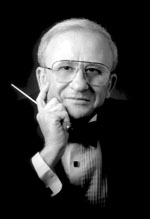
By David Amos
SAN DIEGO — The story is told that after a live concert of the NBC Symphony Orchestra conducted by Arturo Toscanini, an elderly lady turned to her companion and asked, “That man on the podium; is he also supposed to know the music?”
This is obviously an exaggeration of what most people understand about the role of “that man on the podium”, but it might be enlightening to remind us of a few things that conductors do.
Over forty years ago, my old conducting teacher at Indiana University, Tibor Kozma used to say, “A conductor is a lot more than just a time-beater, but he better be a darn good time-beater!” True, beating time to let the orchestral musicians know exactly where to start and when to end the notes, so that everyone sounds nice and together, is the main job of a conductor. But there is far more. In order for so many musicians to sound as one cohesive, artistic unit, there must be a balance of the orchestral voices. Are they all playing at the right volumes, loud and soft, to bring out what the composer intended? For example, if the brass is too loud, the violins may not be heard. Or even, if the second trombone is playing louder than the first and third trombones, the trombone section will sound unbalanced. This, a conductor must hear and correct, usually during rehearsals, but sometimes, if needed, at the concert itself. Imagine now, balancing the volumes of all the instruments of the orchestra, not only so that they should be heard, but that the composer’s intentions and style are properly interpreted.
Then, there is the all-important matter of interpretation. No two conductors do the same work the same way, and it is the job of the conductor to first establish in his mind his own concept on how the music should sound; and then, convey it to all the musicians during rehearsals with a minimum of talking, and reinforce those artistic and technical ideas during the concert or recording.
There are infinitely more aspects to the role of a conductor: The ability to hear intonation (if the musicians are playing in tune, individually or as a group), and how to correct it, compensation for the acoustics, adjustments made to the ability of the orchestra, and above all, the ability to work with people.
As Peter Paul Fuchs says in his book The Psychology of Conducting, “Today’s musician is an opinionated, outspoken, sometimes vociferous human being. He is intelligent enough to know that in artistic matters the will of the leader must be obeyed. But he also realizes that this does not deprive him of the right to be respected as a human being”.
How true. In the old days, conductors such as Toscanini, Fritz Reiner and George Szell terrorized and intimidated their players in order to achieve discipline and musical results. And the end product was truly magnificent. Today, it is a different world. Conductors can no longer get away with this sort of dictatorial behavior. They must have the skills of working with people, and to persuade and convince the musicians to the logic and artistry of what must be accomplished. Some conductors succeed at doing this and others do not.
At the same time, there are also dangers of going too far in the other direction. Quoting Fuchs again, “And if the conductor’s tendency is to be a nice guy, if he should wish to please everybody and comply with all the requests, he will soon realize that he has chosen the wrong profession. The making of enemies is a very natural activity for the music director of a symphony orchestra, and if he is bent on survival, he must learn how to make enemies gracefully”. I may not totally agree with all of this, but the point is well made.
Once, Leonard Bernstein became entangled in a musical difference of opinion with some of his musicians, and he finally told them, “I am paid to win all arguments”.
Unfortunately, our society’s vision of a conductor has created a type of personality which may be more show and glitz than true art. Many of our glamour super-stars constantly travel, are heavily supported by an elaborate publicity machine, mix in affluent social circles and get paid outrageous amounts of money. They may be mildly capable or supremely gifted, but usually not more than a vast number of other maestros who, while lesser known, are true artists with recognition and respect within the music profession.
Unfortunately, sometimes practicality gets in the way of pure art. I have worked with, and have talked privately to several musicians who play in a world famous orchestra. They simply hated their resident conductor, both for artistic and personal reasons. When I asked directly to one of them “How come the orchestra voted almost unanimously to hire him?”, the answer was “He came to us bearing a recording contract worth millions of dollars. In spite of our feelings, we agreed to extend him a contract. We had no choice”.
The following story is not true, but in a humorous way, gives us an insightful view of the mystique and ego of the superstar conductor: At a restaurant, three famous maestros were having coffee together. The conversation finally turned as to who is the world’s best conductor. Georg Solti said, “Well, fellows, I have the Chicago Symphony, the word’s best, and I have won more Grammy awards than anyone else. I believe that I am the world’s best conductor”. Herbert Von-Karajan retorted, “I am not so sure about that. Just last month, I was conducting Tristan und Isolde at Bayreuth, and in the middle of the performance, a blinding light came from above and shone upon my head, and a booming voice spoke to me and said, ‘Herbert, you are the world’s greatest maestro’ ”. On hearing this, Bernstein scratched his head and said, “Funny, I don’t recall saying that!”
More on the incredible world of conductors in future columns.
*
Amos is conductor of the Tifereth Israel Community Orchestra (TICO) and has guest conducted professional orchestras around the world. He may be contacted at david.asmos@sdjewishworld.com