By L. Craig Williams

 SCARSDALE, New York – We must constantly think about and learn from the Shoah. As the last survivors of that entirely unique horror pass from our midst, the Shoah assumes new importance for all of society. We must not only be the ongoing witnesses of those people, but we must also continue to analyze and learn from the Shoah.
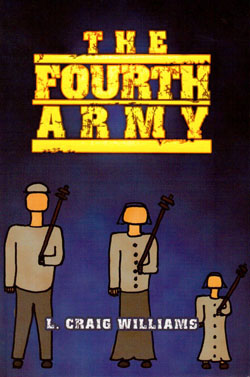
That is the fundamental premise of my new book, The Fourth Army, which invites an entirely new focus on the role of the Jews in Europe in helping defeat the Nazis. The book argues strongly that the Jews and other victims of Nazi oppression formed a fourth army that actively helped defeat the Nazis and their allies along with the British, American and Soviet armies.
Using modern techniques of labor economics that have never been applied to World War II history, I show that vast numbers of Germans and other Europeans were directly involved in delivering the Jews of Europe to their deaths. The current historical approach to analyzing the role of the average German citizen during the Shoah is that very few were involved in rounding up, guarding and transporting the Jews to the death factories in southern Poland and the Ukraine.
But a careful analysis of the immense amounts of armaments, trains, soldiers, camp supplies and other materials directly dedicated to the murder of Jews and other victims was enough to tip the scales in favor of the Allied armies, and thus the Jews were a heretofore unrecognized ally in the defeat of the Nazis. Although unarmed and non-combatant, more than 6 million Jewish citizens of Europe were murdered in special camps designed and operated for that purpose.
Today we know that to issue a paycheck to a grocery store employee in Los Angeles requires the full-time work of three people and the dedication of computers, mailing machines, tax software and other equipment and supplies costing on average about $365 per employee per year. These classic fundamentals of labor analysis have never been applied to understand the full measure of the costs to the German war machine to round up, guard, feed, transport and then ultimately kill millions of Jewish and other non-combatants during World War II.
I dug into rolling stock and train movement information; analyzed the types of equipment, munitions, and foodstuffs; and investigated the weather patterns and troop movements necessary to “process” 6 million people to death in the camps.
Hitler’s maniacal obsession in the war against the Jews cost the German armies so much in military personnel and supplies that the murder of the Jews determined the outcome of the war. The Jews were never a military objective; they were never combatants, except for the uprising in the Warsaw ghetto and limited Jewish partisan groups that developed late in the war. Even though they were largely non-combatants, the materials and soldiers devoted to the war on the Jews was absolutely decisive in the outcome of the war.
The lessons of the Shoah must be understood to be ongoing, and we must continue to learn from those terrible events. It is fundamentally important to study the after-war effects of the war against the Jews. This is important for both the Jewish people and for the world as a whole. The violence that occurred during World War II reached entirely new levels never before seen in world history, and that violence permeates society in many ways that are not understood today.
One effect of the Nazis was to foster a transfer of intellectual capital out of Western Europe to Britain and the United States. That transfer, called the Brownshirt Effect, fundamentally transformed Europe. Germany’s economy recovered very slowly after the war, and even today, Germany’s level of achievement in the arts, sciences and literature has yet to reach its pre-war level of accomplishment, as measured by Nobel and other major prizes.
That downturn in every aspect of social achievement is a direct outcome of the Nazi extermination and destruction of liberal social democratic and Jewish influences in Western Europe. American and British superiority in economics and sciences was directly affected by pre-eminent scholars fleeing Germany, France and other occupied countries, never to return.
A second and extremely important lesson from the Shoah is the need to understand the level of violence that occurred during the war and to identify how that violence continues to seep into our lives today. During the war, death was not only visited on the Jews in the camps but also on hundreds of thousands if not millions of civilians through wholesale bombing of cities. War-making reached an entirely new and horrifying level during World War II. The massive level of violence visited on all parts of civilian and combatant populations throughout Europe created a dangerous tolerance of violence that continues to haunt our modern age.
Video games, televisions shows and many forms of popular entertainment import vicarious violence into our living rooms. Young children play increasingly violent video games, and the common appetite for police dramas, guns, violent action films and books and novels that dwell on “action figures” create a tolerance for violence and destruction that was unknown in earlier times. We are adrift in a sea of commercially supplied violence that we summon up with the flick of a switch. Much of our tolerance for violence – one could even call it our celebration of violence – is not recognized for what it means to our lives and our children’s lives.
The Fourth Army calls for us to recognize the stealthy but steady permeation of our society with vicarious violence and to start changing our daily lives by recognizing the violence around us and then actively refusing to let violence be a form of amusement. Modern Jewish Americans have a unique role in calling on ourselves and others to “plowshare” our lives. We must recognize vicarious violence and strive to eliminate that from our lives.
As a “nation dedicated to bringing light to the nations” and as the unwilling and wounded victims of the worst example of industrialized murder and violence in history, we must call a halt to the spread of guns and violence in our midst. In addition, we must fight for economic and environmental justice for ourselves and for others.
*
L. Craig Williams, author of The Fourth Army, (www.lcraigwilliams.com), holds a bachelor’s degree in European History and a Juris Doctor, specializing in international law. He has written extensively about human resources and individual leadership. Williams has been a member of the US United Nations Association, is a past International Fellow of Columbia University and has published articles on comparative law and been a member of the German-American Law Association for many years. He has lived in Germany, France and England and makes his home in New York State.
I was very interested to read this article about L. Craig Williams’ new book “The Fourth Army”. I found some of his theories to be quite interesting. It would be really interesting to learn where he researched most of his statistics because, according to both Yad Vashem and the USHMM in DC, only about 10% of all rolling stock used by the Germans during WW2 was actually used to send Jews to the death camps in Poland. The second statistic of his is that 6 million died in the death camps. This is not true. Over 1 million were murdered by mobile killing squads between 1940 and 1942, nearly 3 million died of disease and starvation in ghettoes, concentration and labor camps, and nearly 2 million (maybe) were gassed to death in the Death Camps, 1.1 to 1.3 million 0f those in Auschwitz.800,000 in Treblinka. Books like this make me nervous for their possible inaccuracies of information which then become grist to the Holocaust Denier’s mill. Ilona Shechter
Ilona’s comments are insightful and bear further consideration. First as to the rolling stock issue, the German Rail Statistics Bureau admits readily that records for rolling stock were highly disrupted and many were destroyed in the war. Even if Ms. Schechter’s point that only 10% of rolling stock was dedicated to the murder of the Jews, is that the critical 10% with which Hitler could have won the war? Possibly. There is abundant testimony that trains were used to evacuate some death camp inmates before the Soviet Army even while those armies were overrunning German troops, see notably “Steal a Pencil for Me” by Jack and Ina Pollack, two survivors who have confirmed that fact in personal conversations with me.
Next we should consider Ms. Shechter’s dissection of the death numbers, which actually confirm rather than contest the thesis in “The Fourth Army,” at least in part. The actual means of killing the Jews is not discussed in the book in any detail. If as asserted by Ms. Schechter, more than one million Jews were shot by Einsatzgruppen, or mobile killing squads, those squads cost bullets, soldiers, transport, other materials and bled the German moral courage for the war. Much of that killing occurred exactly in the years when the drive into Russia was most critical to the success of the Nazi war effort in Russia. The death squads are actually more directly costly of war material than starvation or gassing.
Even if many Jews died by starvation and gassing, the amount of soldiers and materials required to hold the Jews in ghettos was immense and critical to the Nazi war effort.
The funadmental point is that six million Jews did not walk to the camps and ghettos. German soldiers took them there instead of fighting the Soviet Army. That is the fundamental issue.
L.Craig Williams