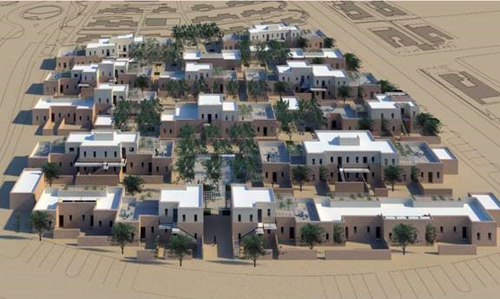
 SDE BOKER, Israel (Press Release)–Ben-Gurion University of the Negev’s (BGU) new American Associates Village here was dedicated at the University’s recent Board of Governor’s meeting. The complex will expand available housing for as many as 150 additional international students, increasing by 50 percent the number of students currently studying at the Sde Boker campus and facilitating growth of two international graduate programs.
The new complex is already home to some 20 graduate students of the Albert Katz International School for Desert Studies, the academic arm of the Jacob Blaustein Institutes for Desert Research, and the Israel Studies International Program. Once complete, this project will add 67 housing units in 14 buildings of varying configurations to the existing 110 units.
Until now, the Albert Katz International School for Desert Studies (AKIS) was forced to reject hundreds of highly qualified, motivated candidates due to the housing shortage. While the classroom, laboratory and teaching capacity were available, there were not enough beds to accommodate more students.
“We decided we needed to tackle this issue and the result is the American Associates Village at Sde Boker,” said Alex Goren, BGU’s board chair and AABGU’s past president.
The renowned Israeli architectural firm, Linenberg-Rozen, designed the housing complex based on two underlying principles adapting to Sde Boker’s specific desert climate conditions. Six drainage basin gardens will be irrigated from the run-off of the village, while the specially designed windows make use of passive heating and cooling to regulate building temperature.
“By creating semi-private internal courtyards, we hope to encourage an atmosphere that fosters communal life,” said architect Ron Rozen.
The American Associates Village was completely funded as part of a $13 million fundraising project by American Associates, Ben Gurion University of the Negev (AABGU) donors.
Along with Alex Goren, Carol Saal, a former AABGU president and current vice chair on BGU’s board of governors, envisioned the idea of top-notch housing facilities for students and their families.
“I thank Steve Breslauer from Houston for being the first to make a lead gift to the project, naming a building on behalf of the Soref Foundation. I also want to thank AABGU board member and BGU chairman emeritus, Robert Arnow, a most generous supporter and inspiration, as well as some 500 donors who have made contributions to this endeavor thus far,” remarked Saal at the dedication.
“When initial plans for this project were presented, a member of the BGU faculty referred to the Village as ‘research infrastructure,’ as the envisioned expansion of the number of graduate students would have a dramatic impact on the research output coming from Sde Boker,” says Doron Krakow, executive vice president of AABGU. “We’re very proud to play a part in that.”
Albert Katz International School for Desert Studies offers both master’s and doctoral degree programs. The multidisciplinary program is structured to provide an integrated approach, offering students exceptional opportunities to pursue a combination of basic and applied research in desert studies. Today, AKIS graduates work in related non-governmental organizations, governmental policymaking positions and academic appointments around the world.
Jacob Blaustein Institutes for Desert Research are comprised of 90 scientists and 60 technical and administrative staff members, who are dedicated to the pursuit of sustainable development for marginal lands, a definition that applies to nearly 40 percent of the world’s surface. The BIDR includes three interdisciplinary research institutes: the Zuckerberg Institute for Water Research; the French Associates Institute for Agriculture and Biotechnology of Drylands; and the Swiss Institute for Dryland Environmental and Energy Research.
Ben-Gurion Research Institute for the Study of Israel and Zionism was established in 1978 to examine the Jewish people’s renewal of their homeland. The Institute launched the Israel Studies International Program (ISIP) in 2011. Like AKIS, classes are taught in English and the master’s program attracts an international student body. In the only program of its kind in Israel, students go beyond the traditional disciplinary contours and explore Israel’s history, society, cultures, and beliefs and political structures. ISIP graduates are prepared for positions in politics, diplomacy and academia, focusing on Israel and the Middle East.
*
Preceding provided by Ben Gurion University of the Negev