-46th in a Series-
Exit 15, El Cajon Boulevard, El Cajon ~ Lankershim, Chase & Knox
By Donald H. Harrison
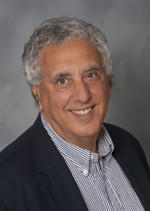
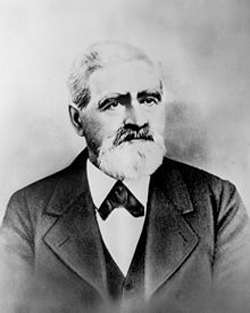
(Photo: Wikipedia)
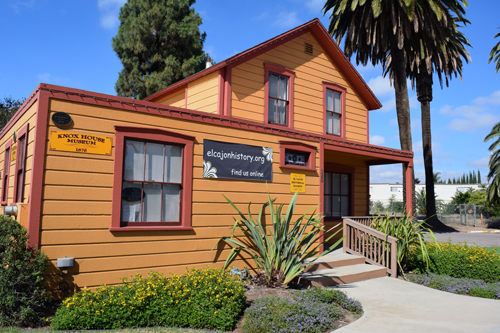
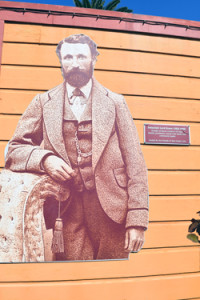
EL CAJON, California — In the early history of the City of El Cajon, two names are particularly well known — Levi Chase, for whom Chase Avenue and the Chase Avenue Elementary School are named, and Amaziah L. Knox, who built El Cajon’s first hotel and also served as the city’s first postmaster back when El Cajon was known as Knox’s Corners. A monument to him is incorporated in the pylons holding up the downtown “El Cajon” sign on Main Street, and his hotel building now houses the El Cajon Historical Society.
Known, but less celebrated, was Isaac Lankershim, the 19th century absentee landowner who retained Levi Chase, an attorney and former U.S Army major, to evict land squatters and clear the title of a large portion of the 48,800-acre Rancho El Cajon, which Lankershim purchased in 1868 from Mexican land grantee María Antonia Estudillo de Pedrorena.
Historian G. Carroll Rice in the April 2012 edition of Heritage, a publication of the El Cajon Historical Society, reported that Lankershim paid Chase for his work with 7,628 acres of land on the southern end of the El Cajon Valley, near where Chase Avenue branches from the El Cajon Boulevard exit on eastbound Interstate 8. Chase shared Lankershim’s enthusiasm for agriculture, growing not only wheat but also raisins, which were “dried and packed at the ranch,” according to Rice.
Lankershim was also the man who hired Knox to be the manager of his El Cajon property, on which he grew wheat. After gold was discovered in Julian, the area where Knox lived was along the route between Julian and downtown San Diego. With travelers passing in both directions, Knox decided in 1876 to build a combination hotel and residence. He included in the structure a place for a small post office, and was rewarded with an appointment as the area’s first postmaster.
El Cajon was only one of Lankershim’s investments in California agricultural land. In 1869, he led a group of San Francisco investors who purchased 60,000 acres in what today is known as the San Fernando Valley of Los Angeles. Initially he raised sheep there. But when wool prices fell, he planted over his holdings with wheat. Imagine, the communities today known as North Hollywood, Sherman Oaks, Van Nuys, Encino, Tarzana, and Woodland Hills all one big wheat field!
Lankershim was profiled in the Summer 2013 edition of Western States Jewish History, and later on the internet pages of the historical quarterly’s online Jewish Museum of the American West, www.jmaw.org. It was noted that while Lankershim started his life as a Jew in Bavaria, he ended it as a Baptist in California. This was principally because on his way to San Francisco, he met and married in St. Louis the English-born Annis Lydia Moore, who persuaded him to convert.
Once in San Francisco, Lankershim and his brother James aggregated agricultural holdings in Napa, Solano County, and Fresno.
“In the late 1860’s Isaac Lankershim moved to Los Angeles,” Western States Jewish History reported. “There he had close business and social relationships with Harris Newmark and other Jewish businessmen. They looked upon his Baptist conversion as an idiosyncrasy.”
David Epstein, editor of Western States Jewish History, recounting how Lankershim was one of the boys in the Jewish circles of early Los Angeles, said, “as far as they were concerned, he was simply a Jew with a quirk.”
Newmark was a Prussian-born grocer who dabbled in real estate and with partners subdivided a city that initially was called Newmark but later was renamed as Montebello. A similar fate befell a city initially named as Lankershim, which the landholder had planted over with fruit trees. It was renamed as Toluca, and later still, became known as North Hollywood.
Far more lasting was the name of the city named for Lankershim’s son-in-law, Isaac Van Nuys, husband of Susanna Lankershim.
Isadore Choynski, a friend of Lankershim’s, commented before the latter’s death in 1882, that Lankershim was “a religious eccentric in a family of ‘pious Jews.’ ’ He also called him “the richest ex-Jew in Los Angeles.”
Like Chase, Lankershim has elementary schools named for him – one in the North Hollywood area, and another in Sn Bernardino, where he also had real estate holdings. In fact the San Bernardino community northeast of the San Bernardino Airport is known as “Lankershim.”
*
As eastbound cars exit at El Cajon Boulevard, a secondary offramp permits traffic to get onto Chase Avenue. This is the historic area that Isaac Lankershim deeded over to Levi Chase.
*
Next: From junk to scrap metals to recycling
*
Harrison is editor of San Diego Jewish World. You may comment to him at donald.harrison@djewishworld.com