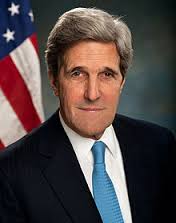
WASHINGTON, D.C. — U.S. Secretary of State John Kerry on Monday, Dec. 10, addressed the American Jewish Joint Distribution Committee. After being introduced by Stuart Eizenstat, who had held office in both the Carter and Clinton administrations, Kerry complimented the JDC (affectionately called the “Joint”) for its work in many countries helping not only Jews but other local residents. He then turned to the issues of the nuclear negotiations with Iran, and the Israel-Palestinian peace talks. Here is an extract of his comments, from that point in his speech on, as transcribed by the U.S. State Department:
*
I want to say a few words to you about another way in which hopefully we in the government are trying to also preserve and nurture Jewish life. And I’m talking about Jewish life in the state of Israel. I know this is not a political group in any way, but it would be a shameful omission if I didn’t honor the fact that everybody here obviously comes here with a passion for the preservation of life in Israel, and more importantly for the long term, the possibility of peace and of stability.
We are deeply committed to the security of Israel and of the well-being of the Jewish people by virtue of that. (Applause.) From the support that we’ve provided as a nation before I was in government, shortly after I’d come back from Vietnam, from the support we provided during the Yom Kippur War in 1973, to the hundreds of millions that we have contributed to help develop weapons systems like the Iron Dome as well as the military technology that we provide the Israelis with today, the United States has long viewed Israel’s security as absolutely fundamental to our own.
So when it comes to the range of issues that face the region today, there can be, in my judgment, no doubt – there should be no doubt – about where the United States stands. We stand squarely beside our Israeli friends and allies, and that bond is ironclad; it will never be broken. (Applause.)
This morning, I talked to Prime Minister Netanyahu. Bibi and I know each other really well now. We’ve known each other for about 25 years, maybe even 30. I knew him when he was in Cambridge, Massachusetts on an interval in politics that some of us have had occasionally. And I have visited with him many, many times, both when he was in office and out of office, and likewise for me. I just got back from what I think was my eighth trip to Israel since becoming Secretary of State, and I leave the day after tomorrow and I will be having dinner with Bibi again on Thursday night. So this is a commute, folks, nowadays. (Laughter.)
I want you to know that every single time that big blue and white plane that lugs me over there comes in for a landing at Ben Gurion Airport, I truly feel in my gut, for reasons of friendship as well as affiliation that Stu mentioned, how precious and how vulnerable and how real the security challenge of Israel is. It’s an extraordinary nation which, when you fly over it and you see what has been blooming out of a desert and built in this short span of time, is absolutely stunning. And when you compare GDPs and per capita incomes and other things to other nations that were in the same place in 1948 and 1950 and ’52 and see the differential today, it tells you a remarkable story of accomplishment and capacity.
I want to make it clear today that we are deeply committed going forward to honoring the bond and honoring those security needs. And I want to reiterate something that President Obama and I have said many times, and I underscored last week when I was in Israel and I underscored again two days ago when I spoke to the Saban Forum here in Washington. And that is: We will not allow Iran to acquire a nuclear weapon – not now, not ever. And I promise you that. (Applause.)
Now, I know that some people are apprehensive and wonder sort of have we somehow stumbled into something or created something where in fact the Iranians have pulled the wool over our eyes and we’re going to not know what they’re doing. Let me just say to you very simply: I’ve spent, as Stu said, almost 30 years in the Senate. I chaired the Foreign Relations Committee. I understand military and security issues. And I understand the fundamental basics of – as does the President and most of the people around us – what is necessary for a nation to prove it has a peaceful nuclear program. And I can’t stand here today and tell you that the Iranians are going to do what they need to do. But I do know that Israel is actually safer today than it was the day before we made the deal, because in this deal they have to destroy all of their 20 percent enriched uranium; they have to hold their 3.5 percent low enriched at the current level; they are not allowed to install any new centrifuges; they have to allow us daily inspection inside that secret mountaintop, Fordow; they have to allow us daily inspection in Natanz in the nuclear plant; they have to allow us regular inspection in the heavy water reactor that has the potential of plutonium; they are not allowed to install any further nuclear components into that construction site; they cannot test additional fuel; and we are allowed to go into the storage sites and manufacturing facilities of all of their centrifuge production facilities – all things we couldn’t do before we made this first step agreement.
Because of what we’ve done while we negotiate the final comprehensive agreement, which is what Bibi wanted in the first place, we will actually be setting their program backwards, expanding the amount of time that it might take if they were to try to break out. That means we have more time to respond, more time to know what is going on. That is why I can say to you in good conscience I believe Israel is safer today than it was before. Now, does that mean this will be successful in the long run? I don’t know. But here’s what else I do know: If we aren’t successful, if we get to the end of these six months and they don’t do the simple things you need to do to prove your program is peaceful, then we will have kept united the P5+1, we will have shown the global community our bona fides to attempt to give them an opportunity through diplomacy to do what they need to do, and we will not have taken any sanction off the table. We can ratchet them up when we want. We will go back to Congress, we will ratchet them up, we will ask for additional sanctions. And if needs be, if we cannot get this done on time, we will take no other option, military or otherwise, off the table. So I am confident that we are going to approach this with a view to making Israel more secure.
Let me also say to all of you there are other issues that go to Israel’s existential security, and none more so than the ticking time bomb of demographics in the region and the realities of the de-legitimization campaign that has been taking place for some period of time. I believe, as President Obama does, that Israel will be far more secure if we can also put to test the possibilities of the two-state solution. And so we will continue to attempt to do that despite the skepticism, despite the cynicism in some quarters, that that day can never come where you would actually achieve a two-state solution with two peoples living side by side in peace and security.
I believe, though, that it remains a possibility. And it seems to me that for all of you, for anyone who cares about the security of Israel – and all of you do – for anyone who cares about the future, as I know all of you do, and engaged in the activities you are here at the JDC, you must also believe that peace is possible. And as these tough but very critical negotiations continue, I hope that you will understand we will continue to consult, we will continue to work closely, we will do everything in our power to make sure that our friends in Israel are comfortable with the direction we’re moving in and are part of it.
And I talk to Bibi at least two or three times a week. We are hand in hand and mind in mind trying to figure out how to do this in a way that protects the security of Israel, that establishes the sovereignty and dignity of an independent and viable Palestinian state. If it was easy, it would’ve done a long time ago. It isn’t. But I think the effort is worth it.
And I know why it’s worth it. I spent a lot of time – when I first went to Israel in 1986, I spent an entire week, and I traveled everywhere. And this wonderful fellow by the name of Yadin Roman, who’s the publisher of Eretz Israel magazine, was my guide and took me around. And he was brilliant, and he knew the history of everything and told me all the details of everything I was seeing. And I went up to Kiryat Shmona, and I went down into a bomb shelter where kids had to run and side from the Katyusha rockets. And I visited all the different religious sites – Christian and Muslim and Jewish, obviously. Went to the Wailing Wall, left my note, which I’m still working on. And visited – tried to swim in the Dead Sea, cloaked in black mud, everything else. And climbed Masada, which is one of the most stirring things I’ve ever done in my life, because we had this huge debate on top of Masada. And Yadin provoked us, purposefully. And he gave us the whole history of Josephus Flavius and told us all the writings in this great contentious debate about had these Jews really died there, had they in fact been there at this moment, or did they escape because they didn’t find a whole lot of skeletons, and people were wondering what happened.
Well, we had this long debate. And I’ll tell you, even before that, I had this marvelous experience of flying a jet out of (inaudible) air base. I’m a pilot. I love to fly. And I persuaded this ace colonel from the war to take me up in a jet, and he got it cleared in Tel Aviv. Somehow they let me do it. And they won’t let me do it now, but it was fun then. And I remember taking off, and he said, “Okay, it’s your airplane the minute you get up in the air.” I went up above the air, and I remember he – I was turning, and he said, “Senator, you better turn faster; you’re going over Egypt.” And so I turned the airplane and came back. And we did some aerobatics, and I was doing a loop, and I went up – way up high and came down. And as you look, you put your head back and catch the horizon underneath you. And I looked, and I looked out and I could see all the way out in the Sinai, all the way down in the Gulf of Aqaba. I could see all the way over into Jordan. And I said to myself, “This is perfect. I’m looking at the Middle East the right way, upside down – (laughter) – and I can understand it now.”
But after the debate on Masada, we took a vote, and we all voted unanimously that it happened exactly the way it is recorded, that they had fought and died. And at the end, Yadin took us to the edge of the precipice. And there, where a lot of the air force, I understand, and other military are sworn in and take the oath, we yelled across the chasm, “Am Yisrael chai.” (Applause.) And the echo came back. And I will tell you, it was stunning to hear that echo. You sort of felt like you were listening to the souls of the past tell you Israel is going to survive. And that’s why, my friends, you have a Secretary of State who gets it, who understands this mission. And with your help and your support, we’ll get it done the right way.
Thank you. (Applause.)
*
Preceding provided by U.S. State Department