By Cailin Acosta in Del Mar, California

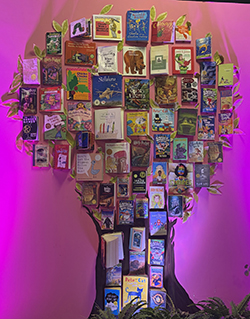
The San Diego County Fair’s 2026 theme, “Once Upon a Fair,” celebrated the joy of books, storytelling, and reading for all ages.
Visitors entering the main exhibit hall were greeted by giant, life-sized displays of beloved classic books, award-winning titles, and famous authors. Beyond the many photo opportunities, the San Diego Public Library hosted an information booth where fairgoers could pick up stickers, pens, and bookmarks, while also signing up for the library’s Summer Reading Program, which welcomes participants of all ages, including adults.
One exhibit explored the evolution of children’s literature through the decades.
Among the featured books was Brown Bear, Brown Bear, What Do You See? by Jewish author Eric Carle and Bill Martin Jr. First published in 1967 and remaining a favorite into the 1970s and beyond, the rhythmic, repetitive story introduces young readers to colors and animals while helping them recognize patterns and make predictions.
Another classic was The Snowy Day by Jewish author Ezra Jack Keats. The story follows young Peter, who wakes to discover his neighborhood blanketed in fresh snow. As he spends the day making footprints, catching snowflakes, and exploring his winter wonderland, the book celebrates childhood curiosity, imagination, and the joy found in everyday moments.
Chapter books also gained popularity during the 1970s. One of the era’s best-known titles was Tales of a Fourth Grade Nothing by Jewish author Judy Blume, the humorous story of Peter Hatcher and his mischievous younger brother, Fudge.
Poetry found its place in children’s literature with Where the Sidewalk Ends by Jewish author Shel Silverstein, whose whimsical poems and distinctive illustrations have delighted generations of readers.
The 1980s featured favorites such as If You Give a Mouse a Cookie by Jewish author Laura Numeroff, a playful story showing how one small favor can lead to a chain of unexpected events.
The exhibit also highlighted The Very Hungry Caterpillar by Eric Carle, whose beloved picture book follows a tiny caterpillar as it eats its way through an assortment of foods before transforming into a beautiful butterfly.
For older readers, the 1990s brought the immensely popular Goosebumps series by Jewish author R.L. Stine. The spooky yet age-appropriate stories introduced millions of children to the thrill of horror while encouraging reluctant readers to keep turning the pages.
Another section of the exhibit explored different literary genres.
The folklore display featured Hansel and Gretel, illustrated by Jewish storyteller Maurice Sendak. The classic fairy tale follows two siblings who become lost in the forest and discover a house made of candy inhabited by a wicked witch. Through quick thinking, courage, and teamwork, Hansel and Gretel outsmart the witch, escape danger, and return home safely.
The exhibit explained that beyond its spooky surface, Hansel and Gretel reflects universal themes of fear, survival, resilience, and hope. The forest and the witch symbolize the challenges and uncertainties people face throughout life, while the children’s bravery demonstrates that perseverance and ingenuity can overcome even the darkest obstacles.
Comic books were also spotlighted, tracing nearly a century of history.
The exhibit noted that modern comics evolved from newspaper strips such as The Yellow Kid in the 1890s, whose colorful speech balloons and recurring characters helped launch the medium.
During the “Golden Age” of comics (1938–1956), superheroes exploded onto the scene with creations such as Superman by Jewish creators Jerry Siegel and Joe Shuster, followed by Batman, Wonder Woman, and Captain America.
The “Silver Age” (1956–1970) introduced more complex and relatable heroes, thanks in large part to Jewish Marvel legends Stan Lee and Jack Kirby. Their characters faced not only supervillains but also everyday personal struggles.
By the “Bronze Age” (1970–1985), comics began addressing social issues including racism, drug addiction, and inequality, expanding the medium beyond traditional superhero adventures.
The “Modern Age” (1985–present) brought more sophisticated storytelling with groundbreaking works such as Watchmen and the Pulitzer Prize-winning Maus by Jewish author Art Spiegelman. Independent publishers flourished, graphic novels became mainstream, and Japanese manga, pioneered by Osamu Tezuka, grew into a worldwide phenomenon. Today, digital publishing and webcomics have made it easier than ever for aspiring artists to share their work.
The exhibit also explained how comics have reflected society throughout their history. It highlighted the creation of the Comics Code Authority in 1954, which regulated comic book content for decades before its influence ended in 2011. During the 1970s and 1980s, comic collecting became a major hobby, while today comic books continue to influence films, television, fashion, and popular culture around the world.
Visitors also learned about the history of graphic novels, which combine artwork and prose to tell complete stories. Early examples date back centuries, long before superheroes existed. The term “graphic novel” first appeared in 1964, but the format gained widespread recognition during the 1980s with the publication of Art Spiegelman’s Maus, the first graphic novel to receive the Pulitzer Prize.
Unlike serialized comic books, graphic novels are often published as complete standalone works. Today they encompass every genre imaginable, from superhero adventures and manga to memoirs, historical nonfiction, mythology, and literary fiction.
After exploring the history of books and storytelling, children could write and illustrate their own fairy tales to take home or display on a community wall. Another area celebrated Dr. Seuss with whimsical funhouse mirrors that stretched and shrank visitors into comical proportions. Nearby, Scholastic Books operated a bookstore where fairgoers could browse and purchase books to continue their reading adventures after leaving the fair.
All in all, it was a truly book-tastic experience. I’m an avid reader, so this year’s theme was one of my favorite San Diego County Fair exhibits, reminding visitors of all ages that great adventures begin by opening a book.
*
Cailin Acosta is the assistant editor of the San Diego Jewish World.
This writer is thorough and succinct. Her writing is honest and vibrant. I look forward to reading her articles.
I visited this exhibit at the fair and she left nothing out. The only thing I would like to add as a Jewish person from a mixed race home is that… the Snowy Day which I owned as a child broke barriers by including an African American child a little boy as its main character. It depicted him with dignity and gave children of color an existence in childhood literature which was groundbreaking for its time.