By Michal Beruven
AFULA, Israel — I serve as a sixth grade homeroom teacher at Alumot Elementary School, headed by Principal Raya Shechtman and located here in Israel’s northern Jezreel Valley. More than 260 students attend Alumot, from grades 1-6.
The community is an integral part of the school, which maintains regular contact with parents, the community’s retirees, soldiers in a unit adopted by the school, youth groups and residents with special needs. This last partnership especially reflects the school’s belief that we should be patient and tolerant to those who are different from us. Alumot is a certified “green school,” recognizing its curriculum is related to environmental sustainability, the intelligent use of resources, and contributions to the community.
One of the unique things about Alumot is the Personal Research Excellence program. This program is based on the view that the school has a responsibility to make its students independent and curious learners with a desire to understand and learn various subjects according to their choice and interest. Personal Research Excellence includes developing a wide range of scholastic subjects. The teaching staff leads students to engage in high-level research learning, after which each student presents the results of the research that he/she developed during the lessons.
In 2010, Alumot joined Athena Fund’s “Laptop for Every Teacher in Israel” program, which donates laptops to teachers in Israel. In addition to the computer, each teacher receives 120 hours of training, including basic knowledge in operating the computer, as well as digital skills, integrating the computer in frontal teaching, using available online information, and more. The training also facilitated further learning amongst the participants as well. Teachers who are familiar with various ICT areas taught those who still needed support, helping to expand knowledge and reduce anxiety.
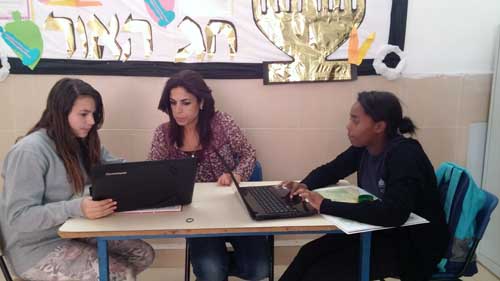
One day, my blackboard and pen where taken away, and I received a computer. I quickly realized that students have the technical knowledge and I have the pedagogical knowledge, and together we are a winning team. Today I do not know how I could teach otherwise. In addition to the pedagogical aspect, using computers greatly reduces the use of paper. Thus, for example, messages are sent by email, in classroom forums and over the school’s website. There are fewer worksheets. Using a computer has also completely removed the fear associated with having to contend with the latest technological advancements.
Athena Fund’s project is now integrated into the school’s ICT vision, led by Principal Shechtman. At Alumot we believe that in the technological era in which we live we should provide our students with 21st century skills, including the use of advanced technologies and computer literacy. The hope is that digital environmental innovation will make it possible to address the required achievements and the quality of teaching, learning and assessment processes.
As noted by Principal Shechtman, the ICT-based lessons improve teaching and increase the degree of motivation for learning. The use of innovative pedagogy that includes a variety of media adds a new dimension to classes and enables a quantum leap for the whole school.
I acquired a lot of knowledge and operational tools to combine theory and computerized tools, and to implement innovative teaching methods. The computer allows better demonstration capability of the material being taught, use of presentations, videos, actual content and referral of students to online learning materials. There is no doubt that the use of computerized tools enhances the lesson, makes it more interactive, and stimulates interest. Many students expressed great interest in this type of teaching, since many students are visual learners. It is much more interesting for them to see a video that shows the subject vividly and visually, instead of hearing a lecture for 45 minutes. In addition, the use of demonstration means increased student concentration and active participation in class. Computer usage has also led to a decrease in classroom discipline problems.
One of our students, “X,” is a child of Ethiopian origin who comes from a poor family. His parents are elderly, he has many siblings and there is really no one to provide him with close, personal support. What he receives at school is all he has. X grew up in difficult conditions and was an inattentive student – a challenging boy.
In the third and fourth grades, X suffered from behavioral problems in the classroom. He annoyed other students, was involved in violent incidents, and spoke disrespectfully to teachers. His report card noted that his behavior “requires improvement” and he received a failing grade in many subjects.
When he was in the fifth grade, about four months after the year began, Alumot teachers received laptops and professional training courses. I began to present interesting, ICT-based lessons, and I noticed that X underwent a transformation. With the computers, learning became different. The computer stimulated his interest through demonstrations, addressing challenges at his level. With ICT-based learning programs it was possible to access all study materials. Writing topics that previously frustrated X were solved by the computer. The computer transformed his learning into an experience.
Without a doubt, the change I witnessed in X was due to the fact that I began teaching students using a laptop. X became another child: attentive, quiet, motivated and with a desire to move forward. He slowly began to reach grade level and participated in team assignments. Today he suffers from zero discipline problems, is active in one of the sports teams, and is a positive student in all respects. The great achievement is that discipline problems disappeared even in subject lessons taught by other teachers.
X says that the fact that the school enabled him to study with a computer, caused him to change. His grades improved, he made good progress, and a personal learning program was designed for him. X even showed progress in language and mathematics. The computer makes it possible to demonstrate fractions in math. With a click of a button all of the templates are opened and comparisons can be shown through a game. In another subject – geography, for example – natural phenomena can be illustrated through a variety of demonstrations, especially when most learning is done through play experience.
There is no doubt that “Laptop for Every Teacher” is revolutionizing the education field in Israel. The project, which is funded by donations, aims to provide a laptop for every teacher by 2018. So far, Athena Fund, headed by President and Founder Uri Ben-Ari, has distributed over 11,000 computers in 939 schools and preschools, in 430 cities and communities of all sizes.
*
Teacher Michal Beruven’s account was arranged by the Athena Fund at the request of San Diego Jewish World