By Donald H. Harrison
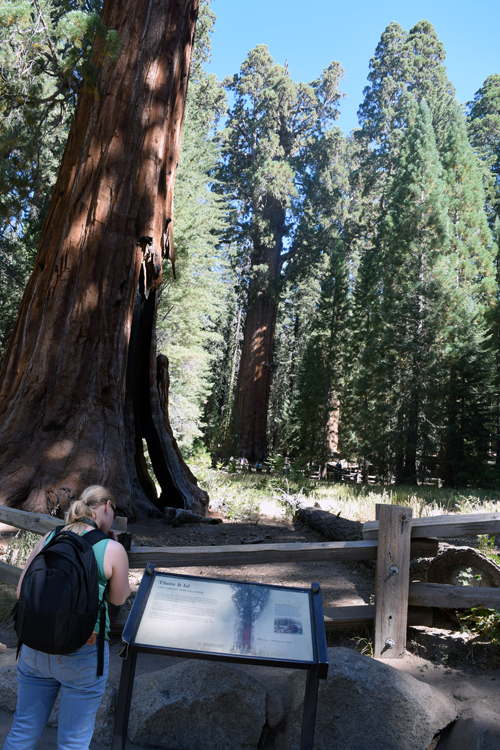
SEQUOIA NATIONAL PARK, California – The giant sequoias can be awe-inspiring and not only for their size, says Matt Fagan, the National Park Service’s district interpreter.
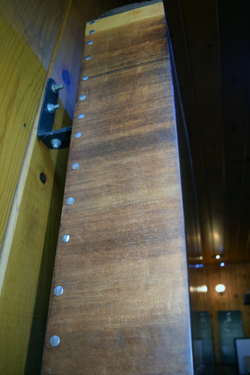
“There was a gentleman named Walter Fry who back in the early part of the 20th century (circa 1920) was a lumberman and he cut down one of the large trees. He decided to see how old it was, so he started counting the rings. He counted 3,200 rings, so that tree he had just cut down was at least 3,000 years old. He was so mortified that he ended this 3,000-year-old organism’s life that he did a complete 180 (degree turn) and became an advocate for preserving these trees. He actually became the first ranger and naturalist in the National Park Service here in Sequoia.”
So, if that tree was felled in 1920 and it was 3,200 years old, its seed must have germinated about 1,280 BCE – which, according to various biblical calendars, would have been during the latter part of the life time of Moses.
No wonder Fry was filled with regret for what he had done.
Today, the most celebrated tree in Sequoia National Park is the General Sherman Tree, considered by volume to be the largest tree in the world. Oh, there are taller trees such as the coastal redwoods of central and northern California. But there are no trees that are larger when you consider the General Sherman’s height and diameter. The General Sherman is 275 feet high (in American football that would be a distance stretching from the goal line to a point between the nine and eight yard lines on the opposite end of the field). At its widest point the General Sherman Tree is 36 ½-feet in diameter. Its circumference at that point is 108 feet. The tree narrows as it gets higher, but at a point 180 feet high, it still measures 13.7 feet in diameter.
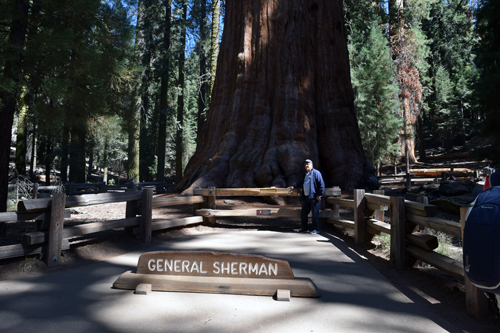
What all these statistics mean, according to Fagan, is that if you were somehow able to hollow the General Sherman Tree out, and fill it up with water, it could hold more water than any other tree in the world. In the world! Park statisticians figure it could hold enough water to fill 9,844 baths, or “one bath every day for 27 years.”
No one knows exactly how old the General Sherman Tree is. The estimate is between 2,200 and 2,700 years old. When a tree falls, one can saw out a section and count the rings as Walter Fry did to determine his tree’s approximate age. But when the tree is still standing, there is no way with absolute reliability to determine its age.
“If you would try to core into the heart of them, they are so dense that by the time you get to the middle of them, the corer would stop working,” Fagan said. “There is some technology now where they can take a measurement of a tree and compare it to the base measurement of other trees, and get a fairly accurate estimate, but only within a couple of hundred years.”
And a couple of hundred years are a breath and a wink in the life of a sequoia.
There may be older trees that the General Sherman living today, possibly even a parent tree, but there just is no way of knowing. Age does not determine the size of a tree; that is determined by the growing conditions, which for the General Sherman were optimal.
“It must have bare soil, open canopy, enough water, slope of the hillside just right, and no major streams draining a lot of the water off,” said Fagan. “It was like the story of the three bears (in the Goldilocks fable). This place was ‘just right.’”
The giant sequoias generally grow on the western side of the Sierra in a zone between 5,000 and 7,500 feet. According to an explanation at the park’s Giant Forest Museum, “temperatures above 7,500 feet are usually too cold for sequoias” and “below about 5,000 feet it is too dry.”
At the same museum, the General Sherman Tree is estimated to weigh 1,385 tons, which is equivalent in weight to ten blue whales, according to an exhibit.

Fagan said he particularly enjoys watching tourists try to take a photo of the General Sherman Tree from up close. One would need an extremely wide lens to get the entire tree into a single photo, but that doesn’t stop some visitors from lying on the ground, twisting themselves into fantastic positions, all in an effort to get the shot. Sympathetic to their goals, the National Forest Service found a spot, quite some distance from the General Sherman Tree from which it might be photographed in its entirety.
How is it that the sequoia trees are so durable? “They are remarkable in that they are pretty resilient to any sort of pests such as insects and they are fire adapted,” says Fagan. The bark can be up to two feet thick while the sap running inside the tree is watery, making the tree flame resistant. In a way, fire is the friend of the sequoias because it burns away the branches, leaves and other detritus that may have fallen to the ground below it. Its seeds need bare soil to germinate.
Interestingly, the trees shallow roots and heavy weight can contribute to its downfall. If for any reason the tree starts to lean – heavy snow on one side, or erosion of the soil beneath it, or other such natural reasons – it can become unbalanced, and then might topple from its own weight.
Sequoia National Park employs a tree specialist to check the trees, particularly along the road, or near buildings, to make certain that they are not dangerously leaning. If they are leaning in the populated areas, they have to be cut down. On the other hand, if they are leaning in the middle of the forest, and a tree falls, well, that is not only a question for philosophers (does it make any noise?) but also for ecologists. There is no reason to haul it away because it becomes a home for chipmunks, squirrels, and other forest species.
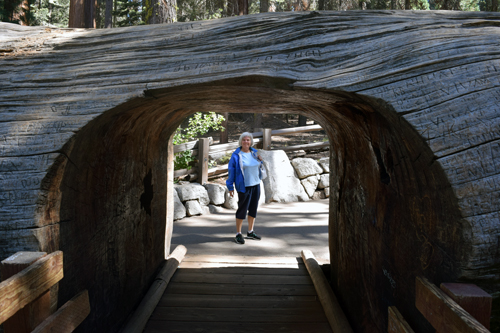
Where does the name “sequoia” come from and who decided to name the largest sequoia “General Sherman?”
The answers to these questions are not at all clear.
One legend is that the Austrian botanist Stephen Endlicher (1804-1849), who came up with the name “sequoia,” admired the Cherokee Indian Sequoyah, who devised the Cherokee alphabet, and named a tree in the American West for a member of a tribe that was moved from the American East Coast to Oklahoma. But scholars could never find any reference to Sequoyah in Endlicher’s extensive writings. Perhaps, they suggested, he generated the name from the Latin word for “sequence.” No one knows for sure.
About “General Sherman,” it is known that naturalist James Wolverton had served as an officer in an Indiana regiment under General William Tecumseh Sherman during the U.S. Civil War. He named the tree in 1879 in honor of the commanding general he so admired. There are other trees in the Sequoia National Forest and adjoining Kings Canyon National Park which also are named for people, most notably the General Grant Tree, which previously had been thought to be the largest. (The irony is that Ulysses S. Grant outranked Sherman)
Before the U.S. National Park Service was created, these national forests were administered by the U.S. Army, including by the African-American members of the 9th Cavalry Regiment, more commonly known as the Buffalo Soldiers. One of the trees was named for their commander, Colonel Charles Young, who became the first African-American superintendent of a National Park.
When it was first proposed to name a tree for him, Young demurred, saying he would prefer that a tree be named for his personal hero. So one of the trees is named for educator and author Booker T. Washington, according to Fagan.
For those of us who like to find Jewish stories when we travel—and perhaps feel that the tree being a contemporary of Moses is insufficient for such purposes – Fagan came to our rescue.
Near Sequoia National Park are Kaweah Lake and the Kaweah River. “In 1885,” said Fagan, “there was a utopian socialist colony just down the hill called the Kaweah Colony. When they saw the tree and wanted to name it for someone they respected, they decided to call it the Karl Marx Tree (Yes, Marx by ancestry was Jewish.) For five years, there were dueling names, but in 1890, Sequoia became a National Park managed by the Army.”
It’s not hard to guess which name the U.S. Army preferred!
*
ACCOMMODATIONS AND TRANSPORTATION
Nancy and I lodged at the Comfort Inn in Three Rivers, California, which is only minutes away from a southwestern entrance to Sequoia National Park. We were assigned to a room for the disabled with the understanding that if a customer who actually was disabled came along, we would surrender the room and be assigned another. Our room had such amenities as a fairly large-screen television, a refrigerator, microwave, and a coffee maker, but its Wi-Fi was spotty. Outside there was a swimming pool and Jacuzzi. The clientele was international, with Italian speakers particularly in evidence. Across Highway 198, which is a two-lane road, were two restaurants, Casa Mendoza, specializing in Mexican food, and Todd’s Pizza Factory. We ate at one the first night, and the other the second night of our stay. Both casual restaurants were good.
Although one can drive a private car into Sequoia National Park and then park and hike, we found it more convenient to leave our car at the Comfort Inn and to catch the municipally operated Sequoia Shuttle into the park, where, at the Giant Forest Museum, it links up with the free park shuttle. The Sequoia Shuttle, which operates from approximately one week before Memorial Day to one week after Labor Day, costs $15 per person. The park shuttle has various routes. We took it from the Giant Forest Museum to the General Sherman Tree and on to the Lodgepole Visitor Center, where we encountered Fagan, who has wide story-telling experience. He has served the National Park Service in a variety of venues including the Washington D.C. Mall, the historic section of Philadelphia, Everglades National Park and the Dry Tortugas.
*
Harrison is editor of San Diego Jewish World. He may be contacted via donald.harrison@sdjewishworld.com. Comments intended for publication in the space below MUST be accompanied by the letter writer’s first and last name and by his/ her city and state of residence (city and country for those outside the United States.)