By Ari Melnik in Ramat Gan, Israel

The same war that sent some of our diaspora brothers and sisters rushing toward us sent others rushing the other way. People we assumed were family turned out to be strangers. People we had never met flew across an ocean just to stand next to us in the dark. I carry both.
Start with the cold shoulder, because it was not, in most cases, delivered by strangers. Strangers screamed and marched. The wound that Jews abroad kept describing to me came from closer in: the non-Jewish friend of 15 or 2o years who simply vanished after October 7. No call. No message. Not even the diplomatic thinking of you. Just silence. And then, weeks later, a shared graphic, a photo from a demonstration. The friendship never formally ended. It simply stopped being one.
I heard this from clients more times than I can count. American, Canadian, South African. The texture was always the same.
 And then it happened to me. When I lived in England in my 20s, I had a close friend in Manchester. We knew each other’s families. After October 7, I sent him a message. Nothing dramatic. Just letting him know I was alive, that my family was alive, that I was thinking of him. He never answered. Months later a mutual friend told me why. He had decided Israel was committing genocide and had decided the right thing to do with a friend in Tel Aviv was to act as though that friend had never existed. It is not the disagreement that wounds. It is the erasure. A political argument at least grants you the dignity of existing. This was quieter and crueler. You were sidelined by someone who knew exactly where you lived and chose, deliberately, to look the other way.
That is the coldest shoulder.
But the same fire that made some people disappear brought others toward us for the first time. Among the solidarity missions I guided after October 7 were Jews in their 70s and 80s visiting Israel for the very first time. A lifetime of Jewish identity. Holidays. Synagogue. Children and grandchildren raised inside the tradition. And yet this was the moment that finally brought them: a country at war, a nation in mourning.
One man in his 70s had come on his own, not to be guided but to volunteer, bused into the fields each morning to pick fruit. One day I walked a few of them through Kfar Aza. The wall of one house still carried the marks the rescue teams had sprayed months earlier, noting that the house had been cleared and whether there had been bodies inside. Blasted concrete lay on the floor. Some of the visitors crouched, picked up a piece, turned it over, and set it back down where they had found it.
I asked him why now. He did not answer. His eyes filled, and he kept looking at the wall, and that was the answer. He was not mourning only the victims. He was mourning a version of himself he had not known was missing.
That is the warmest hug.
I carry both. Some days I think about my friend in Manchester and the silence in my phone, and the cold shoulder is the only thing in the room. Other days I think about the man with his hand on the wall of a burnt kibbutz house, crying for reasons he had not seen coming, and the warmest hug is what I take into the rest of the day. I do not get to pick which one shows up on which morning. But both of them are real, and neither is going away.
*
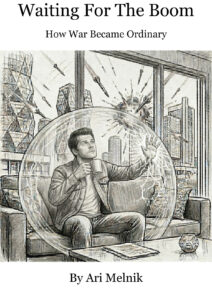
Ari Melnik is a licensed Israeli tour guide based in Ramat Gan. He has just published the memoir: Waiting for the Boom: How War Became Ordinary from which this column is excerpted.
Thank you for this intimate account of the global and personal response to October 7. We Jews remain in a precarious position, caught between cold shoulders and warm hugs. Thanks for a well written, inspiring article.