SAN DIEGO — Following are some of the stories of Jewish interest that hit our editor’s computer mail box at editor@sdjewishworld.com on Thursday, June 14. We are interested in local, national, and international news of Jewish interest, and welcome comments from members of the Jewish community about these news items.
Even when fasting for Ramadan, Muslim volunteers respond to emergencies
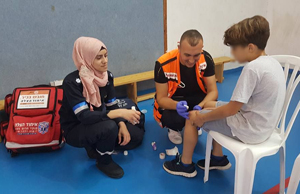
Five United Hatzalah emergency medical volunteers responded to a large-scale fire in Umm al-Fahm on June 13th, the penultimate day of the month of Ramadan, the holiest month in the Muslim calendar. The blaze took place in an auto-body parts store and quickly spread to other buildings and even engulfed part of the wooded area behind the store. The resulting fire was massive and endangered a number of buildings, residents and passersby. In addition to the stores and the traffic who were almost engulfed in flames, a number of teenagers who were in the area became trapped and were threatened by the blaze. Numerous children sustained light injuries and suffered from smoke inhalation.
United Hatzalah volunteer EMT Sanaa Mahameed who lives in Umm al-Fahm said: “I wasn’t in the city when the blaze began, but shortly thereafter, rescue services asked for all available responders in the area to come as they were fearing that it would turn into a mass casualty incident (MCI). Luckily that didn’t happen and only a few people were lightly injured. We provided those suffering from smoke inhalation with high-flow oxygen and treated the light injuries that the teenagers had sustained,” said Mahameed.
She was joined at the scene by fellow Muslim responders from the area, Dr. Dahar Agbariyah, and EMTs Yassuf Giselle, Lotafi Mahameed and Nada Muslimiani. Sanaa, as well as the other responders, finished treating those injured in the fire and then almost immediately received an emergency alert directing them to a car accident that took place on Highway 65 outside of Umm al-Fahm towards the direction of Afula.
“It is hard to go from call to call during a fast,” Sanaa said. “It’s not that I’m hungry, but it is hot outside, especially during the summer and after responding to emergencies, especially a large fire like today, one gets very thirsty. I’ve seen a lot of people faint due to the combination of the heat and the fast and the lack of essential vitamins.”
While Jews fast for six days a year throughout the calendar, Muslims fast for 30 days straight, not eating or drinking anything during the daylight hours for an entire month. Only after night falls can they eat or drink. It is a marathon of fasting and one that makes keeping with a daily routine extremely difficult. Responding to emergency calls in the middle of that routine is even more challenging yet the close to 400 Muslim volunteers of United Hatzalah do it every day.
“For me, it is not a question of whether to respond or not. Fast or no fast, if there is someone who needs help or a life needs saving, then I will do whatever I can to help the person and save their life. That is why I do what I do,” said Mahameed.
Murad Aliyan, who sits on the board of the organization and plays a vital role in coordinating all of the Muslim volunteers and chapters in the organization said: “Ramadan is one of the hardest things for a Muslim first responder. Between the heat and the continued fasting every day for a month, a person feels at a certain point that they have no more energy to do anything that is not absolutely necessary. In spite of all that, there are some people who are filled with motivation to go out and save lives in the quickest and most professional way possible. At the end of the day, our goal is to save lives and it doesn’t matter to us who those lives belong to or where they are located. If we can help them, we will. The motivation of our Muslim volunteers which is usually exceptionally high is even more so this month. We have gotten used to giving everything we have got even while fasting and facing the intense heat of a Middle-Eastern summer.”
President and Founder of United Hatzalah Eli Beer spoke about the unique dedication of these volunteers. “It is certainly not an easy thing to respond to calls while fasting. For me, to do it while fasting for a month is unfathomable, yet here we have 400 volunteers who do it every year, every day, for a month. It is certainly a true sign of selflessness and nothing makes me prouder than seeing our volunteers responding and saving lives regardless of what circumstances they were in beforehand. Whether it is responding to a fire such as the group from Wadi Ara did yesterday, or responding to a CPR call in Abu Gosh that many of the responders who live in that area did this morning, these Muslim volunteers really are going above and beyond the call of duty to help others regardless of religion, national association or politics. They truly are heroes.” —From United Hatzalah
*
$6.6 million for Syrian first responders and U.N. unit investigating Syrian abuse
 U.S. State Department spokesperson Heather Nauert announced on Thursday that President Donald Trump has authorized the United States Agency for International Development and the U.S. Department of State “to release approximately $6.6 million for the continuation of the vital, life-saving operations of the Syrian Civil Defense, more commonly known as the White Helmets, and the UN’s International, Impartial and Independent Mechanism (IIIM).”
“The United States Government strongly supports the White Helmets who have saved more than 100,000 lives since the conflict began, including victims of Assad’s chemical weapons attacks,” she added in a statement. “These heroic first responders have one of the most dangerous jobs in the world and continue to be deliberately targeted by the Syrian regime and Russian airstrikes. Since 2013, more than 230 of these brave volunteers have been killed while working to save innocent Syrian civilians.
“The IIIM’s work is vital to assisting the investigation and prosecution of persons responsible for the most serious crimes under international law committed in Syria since March 2011. Their mandate, collecting and analyzing evidence of violations of international humanitarian law and human rights abuses will help ensure those responsible for these crimes are ultimately held accountable.” — From U.S. State Department
*
Project to combat misogyny wins ADL award
 Four students from Boise State University have been selected by a panel of experts and leaders as the first-prize winners of a the Anti-Defamation League’s inaugural Innovate Against Hate campus challenge, a nationwide contest that challenged students from across the country to build and launch a social marketing campaign aimed at countering hate and extremism.
The Boise State University student project, called S.A.M.E. (Students Against Misogynistic Establishments) focused on combating violence against women by targeting at-risk men who might be recruited to misogynistic and male supremacist hate groups perpetuating and normalizing violent misogyny. The group was declared the winner of the top prize of $5,000, after competing at a live event in Washington, D.C. against two other student groups from the University of Maryland and the University of Nebraska.
“We were seeing a problem on our campus and in our community, where misogyny and violence are acting as a gateway to other forms of extremism which were growing and needed to be confronted,” said Janice Witherspoon, 21, one of the student project leaders of S.A.M.E. “We’re seeing that people are starting to take the issue more realistically, and we hope to take our mission to a national level, combating this on other campuses and communities across the country.”
“I have seen similar programs dedicated to countering extremism, but in this era of heightened hate and bias across a broad spectrum of ideologies, it demanded a broadened scope – and these students rose to the challenge,” said George Selim, Senior Vice President of Programs at ADL and former national security official. “It is critical that issues like misogyny receive more attention for their role in a broader spectrum of hate and extremism. We are also inspired by the results of the other student campaigns, including the other two teams who countered bias against immigrants and refugees.”
The program was developed in partnership with EdVenture Partners (EVP), an educational organization that has 28 years of experience developing innovating industry-education partnership programs, and Facebook, which provided advertising credits for student teams. Fabria Yassaee, Facebook Policy Manager, served as a member of the judging panel for the final challenge. Other judges included: Imam Magid, Executive Imam of All Dulles Area Muslim Society (ADAMS) Center in Sterling, Virginia; Ron Estrada, Senior Vice President of Corporate Social Responsibility & Community Empowerment for Univision Communications Inc.; Ashley Bell, Founder and Chief Executive Officer of 20/20 Bipartisan Justice Center; George Selim, Senior Vice President of Programs at the Anti-Defamation League; and Sally O’Brien, Senior Vice President of Institutional Partnerships at The Pew Charitable Trusts
The semester-long challenge for student teams was comprised of 19 schools countering hate online and in their local communities, culminating in the top three teams competing in a final challenge, hosted by New America. — From Anti-Defamation League.
*
Police on front lines in battle against terrorism
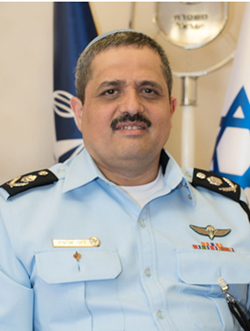
“The security burden has gradually shifted to the shoulders of the Israel Police, and today we are unfortunately faced with terrorism that has no political or organizational limits,” Israel’s Police Commissioner Roni Alsheich said Thursday at the Homeland Security Forum.
“Terrorists are less vulnerable because they do not occupy a defined territory and they represent a radical ideology making decisions sporadically,” Alsheich added. “Through cyber space and the knowledge that is available, this process has also created a blurring of the boundaries between crime and terrorism. In our case we are dealing with the phenomenon of the ‘lone wolf,’ which requires all the police for a rapid response capability at any time and anywhere, no matter what the role.”
The police commissioner said combatting terrorism is “demanding for the policeman in the field, since it compels him to take the initiative, to distinguish between a criminal and a normative citizen, all taking into account the differences and cultural characteristics of every population.”
He said, “Israel Police has set itself the goal of improving the norms of obedience to the law in each of the various sectors through partnerships and connection to the community. We hope to build a better police force in order to successfully cope with the various challenges.
“The multi-cultural challenge is certainly one of the most complex challenges facing the Israeli Police. But by solving it, it also gives us the greatest satisfaction. The police will continue to be committed to providing service to every citizen in the State of Israel, connecting to the community will continue to be a ‘force-multiplier’ of police work and public trust will continue to be important for our ability to provide optimal police services to the different Israeli communities.” — From Israel’s Ministry of Public Security
*
Network of Jewish Human Service Agencies supporting ‘Never Again Education Act’
 The Network of Jewish Human Service Agencies recognizes that Holocaust education is critically important. Introduced by Reps. Carolyn Maloney (D-NY) and Daniel Donovan (R-NY), the Never Again Education Act (H.R. 5460) is a bipartisan bill that uses private donations to provide teachers with the resources and training they need to teach children the important lessons of the Holocaust and the consequences of bigotry and hate.
This bill would help teachers overcome common hurdles to Holocaust education, including lack of resources and lack of funding. It would require the creation of a Holocaust education website and would connect curriculum experts at the Department of Education with Holocaust educators to develop programs tailored to the individual needs of teachers and communities. – From Network of Jewish Human Services Agencies
*
Tel Aviv University probe the mystery of consciousness
 Consciousness is everything people experience — from the taste of chocolate to the pain of a migraine, the disappointment of failing an exam to the thrill of holding a newborn baby. But the origin and nature of consciousness have puzzled scientists since antiquity.
A new Tel Aviv University study takes researchers a step closer to solving this mystery. The study, drawn from data collected by electrodes implanted in patients with epilepsy, identifies and measures the neural activity associated with a new conscious experience.
The research was led by Dr. Hagar Gelbard-Sagiv of TAU’s Sackler School of Medicine and Sagol School of Neuroscience, and the research team included Dr. Liad Mudrik of TAU’s School of Psychological Sciences and the Sagol School of Neuroscience, Michael Hill of UCLA, Prof. Christof Koch of the Allen Institute for Brain Science and Prof. Itzhak Fried of TAU’s Sackler School of Medicine and UCLA. Lab work and clinical research for the study were conducted at TAU, UCLA, the Tel Aviv Sourasky Medical Center and Caltech Institute of Technology. The study was published in Nature Communications.
“Computers and robots interact with the world without being conscious. But something miraculous happens inside our brains to make us conscious and experience the world from a subjective perspective,” said Dr. Gelbard-Sagiv. “Despite 30 years of neuroscientific research in this area, we still do not know which areas of the brain take part in the process.
“Our new study brings us one step closer to understanding consciousness and conscious experience at the most concrete level: the electrical activity of individual neurons.”
Because the conscious experience is private and inaccessible to observers, it is mostly studied in people who are capable of reporting their subjective experiences. Moreover, researchers are often limited to indirect measures of brain activity, such as EEG and fMRI. Here, the researchers took advantage of a unique medical opportunity: the surgical implantation of electrodes in the brains of patients with epilepsy to determine the precise areas responsible for their seizures. Patients were monitored for a week or two, until enough data on their seizures had been collected. During this time, the implanted electrodes recorded the activity of individual neurons in their vicinity.
The researchers presented two different images to the patient, one to each eye, to probe the moment in which a new experience arises. For example: An image of a house was presented to the right eye and an image of a face to the left eye. In this situation, known as “binocular rivalry,” the brain cannot combine the two images. Instead, the subject sees either the house or the face, and this alternates irregularly every few seconds. These alternations happened involuntarily, while the physical stimulus remained constant. This allowed researchers to isolate brain activity related to the change in perception and differentiate it from brain activity related to the physical stimulus.
The scientists discovered that the activity in frontal lobe neurons changed almost two seconds before the patient reported an alternation in perception, and that the neuronal activity in the medial temporal lobe changed one second before a report.
“Two seconds is a long time in terms of neural activity,” Dr. Gelbard-Sagiv said. “We believe that the activity of these neurons not only correlates with perception, but also may take part in the process that leads to the emergence of a conscious percept.”
“The study captures individual cells in the human brain just before one conscious experience is replaced by another,” Prof. Fried said. “It is a unique privilege to gain such a rare glimpse into human consciousness. At the same time, we can provide clinical care aimed at alleviating severe epilepsy in our patients.” — From Tel Aviv University
Preceding culled from news releases sent to editor@sdjewishworld.com