American Jewish Committee disappointed in Israel’s new ‘Nation-State’ Law
 The American Jewish Committee (AJC) describes itself as “deeply disappointed” that the Israeli Knesset, with the active support of Prime Minister Netanyahu, adopted Wednesday the controversial nation-state bill. The measure passed the 120-member Knesset by a vote of 62 to 55, with two abstaining. It will become Israel’s 15th Basic Law.
That Israel is indeed the Jewish state and its main symbols, including the flag and national anthem, are distinctly Jewish, are well-established facts, which, in our view, as steadfast friends of Israel, make this kind of law unnecessary.
Many American Jews, as well as other Diaspora Jews around the world, are enormously grateful that Jewish self-determination has been reborn in Israel, and are proud that Israelis have created a vibrant democracy in which all citizens, as promised in the Declaration of Independence, are protected and can aspire to full participation in Israeli society.
However, two elements of this new Basic Law put at risk the commitment of Israel’s founders to build a country that is both Jewish and democratic.
First, the measure downgrades Arabic from its longstanding status as one of Israel’s official languages to one that has “special status.” This not only directly affects the 21 percent of Israel’s citizens who comprise the country’s largest minority, but it also would appear to work against the government’s ongoing efforts to encourage the use of Arabic, given Israel’s location in the Middle East.
Second, the clause in the bill saying, “the state views the development of Jewish settlement as a national value and will act to encourage and promote its establishment and consolidation” could be read as a euphemism for the originally proposed endorsement of support for Jewish-only communities in Israel.
AJC asked the Government of Israel to clarify these and other questionable elements of the bill, and to reaffirm the core principles and values that make up the very foundation of Israel’s vibrant and admired democracy. – From American Jewish Committee
*
LGBTQ group decries Israel’s discriminatory surrogacy legislation
 Tyler Gregory, executive director of A Wider Bridge, the North American organization dedicated to supporting LGBTQ communities in Israel, expressed disappointment in the Knesset’s actions to pass a law Tuesday preventing access to surrogacy in Israel for gay couples and single men. Under the law as it stands, gay couples and single men face up to three years in prison if they attempt to pursue surrogacy within Israel.
“LGBTQ people in Israel face mounting odds, something made clearer after the Knesset’s passage of the discriminatory legislation last night, despite fierce opposition from Israel’s LGBTQ communities and allies, and words of support from the prime minister,” Gregory said. “The ability of the ultra-orthodox parties within the government to force a vote on anti-gay legislation is yet another instance of the Israeli government highlighting its support of LGBTQ rights abroad while harming LGBTQ people at home by prioritizing coalition politics over people’s lives.
“While we are not an Israeli organization, we believe that rights aren’t dictated by zip code or borders. That’s why we invest in – and will continue to invest in NGOs in Israel, such as the Aguda – Israel’s LGBTQ National Task Force – which led the campaign against the legislation, through our AWB Impact Grants, building capacity to foster lasting social change. As a newlywed likely to pursue surrogacy with my husband someday, I’m taking this news personally, and I hope our supporters will too. We may have lost last night, but the struggle to build a stronger, more inclusive Israel is far from over.” — From A Wider Bridge
*
Ben Gurion University develops all terrain search and rescue robot
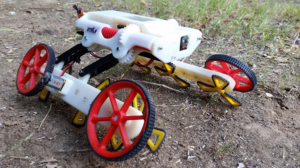 A new highly maneuverable search and rescue robot that can creep, crawl and climb over rough terrain and through tight spaces has been developed by Ben-Gurion University of the Negev (BGU) researchers.
The new Rising Sprawl-Tuned Autonomous Robot (RSTAR) utilizes adjustable sprawling wheel legs attached to a body that can move independently and reposition itself to run on flat surfaces, climb over large obstacles and up closely-spaced walls, and crawl through a tunnel, pipe or narrow gaps.
The innovative BGU robot was introduced at the International Conference on Robotics and Automation (ICRA 2018) in Brisbane, Australia, May 21-25.
“The RSTAR is ideal for search and rescue operations in unstructured environments, such as collapsed buildings or flooded areas, where it must adapt and overcome a variety of successive obstacles to reach its target,” says Dr. David Zarrouk, a lecturer in BGU’s Department of Mechanical Engineering, and head of the Bio-Inspired and Medical Robotics Lab.“It is the newest member of our family of STAR robots.”
Dr. Zarrouk and BGU student and robotics lab worker Liran Yehezkel designed RSTAR to function simply and reliably, change shape and overcome common obstacles without any external mechanical intervention. Its speed and relatively low energy consumption make the robot ideal for a broad range of applications that may require longer work time.
The robot uses its round wheels to travel more than three feet per second on hard flat surfaces and switches to spoke wheels to traverse extremely soft or granular surfaces, like thick mud or sand, without getting stuck. It also climbs vertically and crawls horizontally by pressing its wheels to walls without touching the floor.
The BGU team is working on a larger STAR robot version that will climb over larger obstacles, including stairs, and carry more than four pounds of sensors and supplies. A smaller STAR or RSTAR will piggyback on the larger robot to use in hard-to-reach areasand sneak in between narrow cracks and passages. — From Ben Gurion University
*
United Hatzalah inaugurates 30 new electric EMT bikes
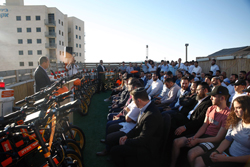
On Wednesday evening as the sun was setting over Jerusalem, United Hatzalah of Israel inaugurated 30 new emergency electric bicycles. The inauguration took place in the presence of the guests of Honor Jerusalem Mayor Nir Barkat and Minister of the Environment and Jerusalem Affairs and Heritage MK Ze’ev Elkin.
The rescue bicycles are outfitted with a box on the back that carries all of the medical supplies that are found on an ambulance with the exception of a stretcher or bed as well as lights and sirens. This equipment enables first response volunteers to ride these rescue bicycles through the crowded streets and narrow alleyways of Jerusalem in both the new and old city and to arrive and begin treatment as quickly as possible at the scene of a medical emergency.
Eli Pollack, vice president of United Hatzalah, said: “The majority of the bicycles that are being inaugurated this evening will serve our volunteers across Jerusalem and I am certain that they will assist in saving lives. They will be utilized by our EMTs, paramedics and doctors who live in congested areas with narrow streets and alleyways. In many of these places, even an ambucycle isn’t practical. We, therefore, are bringing a new lifesaving vehicle to the streets to provide a faster response in these areas.”
Jerusalem Mayor Nir Barkat, said, “By utilizing a simple idea, you have succeeded at beating everyone to an emergency to provide first aid and medical treatment. For years you have been doing this with the help of motorcycles and now you are including electric bicycles to your fleet. On behalf of the thousands of residents of Jerusalem, I want to thank you for the initiative and for saving lives.”
Minister of the Environment and of Jerusalem Affairs and Heritage Ze’ev Elkin commented, “This capacity, to continually think outside of the box, is something that it is impossible to not admire.”
*
Magen David Adom’s female motorcyclists share their stories
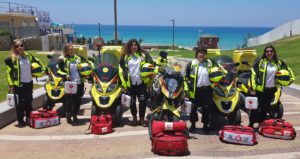
Five female first responders of Magen David Adom’s motorcycle corps, who recently got together for a photo shoot, shared some of their thoughts and experiences.
Sharon Green, 47, a mother of three who resides in Hofit, is a volunteer emergency medicine technician riding an MDA emergency motorbike and an ambulance driver at MDA’s Sharon region. “I remember well the first call to which I was dispatched as an emergency motorcyclist. That event involved two persons who drowned in the sea, near the Beit Yanai Beach. I arrived there at record time, to help them, managed to provide a lifesaving treatment and both of them were saved,” said Sharon in excitement. “Another event that I will not forget was when I rode the bike to treat a two-year old girl, who choked on a foreign object. I was able to extract the foreign object from her trachea and the girl started breathing again.”
Louise Rabinovitch, 51, says she started volunteering at MDA following a serious traffic accident she witnessed about 13 years ago. “I was present there, but did not know what to do. I was not able to help. I promised myself that it would never happen again.” Today, she is the only woman among the motorcyclists in Ashdod, who arrives on event scenes riding her MDA motorcycle.
Asala Abbud, 25, from Gush Halav, said, “As an architect by profession and MDA volunteer, I travel around in the north region and I am confident that the motorcycle will allow me to reach the patients and wounded quickly and give them initial response in order to save their lives. ”
Stephanie Glick, 50, a resident of Kfar Tavor, is a lecturer in the field of educational technology at Shanan College. “It gives me immense satisfaction to help sick and injured people in their difficult moments, knowing I have a vehicle that allows me to arrive quickly on event scenes and save lives.”
Orit Gorgov, 32, is a volunteer in Hayarkon Region. SAs an ambulance driver, Orit can explains the huge difference between the two vehicles. “The bike gives me the ability to arrive quicker and work more effectively, particularly in complicated road scenes, where it is necessary to bypass a large traffic jams”, she says.
*
Preceding articles culled from news releases sent to editor@sdjewishworld.com