This year’s fellows will research diverse topics at the Center for Jewish History
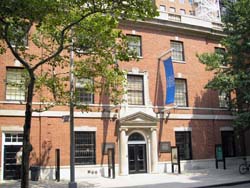
The Center for Jewish History has welcomed a new cohort of fellows to spend the 2018-2019 academic year engaged in research. They will be working with the Center’s Partners’ archives on their original projects. Varying in their disciplinary and chronological scope, the fellows’ scholarship weaves a fascinating and complex picture of the field of Jewish studies today.
Each year the Center for Jewish History hosts a cohort of scholars as well as a distinguished senior scholar. This year Prof. Anita Norich, Tikva Frymer-Kensky Collegiate Professor at the University of Michigan, is the National Endowment for Humanities Senior Scholar. Norich will use her time at the Center to conduct original research on women who wrote Yiddish prose fiction in the middle of the 20th century. She is one of the most accomplished scholars of Yiddish literature; a prolific author and translator, she recently published Writing in Tongues: Translating Yiddish in the 20th Century. Her next book will be coming out in 2019.
Joining Prof. Norich will be doctoral students pursuing diverse research in Jewish studies.
Netta Cohen, from the University of Oxford, will study “When Climate Takes Command: Jewish-Zionist Scientific Approaches to Climate in Palestine, 1900-1967.” Cohen asks about the role of climate and environment — both abstract concepts and concrete conditions — in shaping and reshaping Jewish identity. Cohen analyzes scientific Zionist discourse about the climate, presenting its three aspects: the architectural, medical, and agricultural.
Brett Levi, from New York University, will study “Expanding the Borders of Holiness: The History of the Postwar Haredi Landscape.” The study focuses on the history of Orthodox/Haredi relationships to territory and space in Israel, North America, and Western Europe since World War II. How did Orthodox and Haredi communities reconstitute themselves with respect to postwar geopolitical realities and wider Jewish migration and settlement trends, and how did they engage spatially with their new places of habitation?
Geoffrey Levin, of New York University, will focus on “Another Nation: Israel, American Jews, and Palestinian Rights, 1949-1977”
Levin’s project traces the emergence of Palestinian rights as an issue in American Jewish politics and relations with Israel. He makes two arguments in his research: that changing domestic inter-communal relationships impacted American Jewry’s engagement with questions surrounding Palestinian rights, and that Israelis and Arabs played a much more active role in shaping such engagement than has ever been realized.
Anastasiia Strakhova, of Emory University, has chosen as her subject “Imagining Emigration: Crossing the Borders of Russian Jewry during the Era of Mass Migration, 1881-1917.” In her research, Strakhova compares the bureaucratic regulations of Tsarist Russia, the press discourse about mass emigration, and the personal accounts of the emigrés, to capture the development of the Russian Jewish diaspora in the era of mass migration.
Joël Sebban, of Sorbonne University, has chosen as his topic, “The Invention of the ‘Judeo-Christian Tradition:’ the Nation-State, the Synagogue and the Christian Churches in France, from Napoleon to the Vichy Regime, 1806-1940.”
Sebban is the inaugural CJH-Fordham University fellow in Jewish-Christian relations, tracing the much unexplored process of the invention of the notion of “Judeo-Christian tradition,” and illuminating its position in the creation of modern nation-states. He focuses on France and the US in the 19th and 20th centuries. – From the Center for Jewish History
*
Smart phone networks may sense, then warn about changing weather conditions
 Flash floods occur with little warning. Earlier this year, a flash flood that struck Ellicott City, Maryland, demolished the main street, swept away parked cars, pummeled buildings and left one man dead.
A recent Tel Aviv University study suggests that weather patterns that lead to flash floods may one day be tracked and anticipated by our smartphones.
“The sensors in our smartphones are constantly monitoring our environment, including gravity, the earth’s magnetic field, atmospheric pressure, light levels, humidity, temperatures, sound levels and more,” said Prof. Colin Price of TAU’s Porter School of the Environment and Earth Sciences, who led the research. “Vital atmospheric data exists today on some 3 to 4 billion smartphones worldwide. This data can improve our ability to accurately forecast the weather and other natural disasters that are taking so many lives every year.”
Prof. Price collaborated with TAU master’s student Ron Maor and TAU doctoral student Hofit Shachaf for the study, which was published in the Journal of Atmospheric and Solar-Terrestrial Physics.
Smartphones measure raw data, such as atmospheric pressure, temperatures and humidity, to assess atmospheric conditions. To understand how the smartphone sensors work, the researchers placed four smartphones around TAU’s expansive campus under controlled conditions and analyzed the data to detect phenomena such as “atmospheric tides,” which are similar to ocean tides. They also analyzed data from a UK-based app called WeatherSignal.
“By 2020, there will be more than six billion smartphones in the world,” Prof. Price said. “Compare this with the paltry 10,000 official weather stations that exist today. The amount of information we could be using to predict weather patterns, especially those that offer little to no warning, is staggering.
“In Africa, for example, there are millions of phones but only very basic meteorological infrastructures. Analyzing data from or 10 phones may be of little use, but analyzing data on millions of phones would be a game changer. Smartphones are getting cheaper, with better quality and more availability to people around the world.”
The same smartphones may be used to provide real-time weather alerts through a feedback loop, Prof. Price said. The public can provide atmospheric data to the “cloud” via a smartphone application. This data would then be processed into real-time forecasts and returned to the users with a forecast or a warning to those in danger zones.
The study may lead to better monitoring and predictions of hard-to-predict flash floods. “We’re observing a global increase in intense rainfall events and downpours, and some of these cause flash floods,” Prof. Price said. “The frequency of these intense floods is increasing. We can’t prevent these storms from happening, but soon we may be able to use the public’s smartphone data to generate better forecasts and give these forecasts back to the public in real time via their phones.”