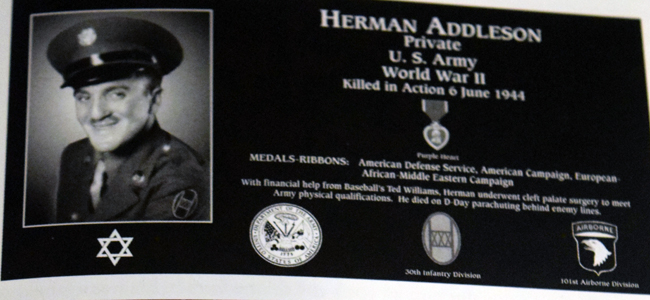
SAN DIEGO — With the approach of Memorial Day, I’d like to salute the memory of Private Herman Addleson, whose story I first wrote in Waxie: An American Family Business Success Story, a book that was published in 2016.
After the Japanese bombed Pearl Harbor on Dec. 7, 1941, Herman was anxious to join the U.S. Army but his cleft lip initially made him ineligible. Recruiters said if he had the lip repaired, he could be accepted into the army. However, the cost of the surgery was out of the family’s range, until a former San Diegan, Boston Red Sox slugger Ted Williams, heard of the predicament of his former schoolmate and fellow baseball lover. (Herman had sold peanuts at the Pacific Coast League San Diego Padres games.) Williams graciously helped pay the cost of Herman’s successful surgery.
Herman told some of his war-time story in letters to Dr. Lauren C. Post, a geography professor at San Diego State College (later University), who published a newsletter for and about SDSU alumni serving in the Armed Forces.
On November 5, 1942, Herman wrote in a note from Camp Blanding, Florida, that some of his classmates already had achieved officer rank, and added: “I feel funny in writing and not being in the same class as they. Yet even as a ‘buck private’ (with hopes of officer training), I feel that I am proud to serve my country, no matter how small or how large my rank may be.”
On September 18, 1943, while assigned to Camp Forrest, Tennessee, he told of his regimen training to become a paratrooper. “We run or shall I say ‘doubletime’ 6 mi, then do exercise, push-ups, knee bend, etc., for 2 hrs, then take up other phases of parachute training. It [is] great and I like it, in five weeks I’ll be jumping from 1200 ft.”
He described that first jump in an evocative letter November 17, 1943, from Fort Benning, Georgia.
“My first jump was Monday, Oct. 18, 1943, a day I’ll never forget as long as I live. We were all up at 5:45 a.m. that morning, many of us had a very restless night. Our thoughts ran in common, I guess, for our past seemed to flash through all of our minds. It was cold and foggy that day and as we marched over to the field, we were all trying to sing. Yes, sing, even if our voices did crack a little. Everyone was excited, nervous and mostly scared. As we took our parachutes out of the bins, I looked at mine and I guess I sa[id] a pray[er]. ‘Please dear chute open for me.’ As we lined up, 24 men in front of the plane, my knees felt like water. Before we got into the plane we were checked five times to make sure we had everything ok. As we step[ped] in the plane and sat down, buckled ourselves to the seats, everyone was joking and trying to sing. Before we knew it the plane went down the runway and we were looking at the ground disappear beneath our feet. There’s a fellow called the ‘jump master’ who gives the orders. When we were at 200 ft., everyone trying to cheer-up everyone else, the jump master’s voice sounded like some immortal soul. ‘Get ready,’ he hollered. At this point every man turned white, or all colors. Yes, the big one, tough ones, officers and soldiers, were scared. A pin could be heard, that’s how still it became. Only the roar of the motors. The next command came very fast. ‘Stand up.’ Every one of us managed to stand and grab the cable above our head. ‘Hook up,’ ‘Check equipment,’ Sound off’ were all done automatic[ally]. Then ‘Stand in the door;’ everyone fixes his eyes on the door. The jump master taps the first man and hollers ‘Go!’ Out we go, and when you leave the door the prop-blast takes you away. You drop 75 ft to 100 ft. before your chute opens. In that time, you don’t know you [are] falling. Then you hear a crack of a whip sound, and you look up and there is the most beautiful sight in the world. The canopy is open and all is fine. Your descent is about 14-20 ft. per second so you are down before you know it. After you [are] on the ground, the tension over, you holler with joy and slap each other on the back. Each jump after that is the same, only with more tensifying [sic] fear as you know what is coming. Yet it is as safe as driving a car or anything else that has the word safe with it. Don’t forget, it’s right here, where the boys are separated from the men. I am now going to school, specialist school to become a rigger.”
On February 10, 1944, he wrote from sea: “Yes sir! We are now on the boat, destination unknow[n]. You’ve heard how tough the paratroopers are. How rugged in physical endeavor, but what you don’t know is how these same men felt as we boarded the ship and left the soil of U.S.A. From the ‘Staten Island Fairy [sic] to the boat was something to witness. First we joked and kidded as we passed familiar signs along the harbor like, ‘Maxwell House Coffee,’ ‘Bethlehem Steel,’ ‘Colgate Soap and Perfume’ and then that thing that stopped the crowd, the ‘Statue of Liberty.’ Tough guys had tears in there [sic] eyes, many stood gazing open mouth, many a heart was in one’s mouth, with a feeling of emptiness in the pit of the stomach. The Statue of Liberty was beautiful and as she disappeared Long Island came in view, then Brooklyn and what memories and laughs we all had. Then as some giant hand [was] pushing us way out, land seemed far off, New York skyline seem[ed] to diminish. When that disappeared and a [sic] possibilities of seeing land of U.S.A., was gone, we just leaned back and silence was a bliss as we all thought of what we left behind and what we are fighting for … This boat is so compacted, a sardine has more room than we do.”
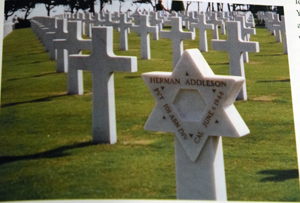
On May 1, 1944, a little more than a month before D-Day, he wrote what would be the final letter in the collection. ‘Seems like a lot of Aztecs [San Diego State’s nickname] are over here, yet I haven’t been able to get around to locate any, except Tom Rice and Guy Sessions, buddy paratroopers. We are going to give those Nazi[s] hell on ‘D Day, so you can see old Aztec is well represented in the [101st] Airborne outfit … If I get back alive, tell ‘Cotton’ to move over with the snow jobs. I’ll really have the latest stuff.”
Herman did not “get back alive.” He drowned after landing in a flooded field during the D-Day invasion of Normandy, France. He was awarded a Purple Heart posthumously.
In taking note of his death, San Diego State University’s Daily Aztec wrote: “Pvt. Herman Addleson was killed in Normandy on D-Day when he landed with the first paratroops. The official notification came to his parents following the official message saying he was missing. Unfortunately, a fellow Aztec had report Pvt. Addleson as being in France with him, but he seems to have been in error.”
*
Herman Addleson was the brother of Ida Addleson, whose husband Harry Wax founded Waxie. Harry and his younger brother Morris Wax, built Waxie into a major janitorial supply house. Under the leadership of Morris’s sons, Charles and David Wax, San Diego-based Waxie grew into the nation’s largest privately owned janitorial supply company with operations in nine western states. During World War II, Harry had served in the Seabees as a Petty Officer First Class, and Morris had served as a Major in the U.S. Army Tank Corps commanded by Gen. George Patton.
*
Donald H. Harrison is editor of San Diego Jewish World. He may be contacted via donald.harrison@sdjewishworld.com