Adieu: A Memoir of Holocaust Survival by Alfred J. Lakritz; Calabasas, California: Belmonte Press; (c) 2024; ISBN 9798989-685103; 237 pages including acknowledgments; $20

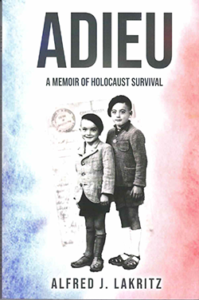 SAN DIEGO — Holocaust survivor Alfred J. Lakritz settled in Oakland, California with his mother Marjum and younger brother Herbert thanks to Alfred’s maternal great-uncle Max Fass, who had preceded the family to America and agreed to sponsor them.
With Alfred’s father, Simche, the family had lived in Kiel, Germany, but after the Nazis began their state-sanctioned war on the Jews, they fled to Antwerp, Belgium, and then on to Vichy France. In 1942, when Alfred was 8 and Herbert was 5, their parents arranged for the boys to be sent to a summer camp operated by a Jewish rescue organization. Much to the boys’ distress, their safety-minded parents had them stay much longer than the summer. While they were gone, their father, who had been helping the French Resistance, was arrested by the Vichy government.
He was sent north to the transit camp at Drancy, outside of Paris, and from there to Auschwitz and later to his death at Majdanek. Simche had a foreboding of his fate, sending from Drancy a Nazi-supplied postcard which he ended with the misspelled word “adjeu,” instead of “adieu,” which is a more final way of saying goodbye than au revoir.
The boys did not learn of their father’s death until after the Germans were driven out of France and they were reunited with their mother and resumed schooling in Marmande, France. Much later in his life, Alfred ferreted out details of a mass machine-gunning at Majdanek in which his father perished.
The administrators of the children’s summer camp had stayed one step ahead of the Nazis, transferring Alfred and Herbert to a succession of temporary refuges, including a convent in Lourdes, a city where Catholics believe the Virgin Mary miraculously appeared. Their mentors taught the boys to pretend to be Catholics, substituting the surname LaCroix for Lakritz.
Their approval to immigrate to the United States came in 1950, five years after World War II ended. Alfred became a high school student in Oakland, California. After losing his French accent, he went on to graduate from UC Berkeley and its Law School. He and his wife, Judy, had two children, and those children went on to provide them a total of four grandchildren.
The memoir, which is his first book, involved painstaking research.
I admired it for two reasons. First, Lakritz carefully identified what he remembered personally, and what he thought he remembered, what he surmised, what other people told him, and what he found in history books and documents. I have read other Holocaust memoirs in which these different kinds of sources were conflated.
Second, his account included some candid facts about his family. Although he was sure his father loved him, he remembered his father becoming very impatient with him during his boyhood – which he attributed to the stress of the times. He believed his mother made a mistake remarrying after they settled in the United States. Worse, she stayed with her second husband even though he knew she was unhappy with him. And he was self-critical as well. A member of a French Christian family that had helped save the Lakritz family wanted his two boys to be able to stay with the Lakritz family in California while they were learning English. Alfred, with regret, told him his house could barely contain his own two children and declined to take the French boys in. His French friend never spoke to him again, probably figuring that as his family members had risked their lives to save his family, accommodating the boys—even if it meant overcrowding – was the least the Lakritz family could do.
The memoir is clearly written, which makes for fast reading.
*
Donald H. Harrison is publisher and editor of San Diego Jewish World.