By Shor M. Masori in San Diego

Leonard Maltin was 14 years old when he opened the Manhattan telephone directory and searched for Reuben “Rube” Goldberg.
Maltin had read the Jewish cartoonist’s How to Remove the Cotton from a Bottle of Aspirin and Other Problems Solved and wanted to interview him for his fanzine. Goldberg’s telephone number was listed, so Maltin called. Goldberg invited him to his studio.
The teenager who had the nerve to telephone a famous cartoonist became a “pile of jelly” when he met him.
The encounter crossed a fourth wall that existed outside any theater or television studio. On one side were the people who made the work. On the other were the young fans hoping to learn how it was done. Back then Maltin could cross it with a telephone call.
That access would be dangerous today. A public home address can lead to doxxing, swatting and harassment. Artists must guard boundaries that Goldberg’s generation rarely considered. The need to pass the craft forward remains, but the door now opens through different means.
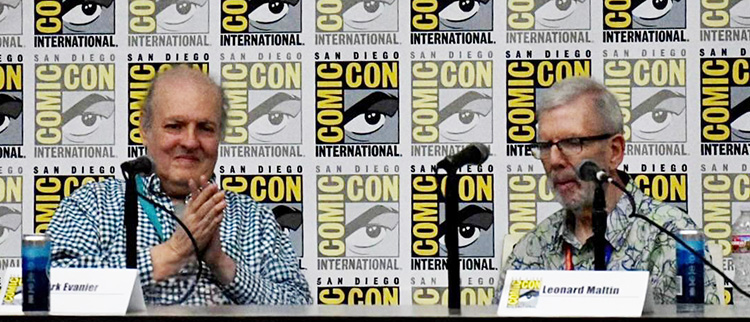
Maltin told the Goldberg story at Comic-Con during “Great Cartoonists and Comedians We Have Known,” a conversation with comic-book and animation writer Mark Evanier. Maltin began publishing Film Fan Monthly at 15 and built a career as a film critic and historian. He spent 30 years on Entertainment Tonight and wrote books including Of Mice and Magic: A History of American Animated Cartoons. His collection of original cartoon art grew from the interviews and friendships that began when he was a teenager.
Mark Evanier also entered the industry through a creator willing to help. Jack Kirby liked something the teenage Evanier had written, recommended him for a job on the day they met and later hired him. Evanier went on to write comics, animation, and television while becoming one of Kirby’s principal biographers.
Maltin and Evanier, both Jewish, reminisced about artists who shared their time and work.
Charles Schulz once opened a drawer and gave Maltin an original Sunday Peanuts strip. Maltin recognized it immediately. Schulz had forgotten to draw the black zigzag across Charlie Brown’s shirt.
Schulz offered to add the missing line. Maltin refused. The mistake made the strip worth more.
Jules Feiffer advised Maltin to become a fuller, worldly person because doing so would make him a better artist. The work could not grow unless the person making it continued to.
Like Goldberg, Jack and Roz Kirby extended that openness into their home. They kept their address in the telephone directory, allowing fans to find them and arrive without invitations. The Kirbys often let them inside.
Their guests included comic-book artists, actors and readers who wanted to meet the man who helped create Captain America, the Fantastic Four, Thor, and Black Panther. Lou Ferrigno visited. Mark Hamill brought his children. Jim Steranko drew rockets for the Kirby grandchildren while Roz made grilled-cheese sandwiches.
At Comic-Con’s Year of Jack Kirby panel, writer Mark Waid told Kirby’s grandchildren that the open-door policy stunned him. He loved the people in the audience, he assured them, but none of them were invited to his house.
The old model could not survive unchanged. Comics and animation became established industries with agents, contracts and specialized training. Access became easier to sell, creating a market for classes and coaches promising shortcuts.
Evanier addressed that phenomenon while moderating “Business of Cartoon Voices.” Voice actors Debi Derryberry and Gregg Berger joined talent agent Melissa Berger Brennan to explain what the profession requires and how aspiring actors can avoid costly scams.
Evanier credited Daws Butler, Mel Blanc and June Foray with digging the first trenches of cartoon voice acting before the profession had a defined path.
Blanc, born Melvin Blank, became known as the “Man of a Thousand Voices.” He performed Bugs Bunny, Daffy Duck, Porky Pig and many other Warner Bros. characters. Foray, born June Lucille Forer, voiced Rocky the Flying Squirrel, Natasha Fatale and Granny. These two Jewish performers helped establish the sound of American animation.
Their example also included making room for the next person.
Evanier recalled Blanc walking into a room filled with established performers and introducing a young Gregg Berger. Blanc told the group, “He is one of the new kids, but I think he’s going to be around for quite a while.” The endorsement gave Berger standing in a room where he was still trying to establish himself.
The Comic-Con panel now performs a related function in public. Working actors and agents explain the business without charging admission beyond the cost of the convention badge. Evanier has said that at least two aspiring actors who once attended his panels later returned as instructors. Careers launched from the audience are rare, but they do occur.
The fourth wall moved again as comic-book fandom entered mainstream television. The fans behind the counter became the heroes of the story.
Stuart Fails to Save the Universe, the newest spinoff from The Big Bang Theory, follows comic-book store owner Stuart Bloom (Kevin Sussman) after he breaks a device built by Sheldon and Leonard and triggers a multiverse Armageddon. Stuart must repair reality with his ex-girlfriend Denise, geologist Bert Kibbler and physicist Barry Kripke.
The 10-episode HBO Max series was created by Chuck Lorre, Zak Penn, and Bill Prady and premiered July 23.
Lorre, the Jewish producer who co-created The Big Bang Theory, wanted to send those characters into an adventure filled with action, visual effects and alternate realities. His goal: to create the kind of show that Sheldon, Leonard and their friends would watch and argue about.
The production also opened its doors to artists from the world it was portraying. DC president and comic-book artist Jim Lee appeared as a surprise guest at the Comic-Con panel. The series uses DC characters, including Mr. Freeze, and Lee contributed custom art and comic-book covers.
Lee described the show as nerds going through Gulliver’s Travels. Stuart and his friends move through worlds governed by the rules they once debated from behind the counter. Lee said the series had created some of his favorite versions of DC characters.
Jewish humor of course still exists within the new universe. One joke concerns cannibals who eat a Jewish man and then complain that the meat was not kosher.
The creative world Maltin entered through a telephone book is now protected by locked sets, nondisclosure agreements and corporate security. It is also filled with people who were once fans, store clerks and teenagers trying to get their first job.
Goldberg answered Maltin’s call. Kirby recommended Evanier. Blanc vouched for Berger. Evanier’s panel tells aspiring actors what the business will demand from them. Lee and Elfman brought their own crafts into Lorre’s new universe.
The telephone directory is gone, and the home address should remain private. However, the fourth wall still opens when someone on the other side decides to let another person through.
*
Shor M. Masori is a freelance writer based in San Diego.
Pingback: Comic-Con weighs this era’s impact on fiction writers – San Diego Jewish World