The Elephant and the Purim Crown by Haviva Kierzenblat with illustrations by Rebeca Luciani; Minneapolis, Minnesota: Kar-Ben Publishing; (c) 2025; ISBN 9798765-619896; 32 pages including glossary and author’s note. Publication date: January 7, 2025. Purim 2025 arrives evening of March 13.
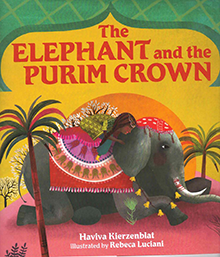
 SAN DIEGO — Rachel was a child in the small Jewish community in Burma, today called Myanmar. She lived in the city of Rangoon, today called Yangon. She happily rode on the back of an elephant, until she looked down, and saw that the elephant’s feet were cracked and bruised. Dismounting so that she did not cause further harm to the elephant, she fed the appreciative animal a mango, then departed to attend the Purim feast, at which she won a beautiful golden Purim crown studded with rubies.
Rachel returned to the elephant’s owner and offered to trade the crown for the elephant. The owner, impressed by the girl’s kindness, said it was time for the elephant to retire and presented the animal to Rachel. The girl named the elephant “Esther” after the heroine of the Purim story and arranged for her to live in a wildlife sanctuary.
The story, intended for children between the ages of 4 and 9, teaches several lessons. Author Kierzenblat’s main message reinforces the ethical concept of being kind to animals.
Another is the fact that Jews lived throughout the Diaspora, incorporating into their daily lives the customs of the people around them. Rachel wears a longyi (a skirt made from a single piece of cloth with its edges sewn together); travels in a rickshaw (a human-pulled seat for traveling), and eats curries, puris (a puffy dough appetizer), and agar-agar (a dessert made from coconut milk, sugar and seaweed).
A third lesson, as shown in Luciani’s marvelous illustrations, reflects the fact that Jews come in many different skin colors — in the case of Rachel, dark brown.
This is an engaging tale that children fascinated by animals will want to read over and over.
*
Donald H. Harrison is publisher and editor of San Diego Jewish World.