By Cailin Acosta
SAN DIEGO – The San Diego Public Library’s Central Branch held its opening reception Saturday, June 21, for the “In the Land of Milk and Honey” exhibit by the Feminist Image Group (FIG).
These artists confront the forces of cultural repression and celebrate the freedom to think, create, and speak without fear. This exhibition includes the artists’ interpretations of the realities of censorship. The visual narrative reclaims the power of free expression through art.
The goal of this exhibition is to stand for creative freedom, the right to read, and the power of art to challenge and inspire. Being a feminist bothered by the repression felt in the workplace, in society, and from the current presidential administration, this exhibit spoke to me. For those of us who are tired of attending rallies and losing our voices screaming to be heard, creating art is a reminder that we will be seen and we will be heard.
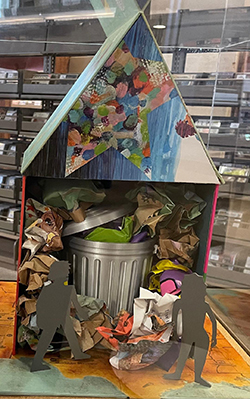
These include Draw Me a Star by Eric Carle; The Family Book by Todd Parr; Julian is a Mermaid by Jessica Love; Tango Makes Three written by Justin Richardson and Peter Parnell, illustrated by Henry Cole; and When Aiden Became a Brother written by Kyle Lukoff, illustrated by Kaylani Juanita.
All these books were written for children ages 3-7 years old and present contemporary families and identities with honesty, warmth, and care – qualities that, alarmingly, have been politicized. Newbry’s sculpture is a response to this climate, emphasizing that shielding young readers from the diverse realities of the world does more harm than good. Acceptance, empathy, and representation are not radical ideas – they are the foundation of a healthy and inclusive society.
Newbry integrated a QR code that visitors can scan to hear a voice softly “shushing” and urging them to “be quiet.” This act becomes a metaphor for censorship – symbolizing how these authors are being silenced, their stories unheard in places where their books are banned.
Draw Me a Star by Eric Carle was banned for the Star asking the artist to draw a man and a woman. The artist drew a nude man and nude woman which was assumed to be Adam and Eve. Carle was born to German immigrant parents in New York. When Carle was six, his family returned to Germany, and he lived through World War II. Carle’s experiences during this time, particularly in Nazi Germany, had a profound impact on his life and work. Carle has said his reflections on his childhood were of deep sadness and a desire to create art that would comfort children. Carle never revealed that he was Jewish, although there were many connections to Jewish culture. He celebrated Jewish holidays, and his work has been interpreted to contain universal lessons that resonate with Jewish values.
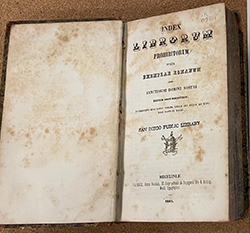
The San Diego Public Library had a copy of the Roman Index of Forbidden Books that was printed in 1843. The index Librorum Prohibitorum was a changing list of publications deemed heretical or contrary to morality. Roman Catholics were forbidden to print or read them, subject to the local bishop. Catholic states could enact laws to adapt or adopt the list and enforce it.
The index was active from 1560 to 1966. It banned thousands of book titles and blacklisted publications, including the works of Europe’s intellectual elites. The index condemned religious and secular texts that were deemed to be repugnant, potentially misleading, and heretical to the Sacred Congregation. The list aimed to protect church members from reading theologically, culturally, or politically disruptive books. Noteworthy Jewish theological works in the index included those of Baruch Spinoza.
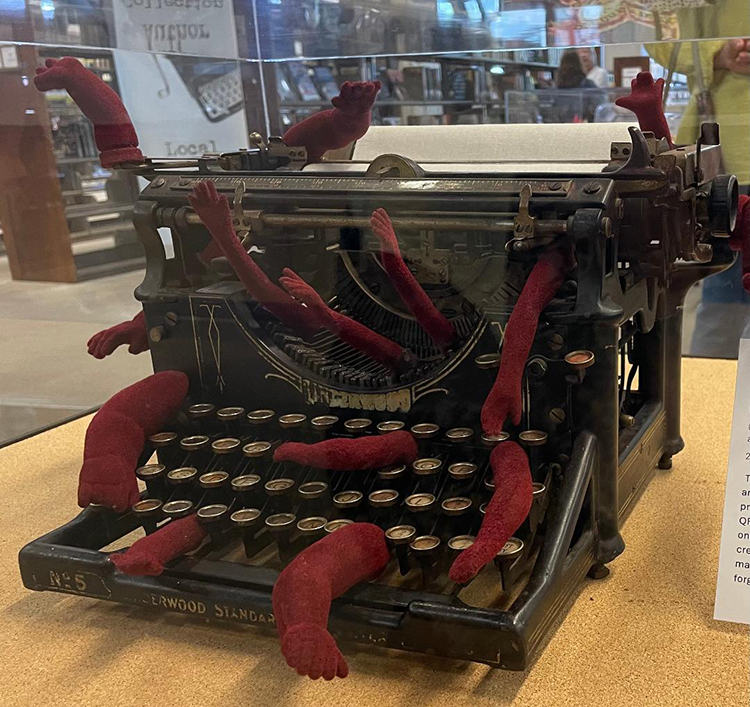
Marty Ornish’s piece Censor, Repeat, Forget (seen in photo above this article) featured an Underwood typewriter, doll arms, rayon flocking, and linen fabric. The assemblage resurrects an Underwood typewriter as a haunted archive of silenced voices. The red velvet arms writhe from the keys – half protest, half exorcism – reaching for words now blacklisted or burned.
A QR code lets the viewer hear the mechanical clatter of free expression, once taken for granted, now back on trial. Ornish states her piece echoes McCarthyism that creeps forward in new packaging, dressed in parental outrage and manufactured fear. She states this piece is to remember what we are being told to forget.
This exhibition will be at the San Diego Public Library – Central Branch until Sunday, October 12. Click here for more information on the Feminist Image Group (FIG).
*
Cailin Acosta is the assistant editor of the San Diego Jewish World.
I forgot to mention the library will be having a statue unveiling in October in honor of Banned Books Week. It is a monument by Cindy Zimmerman featuring words that have disappeared from the internet during the first two months of the Trump administration.
Interesting article and I love the piece by Marty Ornish.