By Alex Gordon
HAIFA, Israel — Why do rich people become revolutionaries who want to destroy the system that makes them rich? They are disgusted by social injustice. They find it hard to imagine that the new system they seek to build on the ruins of the old one might be even more unjust than the system they are rebelling against. They do not realize that revolution brings violence incompatible with social justice.
In the wealthy Jew of the early twentieth century, to the desire to establish justice in society is added the desire to neutralize the “injustice” arising from his innate “defect” of being Jewish. The Jewish American historian Seymour Martin Lipset wrote: “Participation in the socialist and communist movements meant for many Jews a way to escape Jewishness and assimilate into a universal, non-Jewish world.” These revolutionaries refused to solve the Jewish problem by Jewish means and blew up old, relatively prosperous societies, thereby harming Jewry as well.
The hero of this essay was a millionaire’s son who refused to give up his wealth, a doctor who undertook to cure a sick social system and contributed greatly to the creation of an even sicker system, a cold-blooded diplomat who seemed the epitome of poise and self-confidence and a severe neurotic.
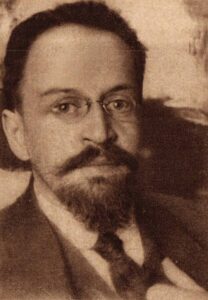
Adolf Joffe (alternatively spelled Yoffe and Ioffe) was born on October 10, 1883 in the Crimean capital Simferopol, in the family of the merchant of the 1st guild Abram Joffe, a millionaire who owned the post office and transport of the Crimea and was the owner of a large amount of real estate in the Russian Empire, including a house in Moscow. He held the title of hereditary honorary citizen and had good relations with the chairman of the Council of Ministers of tsarist Russia, Count Sergei Witte.
Abram Joffe belonged to the top of the local Jewish community, was the head of the Simferopol Choral Synagogue, was a trustee of the Simferopol Jewish school and deputy chairman of the board of the society for the poor Jews of Simferopol. Despite the fact that Adolf’s childhood was spent in the family of a wealthy religious Jew, he met revolutionary-minded students in high school, became interested in illegal Marxist literature and at the age of 19 became a member of the Russian Social Democratic Party.
Young Joffe took an active part in the 1905 revolution in the Crimea and Odessa. On August 13, 1905, he helped Menshevik Konstantin Feldman, one of the participants in the revolt on the battleship Potemkin, to escape from Sevastopol military prison. For this activity, Joffe was sentenced to exile in Siberia. In 1906, he managed to escape to Switzerland.
Adolf Joffe studied at the universities of Zurich, Berlin and Vienna. He graduated from the Faculty of Medicine of the University of Vienna in 1908. Because of his nervous illness, he was interested in psychology and was treated by Freud’s disciple, Alfred Adler, who created a school of individual psychology. Leon Trotsky, whom he met in Vienna, recalled, “Despite his extremely imposing appearance, too imposing for his young age, extreme calmness of tone, patient gentleness in conversation and exceptional politeness – traits of inner poise, Ioffe was in fact neurotic from a young age.”
In 1912, Joffe returned to Russia, was arrested in Odessa, and in 1913 was sentenced to life exile in Siberia. The February Revolution of 1917 freed him. During his exile in Siberia, Joffe returned to the medical profession and published an article in the journal Psychotherapy in 1913. At various times he held influential positions in the state apparatus that allowed him to promote and spread interest in psychoanalysis in post-revolutionary Soviet Russia.
While living in Vienna, Joffe took part in the publication of the Social Democratic newspaper Pravda, along with leading revolutionaries, the Jews Alexander Parvus and Trotsky. Adolf experienced the February Revolution in exile in Siberia. Although Joffe was a Menshevik, in Russia, during the revolution, he collaborated with the Bolsheviks and promoted the ideas of the socialist “permanent revolution,” which occurs as a result of a chain reaction worldwide. The idea of the permanent revolution was developed by Parvus and Trotsky as a justification for the October Revolution, so far, the only revolution that encouraged the Bolsheviks in 1917.
In August 1917, Joffe was elected to the Petrograd Duma (parliament), in which he led the Bolshevik faction. Trotsky recalled: “It was a surprise to me, but in the chaos of events I hardly had time to rejoice at the growth of my Viennese friend and pupil. When I had already become chairman of the Petrograd Soviet, Joffe appeared one day in Smolny [palace] to report from the Bolshevik faction of the Duma. I must confess that I was worried about him from old memory. But he began his speech in such a calm and confident tone that all apprehensions were at once put to rest. The many-headed audience in the White Hall in Smolny [palace] saw on the rostrum an imposing figure of a brunet with an oaky beard and sagebrush, and this figure must have seemed the embodiment of positivity, poise, and self-confidence.”
After seizing power, the Soviet government issued the Decree on Peace, concluded an armistice at the front and in December 1917 began negotiations with Germany and its allies. Joffe was appointed Chairman of the Russian delegation and traveled to Brest for the negotiations. On March 3, 1918, the Brest Peace Treaty was signed, obliging Russia to pay Germany a six-billion-mark contribution.
In April 1918, the Council of People’s Commissars sent Joffe to Berlin as Russian ambassador. He had a dual task: to consolidate the agreements with Germany and to promote the rapid advance of the German Revolution. Joffe established an extensive propaganda network operating in Germany and in other countries of central and northern Europe. This network carried out revolutionary propaganda and inspired the cadres of the future German Revolution. As a result, he was expelled from Germany.
In the fall of 1919, during the counter-revolutionary Nikolai Yudenich’s attack on Petrograd, Joffe worked there as a member of the Defense Council. After the victory over Yudenich in February 1920, Joffe concluded a peace treaty with Estonia. After the Soviet-Polish War, Joffe concluded and signed a peace treaty with Poland in March 1921.
In March 1922, Joffe took part in the XI Congress of the Bolshevik Party, after which he was sent to Europe on an important diplomatic mission. The hostilely arrogant attitude of the victors to Germany pushed the latter to rapprochement with Soviet Russia, and the Treaty of Rapallo between Russia and Germany was signed on April 16, 1922.
In August 1922 Joffe was sent to China and Japan on a diplomatic mission. While in Japan, he contracted tropical malaria, after which his legs gave out, and he also suffered two heart attacks. He returned from Europe in May 1925 severely weakened and had to undergo constant medical treatment. Because of his friendship with Trotsky, Joffe was removed from the People’s Commissariat of Foreign Affairs and appointed Trotsky’s deputy in the Main Concession Committee. In addition, Joffe lectured at Moscow University in the Department of International Relations.
Joffe was one of Trotsky’s closest friends and associates, who recalled that in 1925 Joffe told him: “You do not realize the degeneration which the party has undergone. The overwhelming majority of it at any rate the decisive majority are officials; they are much more interested in appointments, promotions, favors, privileges than in questions of socialist theory or in the events of the international revolution.”
In October 1927, Trotsky and Grigory Zinoviev were expelled from the Central Committee of the Bolshevik Party. Members of the “united opposition,” Trotsky and Zinoviev, despite the threat of expulsion from the Bolshevik Party, continued to oppose Stalin’s regime, tried to appeal to the party and working masses, and spoke at various rallies. On November 7, 1927, the day of the celebration of the tenth anniversary of the October Revolution, small opposition marches were held in Moscow under the slogans: “Let us fulfill Lenin’s will!” and “Long live the leaders of the world revolution, Zinoviev and Trotsky!” A week later, the Central Committee of expelled Trotsky and Zinoviev from the Bolshevik Party.
Joffe’s second wife Maria recalled: “He was undoubtedly one of the first to sense, even in the 1920s, where the party and the country were going, and what role Stalin would play. This premonition of impending tragedy, the shock of Trotsky’s expulsion from the party against the background of a severe, incurable disease, when he himself was powerless to do anything, of course, brought the hour of his suicide closer. […] Apparently, in suicide Joffe saw an effective and the only form of protest available to him, seriously ill.” Adolf Joffe committed suicide on November 17, 1927. At a funeral rally on November 19, Trotsky said: “Imitate him in life, not in death! Live as he lived. Fight as he fought all his life!”
Stalin took revenge on Joffe after his death. Adolf’s wife Maria spent 28 years in the gulag. His daughter Nadezhda spent about 20 years there. His eighteen-year-old son Vladimir was shot.
*
Alex Gordon is professor emeritus of physics at the University of Haifa and at Oranim, the Academic College of Education, and the author of 11 books.