By Yakov Nayerman

SAN DIEGO — For many people, including me, the wars in Israel and Ukraine are not some distant or abstract thing — they are deeply personal. I have close family and friends in both countries. After news of another bombing, explosion, or attack, I call or write to them with the same question: “Are you okay?”
Their messages and social media posts — if you didn’t know where they were written from — could almost be the same (translated from Russian):
–“Thank you, Yakov. My family and closest friends are safe. But the night was hellish. Fifty-three drone strikes by Shaheds, four KABs, and a missile. Like carpet bombing. Still waiting to hear back from the rest of the people in Kharkiv.”
–“Yakov, hi. We’re okay — trying to keep ourselves distracted as best we can. Thank you for your care and support. A popular joke here: the people of Israel are alive, just sleep-deprived. Unfortunately, there were a few hits, so not everyone feels like joking. Another night.”
–“My daughter writes from Israel: ‘Don’t worry, Mom, we’re in the shelter. It’s really loud but not scary.’ It is scary. Today’s photos of Kyiv and Tel Aviv look the same. Death, fire, destruction.”
–“Parents stand staring at the excavator clearing the rubble of an apartment building in the capital. It’s an unbearable sight. They wait and believe — their son is alive. All of Ukraine waits and believes with them.”
–“A son in Petah Tikva writes that his mom and dad died in a second. A direct hit on their house. The parents were in the bomb shelter, he says, but they couldn’t be saved. All of Israel mourns with him.”
There is so much in common between these wars. Ukraine and Israel are both fighting to defend themselves against enemies much bigger and better armed. Both countries rely on Western help. Both try to hit military targets, while missiles and bombs rain down on civilians in return. Both must fight with skill, not numbers alone. And both countries show an amazing level of unity: almost everyone is involved — volunteering, raising money for the army, helping refugees.
Of course, there are differences too. Israel faces many non-state and semi-state forces — Hamas, Hezbollah, the Houthis, and Iran’s proxy groups. Ukraine is fighting an uneven war against one of the world’s biggest armies — Russia. Ukraine has much of the world’s sympathy, while anti-Israel protests and resolutions have grown larger than in decades. The wars against Israel are driven by religious and ideological hatred, while Russia’s goal is purely imperial.
But all these differences fade when you see the main thing they have in common: both are wars for survival. If Russia stops its attacks and leaves Ukraine, the war ends. If Ukraine stops resisting, it will disappear as a free country. If Israel’s enemies stop trying to wipe it out, there will be peace in the Middle East tomorrow. If Israel stops fighting, the world’s only Jewish state will be erased from the map.
There’s another connection too. I see these wars as two battles of one bigger fight: freedom and democracy against tyranny; Good against Evil.
Seventy years ago, Churchill and Roosevelt put aside their differences and joined with their former enemy Stalin to fight the Axis powers (Berlin–Rome–Tokyo). Thanks to total unity, they won.
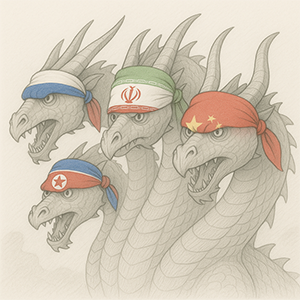
Today, the new axis runs through Moscow, Tehran, Pyongyang, and Beijing. The front line runs through Ukraine and Israel. And unity today is just as important as it was then.
As Benjamin Franklin said in 1776: “We must, indeed, all hang together, or most assuredly we shall all hang separately.”
*
Yakov Nayerman is a freelance writer based in San Diego.
Very well said. I wish someone from our government read it and act on it . As well as European leaders.