By Alex Gordon
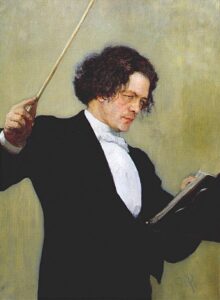
HAIFA, Israel — Anton Rubinstein (1829 – 1894) was a Russian composer, pianist, conductor, and music educator; the elder brother of pianist Nikolai Rubinstein. Rubinstein’s life began and continued amidst the height of state-sponsored antisemitism in Tsarist Russia.
Antisemitism in Tsarist Russia of the 19th century was a legalized way of interaction between the authorities and the Jews. Jews could only live within the “Pale of Settlement.” They were restricted in their admission to gymnasiums and universities. From time to time, anti-Jewish pogroms occurred.
As a result of the partition of the Polish-Lithuanian Commonwealth in the late 18th century, Podolia, where the Rubinsteins lived, became part of the Russian Empire. The Rubinsteins, once prosperous Polish merchants, became residents of the area beyond the “Pale of Settlement,” where they were not allowed to live in villages, have their own businesses, or leave their place of residence.
And then the future composer’s grandfather, Reuven Rubinstein, made a painful decision: on July 25, 1831, the entire Rubinstein family, about thirty-five people, arrived at one of the churches in the city of Berdichev. Everyone was baptized and received new names.
There were several reasons for such a step. Firstly, baptized Jews were allowed to leave the “Pale of Settlement”. Secondly, Rubinstein’s sons avoided the fate of “cantonists” – Jewish boys who were drafted into the army at the age of 12. The families of the cantonists recited a memorial prayer for those who had left: the boys were forcibly baptized in the army, only a few survived, and the majority died from hunger, cold, and disease.
Finally, the Rubinsteins could now simply live and engage in their modest but stable income-generating businesses. Anton’s father, Hersh-Reuven, was engaged in land leasing and was a merchant of the second guild. His mother, born Clara Löwenstein, a German Jewess, was a musician.
Anton and his younger brother Nikolai owed their musical talents and love for music to their mother. She came from the Prussian city of Breslau, which at that time was one of the centers of European culture and education, accessible even to Jews, for whom admission to educational institutions in Russia was very limited. Clara’s parents, apparently, were well-to-do people. Thanks to these circumstances, she received an excellent education and knew several languages.
Anton Rubinstein was born in 1829. After the baptism, the laws of the “Pale of Settlement” ceased to apply to his family, and they moved to Moscow, where his father opened a small pencil and pin factory and bought a house where his younger son Nikolai was born.
Rubinstein’s first piano lessons were given to him by his mother. In 1837, at the age of seven, his teacher, the Russian pianist-pedagogue and composer of French origin Alexandre Villoing, who later also became Nikolai Rubinstein’s teacher, began giving Anton piano lessons. In 1840, accompanied by Villoing, he went to France, where, at his mother’s request, he was supposed to continue his studies at the Paris Conservatory.
Instead, it turned into a concert tour; in March 1841, he performed at the Pleyel Hall in Paris and met Frédéric Chopin and Franz Liszt. Liszt, the greatest pianist of his time, called Anton “his successor.” In 1841-1842, he performed in Hague, Amsterdam, Cologne, Vienna, Budapest, England, Sweden, Germany, and Austria. In Breslau, on January 7, 1843, Rubinstein performed his etude Odine.
After spending some time in Russia, in 1844 Rubinstein, along with his mother and younger brother Nikolai, went to Berlin, where he studied piano with Theodor Kullak and began studying music theory under the guidance of Siegfried Dehn, with whom the famous Russian composer Mikhail Glinka had taken lessons a few years earlier. In Berlin, Rubinstein also established creative contacts with composers Felix Mendelssohn and Giacomo Meyerbeer.
In 1854, Rubinstein went abroad again. In Weimar, he met Franz Liszt, who helped him stage the opera Siberian Hunters; on December 14, 1854, Rubinstein’s solo concert at the Gewandhaus in Leipzig took place with great success and marked the beginning of a long concert tour: subsequently, the pianist performed in Berlin, Vienna, Munich, Leipzig, Hamburg, Nice, Paris, London, Budapest, Prague, and many other European cities. His inexhaustible energy allowed Rubinstein to successfully combine teaching work with active performance, composition, and music education activities.
Traveling abroad every year, he met there the Russian writer Ivan Turgenev, the French composer Hector Berlioz, and the widow of the German composer Robert Schumann, the outstanding pianist Clara Schumann. Abroad, Rubinstein enjoyed great popularity, but in Russia, he had influential opponents, the well-known Russian composers Mily Balakirev, Modest Mussorgsky, Alexander Borodin and Nikolai Rimsky-Korsakov.
They feared the excessive “academicism” of the Academy of Music (Conservatory) founded by Rubinstein and did not consider its role significant in the formation of the Russian musical school. His stylistic disagreements with these composers, who represented the “native” and purely Russian direction in Russian music, sometimes took on the character of sharp confrontation. He was perceived by them as an outsider, a German. “German academicism” of Rubinstein was, in their opinion, harmful to the Russian original spirit.
In 1872–1873, Rubinstein’s triumphant tour in the USA took place together with the violinist Henryk Wieniawski. Rubinstein became the first major musician from Russia to tour the USA. The sponsor of Rubinstein’s nine-month tour through numerous American cities in 21 states and 3 Canadian cities was William Steinway, the manufacturer of world-famous concert grand pianos. As a result of the tours, Rubinstein earned a fortune, which he spent on charitable and educational purposes.
Many of Rubinstein’s compositions are based on folk melodies, primarily Jewish ones—operas The Demon (1874), Maccabees (1874), Sulamith based on the Song of Songs (1883), Moses (1892), oratorio Paradise Lost based on John Milton’s poem (1856), The Tower of Babel (1869), and Hebrew Melody with lyrics by Byron translated by Mikhail Lermontov (1868), as well as romances with lyrics by Heinrich Heine. Rubinstein was familiar with Jewish music from childhood through his mother and later studied synagogue music.
In the opera Maccabees, he introduced a melody of a Jewish folk song he had heard from his mother. Soon after the establishment of the Society for the Promotion of Enlightenment among the Jews of Russia, Rubinstein became a member. In the early 1890s, he wanted to write an opera with a contemporary Jewish protagonist, but none of the librettos satisfied him.
As a pianist, Rubinstein ranks among the greatest representatives of piano performance of all time. He is also the founder of professional music education in Russia. His efforts led to the opening of the first Russian Academy of Music (Conservatory) in St. Petersburg in 1862. Among his students was Pyotr Tchaikovsky. Anton’s brother Nikolai became the founder of the first Academy of Music in Moscow.
In protest against the anti-Semitic laws of Tsar Alexander III, Anton Rubinstein resigned from his position at the St. Petersburg Academy of Music. To create Russian music, to be performers of Russian music, music educators, and founders of the first and main Russian higher music institutions, the Rubinstein brothers were forced to renounce their Jewish ancestry. Anton Rubinstein experienced this difficult situation. He exclaimed bitterly: “For Jews, I am a Christian, for Christians – a Jew, for Russians, I am a German, for Germans – a Russian.”
*
Alex Gordon is professor emeritus of physics at the University of Haifa and at Oranim, the Academic College of Education,