By Shor M. Masori
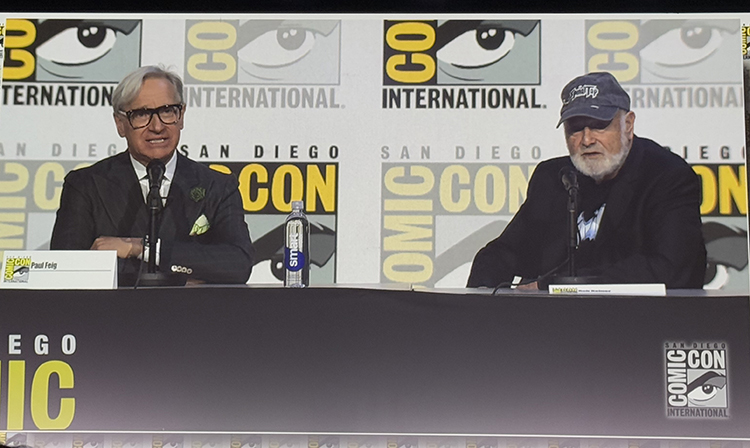
SAN DIEGO – In a Comic-C0n panel that mixed deep industry insight with sharp comedic timing, directors Rob Reiner and Paul Feig took to the massive Hall H of the San Diego Convention Center to reflect on their careers, their craft, and the chaos of filmmaking.
Moderated by Collider’s editor-in-chief Steven Weintraub, the conversation featured two Hollywood veterans whose filmographies span decades and genres: Rob Reiner (This Is Spinal Tap, The Princess Bride, Stand by Me) and Paul Feig (Bridesmaids, Freaks and Geeks, A Simple Favor). Together, they offered a fast-moving, often self-deprecating look at the messy, collaborative magic behind the camera.
Reiner joked early on that he’s “no good at anything”—just capable enough at a little bit of everything needed to make a movie work. He described the director’s job as being “the silent schmuck,” referencing the moment when a crew member would ask to do something obvious or simple and frame it as ‘well where do you want the camera here?’ With a shmuck under their breath because everyone on set, from actors to gaffers, thinks they know better than the director as they work within their expertise. Feig agreed, adding with a laugh that “most of directing is just staring at your watch all day,” with only about 10% of the time spent actually beside the camera in the way people imagine.
Despite their experience, both emphasized the unpredictability of the process. Reiner compared directing to building a great sandbox where everyone feels comfortable playing, from stars to prop masters. A good director knows how to run the sandbox in a way that lets everyone bring in their own toys into one harmonious whole. Feig said to get the best script you can and then let people play once you’re there. The best ideas often emerge after a half hour of shooting the same scene to exhaustion. When you use up all the obvious stuff, and someone can suggest something new that can break through.
That sense of creative chaos, tempered by discipline, runs through both of their current projects. Reiner is about to release Spinal Tap II: The End Continues, on September 12th, where much of the dialogue is improvised and the filming process intentionally loose. Feig wrapped The Housemaid, on December 25th, a new thriller starring Sydney Sweeney, with a mezuzah on the door of the house it’s set within.
Both directors touched on the importance of actors who understand the material—and the director’s role in helping them get there. Reiner recounted how hard it can be for directors to demonstrate their vision to their artists. He once had to demonstrate that scene from When Harry Met Sally (the fake orgasm in the diner) for an actress in front of Billy Crystal… and his own mother (who asked to have what Sally was having.) Reiner said that actors often make the best directors because they understand what they’re asking others to do. Same for writers as, if you can’t say the line yourself, how can they? Feig added that when he has to demo something like that, “it comes out terribly,” but sometimes that’s just part of the job.
When asked about planning versus spontaneity, Feig recalled his early days at USC film school, where Hitchcock-style storyboarding was considered gospel. But on his first film, following his own rigid shot list left him paralyzed. Working on Arrested Development in the early 2000’s, and receiving scripts as he walked onto set, he learned he must trust the moment. Reiner agreed: unless it’s an action sequence that requires precision, storyboards can be a creative trap, especially in comedy.
Feig likened choosing a project to choosing a spouse: “You’re committing to this thing for a year of your life. You better love it.” Reiner asked whether he needs to feel personally connected to a story in order to tell it. “A hundred percent,” Feig answered. That emotional bond is what keeps the vision alive through the many compromises that come with the job.
Editing, they said, is where the real story emerges. Reiner’s original cut of This Is Spinal Tap ran four hours, not including three more hours of interview footage he forgot to integrate. Feig, meanwhile, created his first director’s cut for Ghostbusters (2016) after key scenes were left out of the theatrical release. Reiner quipped that, “I spend more time in a dark room with my editor than I do with my wife.”
Feig praised the efficiency of modern editing tools like Avid, saying he often tries four different versions of a scene in quick succession to find the right rhythm, because at the end of the day, it’s all music.
They both expressed frustration at the disappearance of physical media. They took great joy in giving their fans hours of unreleased content that streamers, in their ever long quest to keep you watching into the next thing, refuse to add to their services. Feig called on the crowd to demand DVDs or physical media back so filmmakers can once again share bonus content, gag reels, and alternate cuts.
Legacy came up often, especially for Reiner, who spoke movingly about his father, legendary film maker Carl Reiner. As a child, he once wanted to change his name, at first his parents were worried it was to escape his father’s shadow. In fact, he wanted to change his name to Carl, not to escape his father’s shadow, but to honor it. Stand by Me remains particularly meaningful to him, as it was the first film he made that he felt Carl wouldn’t have directed himself. It marked the moment, he said, when he started to recognize his own creative identity.
Feig has seen his creative vision shift with time. When he created Freaks and Geeks, he admits he had no idea about the politics of network television. Now, he says, he’s much more aware of what studios want and what would be marketable. This kind of awareness is especially helpful now when studios are more risk averse (read scared of the unproven) but can stifle originality. That’s why Feig says he loves Comic-Con: it’s one of the few places where creators are celebrated before their ideas become just another intellectual property. He also acknowledged the stakes for directors trying to break through today. “If you fail now, you get blackballed,” he said. “But you have to fail in order to learn.”
Casting was another hot topic. Reiner admitted he doesn’t love auditions, but encourages actors to think of the audition itself as the performance, not just a tryout. Feig reminded actors in the room that sometimes it’s not about talent—it’s just a question of whether you’re the right fit—but added that casting directors never forget someone who brings something honest to the room.
In one of the panel’s warmest moments, Billy Crystal (Harry in When Harry Met Sally) sent in a video asking Feig to ask Reiner: what’s it like to direct your friends? Reiner laughed and said that while it was initially scary to direct Billy, one of his best friends, as so much can go wrong, he was grateful that Billy is such a wonderful performer. He had delivered some of the biggest laughs in The Princess Bride, including the now-iconic line about true love being the greatest thing—“except for a nice MLT, mutton, lettuce, and tomato sandwich” while improving.
Asked when he knew The Princess Bride would be a classic, Reiner admitted he didn’t. But the author of the book said it was his favorite work and even wanted it inscribed on his tombstone. “It’s an oddball movie,” Reiner said. With sword fights to conversations about land wars in Asia, the studio didn’t know how to market it, and he worried it might flop like The Wizard of Oz did initially. However, as Feig pointed out, that’s the beauty of filmmaking, it lives forever. Feig mentioned that It’s a Wonderful Life nearly bankrupted its studio and was not popular at the time. Now it, Wizard of Oz, and The Princess Bride are considered within most lists of best movies of all time.
As the conversation wound down, Feig offered one of the panel’s most hopeful notes. He’s not worried about AI taking over storytelling, he said, because AI can only recycle the past. “Everyone in this room,” he told the crowd, “has a story that would thrill us.” The setting it’s delivered within, sci-fi, fantasy, slice-of-life, etc, can be changed. The magic is in the personal connection.
Reiner’s father had once told him to “write something only you could write,” and hope that others would connect. Judging by the long list of unforgettable films these two have created, it’s advice that still holds up.
*
Shor M. Masori is a freelance writer based in San Diego.
I enjoyed reading this article. Sentimental and well written.