Story by Donald H. Harrison; photos by Sandi Masori

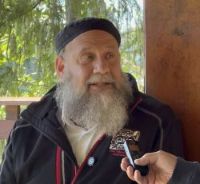
SITKA, Alaska – David Avraham Voluck, affiliated with the Chabad Lubavitch movement, serves as Chief Judge for the Sitka Tribal Court, primarily helping members of the Tlingit and Haida nations to settle their internal disputes amicably.
His work with these Alaskan Natives is so well regarded, he also has been recruited to serve as a judge for other tribes, including the Unangan (eastern) Aleuts on the St. Paul Island Tribal Court, the Chickatoon Village Traditional Council, and an intertribal court for villages on the Kodiak archipelago.

True to his roots as an attorney whose emphasis is environmental law, Voluck led my daughter Sandi and me to the viewing area for the tidal grass flat at the mouth of Starrigavan Creek so we could appreciate Alaskan scenery while conducting the interview.
He said a bear had been spotted wandering across the flat a day before but reassured us that as we were on the overlook and the bear had been spotted on the flat, even if the bear should come back, we were in no danger. We didn’t spot any bears during our discussion.
Clearly, this Philadelphia-raised fellow, who did his undergraduate studies at the University of Pennsylvania, had been Alaskan-ized during the 30 years since he arrived in Sitka to represent the Tlingit people.
Voluck’s friendly manners, respect for elders, and easy laugh so endeared him to the Tlingit people that at one point they wanted to bestow a tribal name on him during an adoption ceremony. However, a village elder said Voluck already had his tribe – the Jewish Levis – so it would be disrespectful to his heritage to give him a pre-existing Tlingit name. He did receive a Tlingit name, Aan S’aati, meaning “Caretaker for the Land.”
The attorney was so taken with Alaskan Natives’ spiritual values that he decided to look more deeply into his own Jewish culture. He took a two-year sabbatical to study Talmud and Halachah at the Lubavitch-sponsored Rabbinical College of America in Morristown, New Jersey.
He told us that there are some noticeable similarities between Judaism and traditional Alaskan Native beliefs.
Their concept of the Creator is “a unifying force that breathes life into creation and it’s everywhere. … So, you can’t mistreat the trees or the salmon or the earth, just like we can’t mistreat each other, because that’s where the Creator lives,” Voluck said.
This is the land of totem poles, which Voluck says outsiders misconstrue to be idols. “They’re not idols at all.” They are story poles. Some indicate who owns the land, other poles are accusatory.
“If you did not pay a debt or you did something very harmful or hurtful, they carve a pole and until you make right whatever the breach was, there in the middle of your village is a pole depicting whatever that shameful thing was.”
Sitka was the Russian capital of Alaska prior to the territory’s transfer by treaty to the United States for $7.2 million in 1867.
“They would carve Russian fur traders and explorers who had engaged in unsavory trades or stealing,” Voluck related. “And so the Russians would see themselves on these poles and somehow get the feeling the Natives were worshiping them as gods. No, that was their credit card bill for everyone to see. So, yes, the poles are fascinating, but they are the farthest thing from any kind of worship.
“And there are funerary poles where they will bury the ashes of their loved ones,” Voluck continued. “The poles were supposed to disintegrate and return back to the forest. But when explorers and anthropologists came, they grabbed these poles and they put them into museums to preserve them because they are amazing works of art, right? But that’s not what they were built for.”
Voluck still represents the Sitka Indians as their advocate in state and federal courts, but he much prefers his role as a judge in their tribal courts.
The American legal system is adversarial; “two sides fight each other, and then justice is somehow served by whoever is left standing,” Voluck said. “This leaves many people leaving the courthouse bruised and bloodied. And even if they win, they’re not happy.
“Indigenous justice is much more based not on winning and losing but on repairing the rip or the tear. So, when there’s a disruption in the community, the fight affects the village…. [Disputants throw] off balance the whole village, and so the village has an interest in restoring their relationship. They don’t necessarily need to become business partners, but we need a working relationship, kinship… The Indigenous idea is that we are family, so let’s figure this out. It’s a problem-solving approach as opposed to an adversarial approach. … It’s designed to repair them back to being useful and productive members of the community… I really like that approach.”
Rather than sitting in an elevated position like judges in American courts do, Voluck sits in a circle with the disputants, thereby keeping the proceedings more informal. However, he wears a judicial robe – often covered with tribal decorations – as a mark of the tribal judge’s authority.
He draws on a variety of legal traditions to guide the disputes to an amicable conclusion. One time, two brothers were fighting over a four-wheel, all-terrain vehicle. “I took the King Solomon approach because both were convinced it was theirs. I was going to force them to chop it in half, and they kind of worked it out from there.”
Sitka’s Jewish population is quite small, insufficient to sustain a synagogue. “Sitka has a big hospital, Indian Health Service facility, and a number of government positions that have attracted Jews of all kinds. There are doctors, lawyers and teachers in town … We get together for holidays and celebrations, but it is loose-knit. There is no rabbi here. Everyone takes turns hosting and presenting a topic for folks to connect on.”
*
Donald H. Harrison is publisher and editor of San Diego Jewish World.
Amazing story.