By Donald H. Harrison

JUNEAU, Alaska — Cruise ship passengers come to Alaska by the thousands in the spring and summer months. That’s when many permanent residents of southeastern Alaskan panhandle towns like Ketchikan, Sitka, Juneau, and Skagway themselves go on vacation.
Congregants of Temple Sukkat Shalom in Alaska’s capital city of Juneau don’t hold their once-a-month Shabbat services during summer and its shoulder months. That’s partially because visiting student rabbis from Hebrew Union College in Los Angeles take off for summer vacations and are unavailable to lead the services. Permanent residents of Alaska–at least those not involved in the tourist industry–also like to travel during these months.
And yet, summer sometimes is the season for the most populous religious celebrations of the year. Alaska State Sen. Jesse Kiehl (D-Juneau), a member of Temple Sukkat Shalom, explained that when he and his sister were growing up in Anchorage, Alaska, their bar/ bat mitzvah dates ordinarily would have been 14 months apart.
However, they celebrated their b’nai mitzvah together on the same day so that “grandma, grandpa, aunts and uncles had to buy only one set of tickets to Alaska” from their homes in the “lower 48” states.
The same phenomenon is true in Juneau where bar/ bat mitzvahs are attended by out-of-state visitors and by most members of the congregation, even if attendees are unrelated to the child for whom the ceremony marks the assumption of responsibilities of a Jewish adult, commented congregant Sheryl Weinberg.

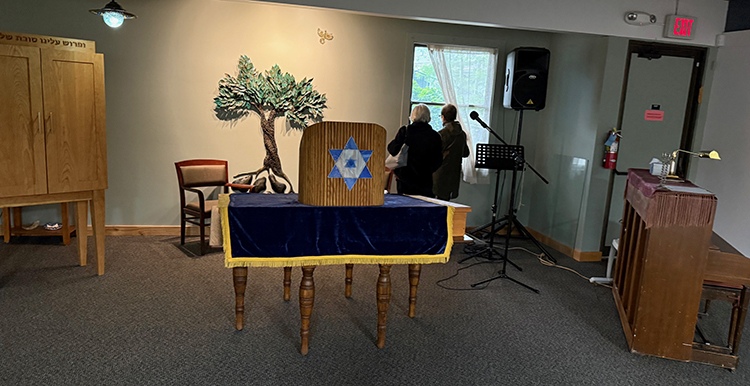
The temple building, converted from an abandoned child care center, holds approximately 70 people in its sanctuary, the number roughly equivalent to the temple’s active membership. Norman Cohen, the current treasurer and several times past president, says the overall Jewish population of Juneau is 300, so the synagogue attracts approximately one-third of the Jewish population. That is less than 1 percent of the 31,000 Juneau residents.
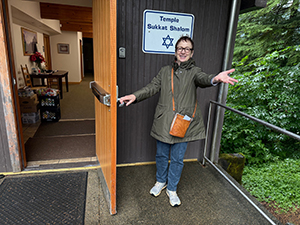
Incorporated in 1991, the congregation met in people’s homes and in churches until 2005, when it took possession and remodeled a building that stood over a watery ravine. To make certain the building could bear the weight of adults, rather than the children who were cared for previously there, four supporting steel posts were driven into the bedrock, according to Weinberg.
In a bidding competition for the government-owned building, the congregation figured 6,000 multiples of chai (18) would do the trick, and they figured too generously: their bid of $108,000 more than doubled the next highest bid of $50,000, Weinberg told me and my wife Nancy on a tour of the structure. The steel posts cost $10,000 each, and there were internal modifications adding to the overall expense. Many small rooms had to be eliminated to provide for a big sanctuary. Children’s low toilets and sinks had to be replaced with adult size plumbing. So the fundraising committee had its job cut out for it.
Contributions supplemented yearly dues which are $300 for a single person, $550 for a family.
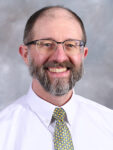
Luckily, small-town congregations have numerous volunteers who like to pitch in — the temple is an extension of their homes — and the money to pay for the building soon was raised internally and with the help of out-of-town relatives. Helpful too was the fact that some congregants in their professional lives were familiar with the mechanics of fundraising. Weinberg is the former director of the education-focused Southeast Regional Resource Center. Cohen, an attorney, worked for the Alaska Fish and Game Commission and at a different time in his career, the Nature Conservancy. Kiehl, an elected official, needs to fundraise all the time. Other congregants direct a rape crisis center and run a shelter for unhoused people.
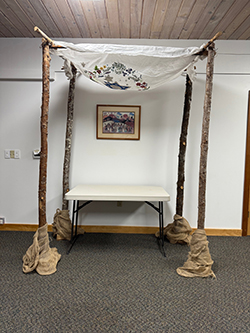
Two Torahs saved from the Holocaust were obtained, one from the Czech Republic; the other from Hungary. A congregant whose hobby is woodworking built the Holy Ark within which to keep them. Another congregant created a rustic chuppah. Jewish books were donated to the congregational library. Temple Sukkat Shalom (Shelter of Peace) is small, yet compact.
Although Shabbat services are conducted only once a month (typically on a Friday night) the space is otherwise well utilized. Saturdays there are adult learning classes. Sundays there is religious school for Jewish children and Unitarian services for a congregation that shares the building.
The two congregations jointly operate a pantry for food-insecure residents. Other social action programs include sponsors’ circles for refugees whose countries of origin include Haiti, Ukraine, and Venezuela.
Antisemitism is present in Juneau. In the 20 years since Temple Sukkot Shalom has occupied the building, it was graffitied several times. But as the building is tucked away in a suburban neighborhood, it doesn’t otherwise attract much attention, Cohen said. “For the most part, Alaska is a live and let live kind of place,” he added.
“One of the things that I really like and appreciate is that Alaska has certain remnants of the old frontier mentality,” Kiehl commented. In the congregation, “There are folks who sort of rebelled by going to Alaska, and others who rebelled by joining a synagogue,” added the state senator.
Kiehl’s capital career started as a legislative aide, advanced as one of 40 members of the House, and currently he is one of 20 state senators. The overall population of Alaska is 775,000, so an individual Senate district accounts for approximately 38,750 constituents. As Juneau’s population is shy of that number, Kiehl’s district also takes in several small towns including the popular cruise port of Skagway.
Because the state’s population is so small, Weinberg says, if you don’t know another Alaskan personally, you’ll probably know someone who does. “The sense of community is so strong and the people are so interesting whether they are the indigenous folks whose families have been here for centuries or whether they are people who have moved here,” she said. “Everybody has a story.”
Temple Sukkat Shalom has a few congregants who are married to Alaska Natives and more than a few who are intermarried to Christian spouses, including Kiehl and Weinberg. “The congregation is “unpretentious and very welcoming,” Weinberg said.
There is a tradition at holiday and b’nai mitzvah services that when people receive blessings, everyone ceremonially touches another person so that the blessings are symbolically shared.
*
Donald H. Harrison is publisher and editor of San Diego Jewish World.
Wow, what a neat story!
Thank you for writing such a lovely piece on our synagogue and some of our members. . What we lack in size we make up in heart. There is really something to be said for small congregations. For the over 50 years I have lived here congregants have volunteered and stepped up to lead services, prepare our kids for their B’nai Mitzvah ( where they lead the service themselves ), teach Sunday and Hebrew school, hold cooking and baking classes , film festivals and of course celebrate each new life and mourn together when someone has a loss. We have filled our synagogue with family treasures , a beautiful hand made Ark , art work and more. As the saying goes – stop by if you’re ever in the neighborhood!