By Jerry Klinger
BOYNTON BEACH, Florida –It started innocently, as most things might, with an email requesting help, from one friend to another. The email would electronically fly more than halfway around the world.
Mike Harold, Chairman of the Phil Lamason Heritage Centre Trust (Inc) in Dannevirke, New Zealand, wrote to John McCormick.
“Hello John McCormick,
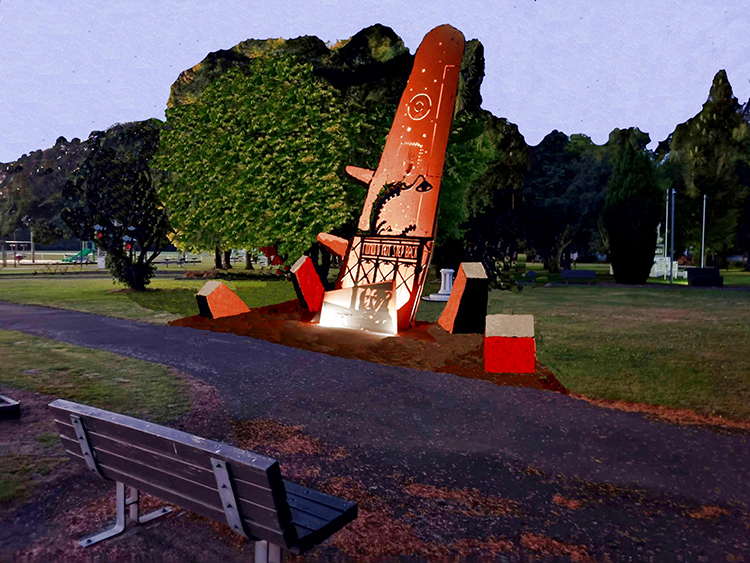
“I am making contact on behalf of The Phil Lamason Heritage Centre Trust (Inc) in Dannevirke, New Zealand, in regard to the recently launched (6 August 2025) Lamason-Buchenwald Memorial Project.
“The Trust is committed to creating a fitting Memorial in Phil Lamason’s hometown to commemorate not only former RNZAF Squadron Leader Lamason’s outstanding leadership and courage, but also the resilience and determination of the 168 Allied airmen wrongly incarcerated in the brutal SS-operated Buchenwald work/death camp in Nazi Germany in 1944.”
The story about the Buchenwald Airmen was a Nazi War Crime that has slipped into the dusty back pages of library books. The books are rapidly being discarded from the shelves and memory.
For many, memory, certainly Holocaust memory, is best forgotten. For others, forgetting risks repeating.
True to his word to help, McCormick, who is not Jewish, forwarded the request for help to the Israeli ambassador, leading members of the Jewish community, and others.
One of the “others,” was John’s good friend, Don Harrison, publisher and editor of San Diego Jewish World. Don had written about John seven years ago.
Don’s motto is “there is a Jewish story everywhere.” The problem was that the Lamason memorial project, superficially, did not lend itself to being a Jewish story.
Buchenwald was a Nazi Concentration Camp outside of Weimar. The Nazis murdered more than 50,000 people there. The victims of the Nazis were political prisoners, prisoners of conscience, homosexuals, Seventh Day Adventists, Pacifists, Russians, Gypsies, Blacks, Whites, non-Jews, and, with relish. Jews — all of them in the Nazis’ view, life unworthy of life.
Human beings from scores of countries were converted into “Luftmenschen,” people whose existence was reduced to a small pile of ashes after the bodies were destroyed by starvation, death, disease, famine, personal brutality, overwork, and ovens.
Don wrote to me because he knew of my long, frequently unpleasant efforts to preserve memory, dealing with the contemporary German Buchenwald Memorial administrators. I had been successful in the construction of the “Kleine Lager” – the “Little Camp” Memorial, known by most as the “Jewish Camp” Memorial.
The “Little Camp” was especially venomous. The Jewish Camp was a segregated Camp at the bottom of Mount Ettersberg, where Buchenwald was sited. The Kleine Lager was its own prison of death within the prison of death. The filth and muck runoff from Buchenwald was deliberately dumped into the “Jewish Camp.”
My father, Fritz Klinger, barely alive, was liberated in the “Little Camp” by battle-hardened American soldiers, many of whom vomited from the smell and sites they never forgot.
At first, I did not understand why Don had forwarded John’s outreach to me. The only common denominator was Buchenwald.
The Nazis’ policy was to send captured downed Allied Air Crews to POW camps. The British did the same. The Russians generally had a more lethal policy.
On 8 June 1944, Lamason was in command of a Lancaster heavy bomber. He was shot down by the Nazis. His target was the railway marshalling yards near Paris. He and his crew bailed out. Fortunately, he was picked up by French Resistance members. For seven weeks, Lamason, with French help, tried to escape to Spain. He never made it.
Lamason was betrayed by a French double agent for 10,000 francs. He was turned over to the Gestapo and sent to the infamous Fresnes Prison for interrogation. Lamason was tortured and kept with 167 other captured Allied Air Crews.
They were classified by the Gestapo as “Terrorfliegers” (terror fliers). In their efforts to reach Spain, they had discarded their uniforms and military identifications. To the Germans, the captured Airmen were lower than criminals. They were spies and denied their obvious rights as prisoners of war.
In the past, captured Allied fliers were sent to POW camps. But, the war was not going well for the Germans. Paris was near falling. Allied armies gained ground. The Gestapo acted.
The 168 men were sent to Buchenwald for special treatment. Their identification papers were very specific – they were not to be transferred anywhere else.
Lamason, by default, took charge of the men. He was the highest-ranking officer among them. Lamason was not just the highest-ranking officer. He was a natural leader, a man of courageous moral character who refused to let the Nazis reduce him and his men to the level of exterminable vermin. Lamason would not back down when the Nazis ordered his men to work in a Nazi War Material factory, a direct war crime. Even with a Luger pistol to his head, he said, “I will not stand back.”
Upon arriving at Buchenwald, the Allied prisoners were not placed in the main camp. They were destined for special treatment. The Nazi Commandant sent them to the “Little Camp,” the Jewish Camp. They slept on the ground for days, no food, clothing – rags like Jewish prisoners.
Lamason organized the men militarily, giving them hope and purpose. The Germans observed, and Lamason was permitted to negotiate with the Nazi Commandant for “slightly” better treatment. Lamason was permitted to move about the main camp. There he connected with the secret International Prisoner group.
Through them, he managed to get a letter to the Luftwaffe that Allied POW fliers were imprisoned in Buchenwald.
The impossible happened. Lamason’s letter landed on the desk of Otto Hans Trautlofft, the Commander of the nearby Luftwaffe air base. Trautlofft was one of Germany’s greatest Aces with over 58 kills. He was also old school and immediately recognized the war crimes being committed in Buchenwald.
Using a recent bombing on an adjacent Buchenwald War Materials factory as an excuse to personally see what was going on, Trautlofft “toured” Buchenwald. He was closely escorted by the Buchenwald’s S.S.
Just before leaving, a prisoner shouted at him from behind the fence in perfect German that he was part of 168 Allied Airmen criminally held in the Concentration Camp.
Trautlofft went up to the fence to see the man. The man was Ben Fred Scharf, an American Airman from New Prague, Minnesota. His family was of German background. Scharf had thrown a “Hail Mary” Pass. It was the airmen’s last chance. They were scheduled for execution in nine days.
Trautlofft did not say anything. He returned to his airbase and contacted Field Marshal Hermann Goering, the head of the Luftwaffe in Berlin. Trautlofft alarmed Goering that if Allied Airmen (POWs) were to be held in death camps, Nazi captured aircrews faced even a worse fate.
Goering agreed. He overruled the Gestapo, and the men were transferred to POW camps. They would be liberated by American or Russian forces.
What does this have to do with a Jewish story? Until I began looking into the Buchenwald Airmen they were always referred to as Buchenwald Prisoners.
The Airmen were more than Buchenwald Prisoners. The horrifying Jewish connection was that the Nazis had made them into Jews, in their view, life unworthy of life.
Lamason and Trautlofft were not Jews. Most likely, Scharf was not Jewish either. Intriguingly, there are background questions about Scharf that cannot be easily answered.
When Lamason selected a translator to interact with the Nazis, he chose one of the 168 who was Dutch. The Dutchman spoke fluent German as his third language. He did not choose Scharf, whose German was his second language. Scharf is not necessarily a Jewish name. His family came from Bohemia. Scharf can be both a Christian and a Jewish name. Even more curious, Scharf also spoke a bit of Polish. Why would an ethnically German American farm boy from Minnesota know any Polish?
The Scharf story intrigued. Did Lamason not use Scharf because of a potential antisemitic reaction from the Gestapo?
Lamason returned to New Zealand and spent the rest of his life as a successful sheep farmer. Scharf returned to Minnesota, married a local girl in a Baptist Church in January 1946. Trautlofft was “rehabilitated” and spent the remainder of his life with the New Luftwaffe, rising to the rank of General before retiring in 1971.
The Allied Airmen returned home. Their respective governments gave them no more thought. A proper memorial for them was never proposed until now.
Does it really matter if Scharf was Jewish? No, what matters is memory. Inhumanity can come about easily when ignorance, hatred, and bigotry are permitted to flourish.
The Jewish American Society for Historic Preservation (JASHP) has made a substantial donation to the Phil Lamason, Buchenwald Memorial project. It is being built in Dannevirke, New Zealand. The name JASHP will be prominently displayed alongside the major donor names with a large Star of David behind it.
*
Jerry Klinger is the President of the Jewish American Society for Historic Preservation.
Amazing!! So much history in here. So special and important to honour these men.
Thank You Jerry. John McCormick…email j.rk52@hotmail.com
Waipukuurau (30 miles north of Phils farm)
New Zealand