By Jerry Klinger
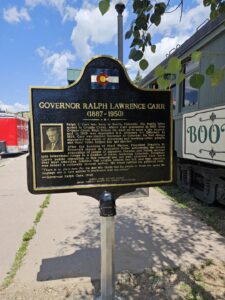
BOYNTON BEACH, Florida — I had never heard of Governor Ralph Carr before a reader shared that he deserved a marker in the town he grew up in – Cripple Creek, Colorado.
It took a year and a half to complete, partly because Cripple Creek is at 9,459’ high up in the Rocky Mountains. The ground is frozen steel-hard for six months of the year.
The marker is on the grounds of the Cripple Creek Historic District Museum.
Robert Miller “Bob” Womack discovered gold in Cripple Creek in 1890. Two years later, by 1892, the once “Cow pasture site” had boomed into a city of 5,000. All sorts of hopeful people arrived with many languages, cultures, religions, and skin colors. Most never found their gold. Womack sold his claim, the biggest in American mining history, for $500 and a bottle of booze. He died in poverty.
Ralph Carr’s family moved to Cripple Creek with their dreams. Carr graduated from Cripple Creek High School, acculturating to many different people and was fluent in Spanish. His moral compass was shaped by the frontier spirit – judge a man by what he can bring to the table, what he can do, not where he came from.
Carr went on to earn a law degree. In 1938, he was elected as the Republican Governor of Colorado.
December 7, 1941, the Japanese surprise attack on Pearl Harbor changed and terrified America. Anti-Asian racism had long been a part of the Western American experience. The Japanese attack unleashed near hysteria.
Within days, America was at War with Japan and its close allies, Nazi Germany and Fascist Italy.
Two months later, on February 19, 1942, President Franklin D. Roosevelt ordered the internment of Japanese Americans. He signed Executive Order 9066. Through the stroke of a Presidential pen, Roosevelt authorized the U.S. military to create military exclusion zones and “relocation centers.” Japanese-Americans, about 120,000 people, 2/3 of whom were U.S. citizens, were to be arbitrarily rounded up.
Governor Carr was ordered to create “internment camps” for the Japanese in Colorado.
Carr refused.
He refused to incarcerate American citizens just because of their skin color or their Japanese ethnicity. He knew the camps were functioning prisons, surrounded by barbed wire and armed guards manning towers with search lights.
In time, the Roosevelt administration compelled Carr to bend to its orders. Carr reluctantly complied but never stopped protesting the injustice and gross violation of the Constitution.
Carr paid a price. He was never elected to another public office again in Colorado.
Years later, his courage, his moral values, and his defense of America and American institutions would be honored by Japanese Americans and the State of Colorado.
Jewish Coloradans, for the most part, kept a low profile as Japanese-Americans were rounded up and taken away to the “Camps.” Some were quiet for racist reasons. They, too, feared the approaching Japanese “menace.”
Most Jews were quiet for another reason: the War in Europe was a hot war. They knew that a central target of the Nazis was the Jews. Antisemitism in America was very real and virulent.
Before December 7, Jews and Jewish organizations treaded very lightly about getting America involved in the European War. American mothers did not want their sons to go and fight “a war to save Jews.”
The tensions, the amplified fears of American Jewry, were very real. As the Japanese Americans were rounded up, they feared they could be next if the European war did not go well. For many Jews, it was better to remain quiet and focus on Jews, not Japanese-Americans.
The Jewish response, from the safety and vantage point of years later, seems wrong, disgraceful.
Despite all, a few Jewish voices did protest. The loudest and earliest was influential Rabbi Irving Reichart of San Francisco’s Temple Emanuel. He would be joined later by Rabbi Edgar Magnin of Los Angeles’ Wilshire Boulevard Temple and a handful of Southern California Jewish leaders.
From the Bench – Judge Louis E. Goodman brought his sense of Jewish values to rule on Japanese-Americans brought before him for insurrection. The young men refused induction to the U.S. Army while their families were being held prisoners in the Tule Lake Japanese Concentration Camp. Judge Goodman ruled the men innocent. They had faced three years imprisonment in Federal penitentiaries.
A Jewish woman, Elaine Black Yoneda, married to a Japanese American, refused to leave her husband and child. She chose to go with them and be interned in the Manzanar “Internment” Camp.
Perhaps the greatest irony of all occurred in Europe when American armed forces liberated the concentration camp of Dachau. A significant number of the American soldiers who freed the Jews imprisoned in the Dachau Death Camp were Japanese-Americans. Their own families were still “interned” in American Camps, back home.
The Jewish American Society for Historic Preservation has approached the Heart Mountain, Wyoming, National Heritage Japanese American Internment Camp Memorial. JASHP has offered to fund a historical interpretive memorial at Heart Mountain remembering, honoring, and telling, the story.
The marker for Governor Carr was the least we could do.
The text of the marker reads:
Ralph L. Carr was born in Rosita, Colorado. His family later moved to Cripple Creek, where Carr graduated in 1905 from Cripple Creek High School. He went on to earn a law degree, and in 1929 was appointed U.S. Attorney for Colorado. In 1938, Carr was elected Governor of Colorado. He had always supported the rights of minorities and working-class people. And their votes helped him get elected.
After the bombing of Pearl Harbor, President Franklin D. Roosevelt signed an Executive Order authorizing the forced evacuation of people of Japanese, German, and Italian descent into internment camps in a number of states, including Colorado. Governor Carr’s public opposition to this removal was not well received. Carr knew that most American families had origins outside the U.S. and that America was indeed a culturally diverse nation. His stand spelled his political ruin.
“There is no place here for the man who thinks that his people or those who speak his language are in turn entitled to preference over any others.” —— Governor Ralph Carr, 1942
*
Jerry Klinger is the President of the Jewish American Society for Historic Preservation.