
By Cailin Acosta
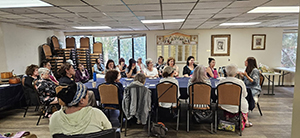
SAN DIEGO – “Elul is the 12th and final month in the Jewish calendar, the sixth month counting from Nisan. Leading up to the High Holidays, Rosh Hashanah and Yom Kippur, it is a month that connects the past year with the coming year – a time when we reflect on where we stand and where we should be going,” said Rebbetzin Chaya Andrusier to the Jewish Women’s Circle’s “Torah and Tea” on Thursday, August 28.
Elul is known as the month of repentance, mercy, and forgiveness. Elul follows the two previous months of Tammuz and Av, months of tragedies that were brought upon us through our sins. In Tammuz, the Jews sinned with the golden calf. Oh, Rosh Chodesh Elul, Moses ascended to Mount Sinai for a third 40-day period until Yom Kippur, when he descended with the second tablets and G-d’s word of joyful, wholehearted forgiveness.
Andrusier mentioned the first time Moses ascended was to receive the first tablets; the second time was after the sin, to ask for forgiveness; and this third time was to receive the second set of tablets. These were days when G-d revealed great mercy to the Jewish people. Since then, this time has been designated as a time of mercy and forgiveness, an opportune time for teshuvah – repentance.
The four letters of the name Elul are an acronym for the phrase in “Song of Songs (6:3): “I am to my beloved and my beloved is to me”. How this breaks down, “I am to my beloved” – we approach G-d with a desire to return and connect. “And my beloved is to me” – G-d reciprocates with Divine expressions of mercy and forgiveness.
As the last month of the Jewish year, Elul is traditionally a time of introspection and stocktaking, a time to review one’s deeds and spiritual progress over the past year and prepare for the upcoming “Days of Awe” of Rosh Hashanah and Yom Kippur.
As the month of divine mercy and forgiveness, Elul is a most opportune time for teshuvah, to return to G-d, prayer, charity, and increased ahavat Yisrael (love for a fellow Jew), in the quest for self-improvement and coming closer to G-d. Andrusier mentioned a Chassidic master Rabbi Schneur Zalman of Liadi likened the month of Elul to a time when “the king is in the field” and, in contrast to when he is in the royal palace, “everyone who so desires is permitted to meet him, and he receives them all with a cheerful countenance, showing a smiling face to them all”.
Andrusier mentioned the basic customs and practices for the month of Elul (except for Shabbat and the last day of Elul). We sound the shofar as a call to repentance. When writing a letter or meeting one another, we bless one another by including the greeting Ketivah vachatimah tovah, which roughly translates as “May you be inscribed and sealed for a good year.”
Chapter 27 of the Book of Psalms is added to the daily prayers, in the morning and afternoon. The Baal Shem Tov instituted the custom of reciting three additional chapters of Psalms each day, from the first of Elul until Yom Kippur. On Yom Kippur, the remaining 36 chapters are recited, thereby completing the entire book of Psalms. During the month, we give additional charity, accruing merit for ourselves. Elul is a good time to have one’s tefillin and mezuzot checked. During the last week of Elul, in the days leading up to Rosh Hashanah, the Selichot prayers are recited. On the first night, they are recited at midnight; on the following days, in the early morning.
The month of Elul resembles the holy portions of the calendar. Elul is a haven in time, a “city of refuge” from busy material life, a time to audit one’s spiritual accounts and access the year gone by, a time to prepare for the “Days of Awe”.
Elul is the opportune time for all this because it is a month in which G-d relates to us in a more open and compassionate manner than he does in the other months of the year. In the terminology of Kabbalah, it is a time when G-d’s “Thirteen Attributes of Mercy” illuminate his relationship with us.
*
Cailin Acosta is the assistant editor of the San Diego Jewish World.
.