September Volunteer of the Month
By Mimi Pollack
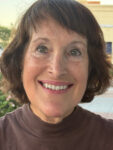
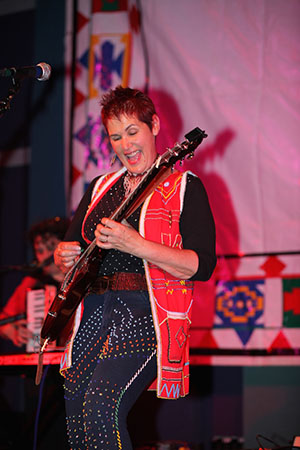
LA MESA, California — From a very young age, my volunteer for September, South African musician Sharon Katz learned about the importance of giving back to others. This is something her mother instilled in her. In addition, growing up during the period of Apartheid, Katz also learned about racism and social inequalities. For her, music was a salvation and a door to a world she wasn’t supposed to be a part of but later thrived in and found her voice to speak up. Today, Katz is a Musician and Music Therapist, and Director of The Peace Train Project.
Born in Port Elizabeth, now known as Nelson Mandela Bay, in 1955, Katz‘s life was changed at 15 when she saw an anti-apartheid play, and her eyes were opened. The Jews of that area were in an enclave of their own in a way, and people lived separate lives and did not mingle much. Katz took refuge in music and taught herself to play the guitar at the age of 11 by listening to the music of Simon and Garfunkel; Peter, Paul, and Mary; and Pete Seeger. That led to a life in music and making a difference, and the formation of the life changing Peace Train Project, where a mingling of music and compassionate activism was encouraged and grew.
In her later teen years, she formed friendships with anti-apartheid actors John Kani [of Black Panther fame] and Winston Ntshona. She would visit them in their homes in New Brighton Township. However, she was highly secretive about this as she knew if she told others about it, they would try to stop her as it wasn’t considered safe.
In a way, she led a double life. She was also active in the Jewish community and had a very strong communal life within her family, school, and various bands and singing groups.
Music became her mission to try and bring together a torn nation. The Peace Train Project was formed in 1992 as a way to honor Nelson Mandela, who would become president in 1994, and help heal a divided country. By then, Katz had her master’s degree in music therapy. Along with her Zulu singing partner, Nonhlanhla Wanda, she formed a 500-voice multiracial and multicultural youth choir. They hired a train, dubbed “The Peace Train”, and they traveled to various and still separated communities all over South Africa. The goal was to rehearse and build trust as they stopped and performed in different towns. Katz likes to say that the Peace Train was a moving billboard for Nelson’s message of peaceful coexistence. In 2023, they celebrated 30 years of that original ride through South Africa.
A 2015 documentary, “When Voices Meet,” chronicles this time and the 20 years that follow. This documentary can be found on Amazon Prime.
Later, Katz moved to Philadelphia, and it became her home base where she taught classes and from where she traveled to concerts all over the USA and the world spreading her message of humanitarianism.
In 2020, she and her long-time wife and business partner, Marilyn Cohen, made another life changing plan by moving to Tijuana, continuing a life of adventure and giving back. This move was inspired after Katz met a woman named Davida from The San Diego PeaceMakers Fund who asked her if she would be willing to do cross border work. Katz said yes and then connected with Alida Guajardo de Cervantes and the organization Promotora Bellas Artes in Tijuana.
Promotora Bellas Artes is an organization that works with school children that come from poorer neighborhoods, bringing music into their schools. The synergy between Katz and Guajardo de Cervantes was so great that together, they devised the Transcending Barriers Project. Katz became Promotora’s guest artist for that period.
Together with the Promotora, Katz worked with 1,500 children, going from school to school in Tijuana teaching them South African songs, etc. Later those children, along with Katz and her band and an orchestra, performed a concert together. The musical director of Promotora Bellas Artes, Daria-Abreu Feraud, a Cuban woman, invited Katz to visit and perform in Santiago de Cuba in Cuba in 2019.
In addition, Katz worked under a grant given to her by the San Diego PeaceMakers fund. She worked as a music therapist with Survivors of Torture International in San Diego, and she also worked with migrant shelters in Tijuana. I saw the joy she brought to the families staying at one of the shelters the day I went to distribute donations. She played her guitar and sang to them for an hour.
Katz has bands in Tijuana, Philadelphia, San Diego, and in South Africa. Besides all her humanitarian work and traveling around, I can attest that she also puts on a great show, so see her while she is still in San Diego as she and Cohen will once again be moving. On December 1st, they will be leaving San Diego to live on a property that they purchased in Todos Santos, Baja California. This will be another exciting adventure for them. Todos Santos is known as being a very artistic place.
Here are some questions I asked her.
1] How old were you when you first had a sense of “giving back” Growing up in South Africa, you must have been sensitive to the inequities, not to mention apartheid. How did you deal with it?
I was very young. At age 11 I taught myself to play the guitar and accompany myself by singing. My mother took me to a Children’s Home in our town of Port Elizabeth (later called Mandela Bay, now called Gqeberha) to entertain the children living in this institution and it made me really think about the impact that music could have. I felt very sad as a child knowing that Black people were oppressed in our country. From an early age, I refused to sing the national anthem of the country which was in the Afrikaans language, and I had a deep resentment for the apartheid regime. I became a rebel and made friends with actors in the Black community who performed plays that they co-wrote with the famous playwright Athol Fugard. I visited my friends illegally in their homes and they, John Kani and Winston Ntshona (Winston is now deceased), remained my lifelong friends.
I co-founded The Peace Train in 1992 not only to share music and messages of peace and unity, but to uplift the participants, and to give back, especially to communities that had been severely neglected. This is a big part of my consciousness. To this day and for the past 25 years, we in The Peace Train have been volunteering our time to help and support food programs, children’s education and homeless children in South Africa. We support Mama Mary Lwate who looks after abandoned children in impoverished areas.
2] When did you move to Tijuana? What volunteer work did you do in Mexico?
I moved to Tijuana in January 2020, and the pandemic began soon after. I volunteered my time in a migrant shelter [Pro Amore] in Tijuana and conducted weekly music therapy sessions with 30 children. During these sessions we all wore masks. In October of 2021, the children joined me in a large-scale project where they joined about 100 youth to travel by train from Tijuana to Tecate (The Peace Train) and they sang together with 200 children from Tijuana and Tecate at the CEARTS outdoor amphitheater in The Peace Train Production.
3] Over the years, since arriving in this area, what volunteer have you done in San Diego?
In San Diego I have worked with Survivors of Torture and I have conducted youth summer music camps at the Central Library which until this year, included children who were able to cross the border unaccompanied. I have had a modest stipend with which to do this work. Very sadly many of these programs are ending due to the government budget cuts which discriminate against immigrants, refugees and asylum seekers.
4] What musical projects do you have coming up? Please share what your plans are for the end of 2025 and 2026.
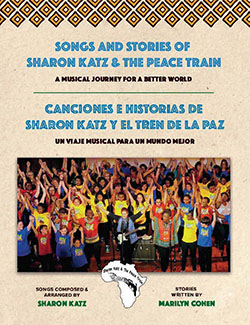 Next month (September) I will be performing in New York City, Philadelphia and in Virginia. We have just published “Songs and Stories of Sharon Katz & The Peace Train” which is now available for purchase. This book was two years in the making.
In November I will perform several concerts with the San Diego based Classics4Kids Philharmonic Orchestra. We will perform the orchestral versions of my songs which are featured in the songbook. These performances will be in several schools and at the Kroc Center.
Later in the year I will be relocating to base my work in Baja California Sur in the town of Todos Santos. I will be volunteering my time working with families who are migrant workers from other parts of Mexico and who live in poverty in this rapidly developing environment. I will be conducting music therapy projects with the children of the migrant workers who work there. Many migrant workers come from all over Mexico to work on farms and ranches in Baja. They live in Pescadero which is close to Todos Santos. I will also continue my work with Survivors of Torture.
5] Why is Tikkun Olam important for you?
As a child this concept was instilled in me by my parents and my community. I was taught that Tikkun Olam is a part of being Jewish. Our own history taught us that survival is dependent upon the kindness of others and that we are on this earth not to just make ourselves grander or better but to give to others and help those who are suffering. I still feel this way and as I get older it becomes even more important.
*
The link for Sharon’s website is www.sharonkatz.com. Mimi Pollack is a freelance writer based in La Mesa, California.
What a wonderful way to promote peace through the wonderful music & dance!
Fantastic!
Wow, what an amazing woman doing inspiring things. Considering the times, this story is very uplifting!