Just Say Welcome! By Emily Raij with illustrations by Nathalia Takeyama; Minneapolis, Minnesota: Kar-Ben Publishing; © 2025; ISBN 9798765-619919; 24 pages; $19.99. Publication date: Sept. 9, 2025.

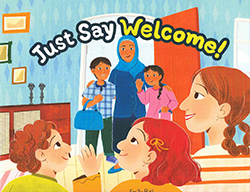 SAN DIEGO – Tilly’s Jewish family hosts an Iraqi Muslim family for a week while the community readies an apartment for the refugee family to occupy.
This book was written for readers aged 4 through 9. There are puzzling omissions from the story.
The visiting family consisted of a mother, Ana; a daughter, Dani; and a son, Youssef. The host family was comprised of Tilly, her younger brother Adam, and an unnamed mother. Unexplained was why neither family included a husband/ father.
Tillie’s family shares their home and meals with Ana’s family, purchasing Middle Eastern foods like labneh, pita, and felafel. Ana comments that the foods taste like those eaten at home.
Youssef, who is older than Adam, teaches him some knee and foot moves for manipulating a soccer ball. Except in the United States, the game is called “football,” yet Youssef refers to it as “soccer,” differentiating the sport from American football.
Neighbors who are African-American Jews bring over a collection of kids’ clothing from the synagogue and also cardamom- and cumin-flavored stew, again reminding Ana of home. Whether the stew is kosher and/ or halal is ignored in this narrative.
Ana wears a hijab, indicating she is a devout Muslim, but while Tillie’s family routinely celebrated Shabbat dinner, there was no evidence of young Adam wearing a kippah during the accompanying prayers. Nor did the story mention Shabbat dinner being served during the week that Ana’s family were guests.
When the week was completed, Ana and her family moved into an apartment, no longer feeling like strangers but as friends. The story concludes with a citation from Leviticus (19:33-34): “The strangers who sojourn with you shall be to you as the natives among you, and you shall love them as yourself; for you were strangers in the land of Egypt.”
*
Donald H. Harrison is publisher and editor of San Diego Jewish World.
As the author of this book, I wanted to respond to your review. I’ll start by sharing that this book is based on my family’s real-life story, so that is what I wrote about. This is explicitly stated in my bio on the book jacket. In addition to being a children’s author, I’m also a professionally trained journalist, so I take fact checking pretty seriously. I’d like to address and correct some of your points.
1. The refugee family arrived without a father/husband. My family does include a father/husband, but I’m not sure why that’s relevant to point out. Families come in all configurations.
2. You write that in the United States, “soccer” is called “football.” I think you meant to say outside of the United States, but because this book was published in the U.S. for an American audience, I used “soccer.”
3. In the story, one synagogue member appears to be African-American. The synagogue I belong to has black, white, Asian, and Latin Jews, as well as people who have converted to Judaism. The neighbor depicted in the book also appears to be African-American, but it never says she’s Jewish. Again, I’m not sure why that’s something that needs to be pointed out, but I hope that, as editor and publisher of San Diego Jewish World, you are aware of the diversity within the Jewish population.
4. The real-life stew was vegetarian, but I’m not sure why it would need to be specified whether it was halal or kosher. This is a short children’s book that cannot possibly include every detail or encompass every aspect of Jewish or Muslim culture, although I did purchase halal food for the family before they arrived to accommodate them.
5. Ana did sometimes wear a hijab at our house. In my family, my husband and son do not wear a kippah at home. No, we did not celebrate Shabbat with Ana and her family while they stayed with us.
6. You misspelled Tilly’s name as “Tillie” multiple times in your review.
I’m concerned that your review is simply a reflection of your disapproval of the message of the story. And that message is that we have more in common with others than not, that welcoming the stranger is a Jewish value, and that strangers can become friends if they take time to get to know each other. I wish you had taken the time to read my book more carefully or contact me or my publisher with questions before posting your review.
On Point 6, “Tilly,” mea culpa. On Point 2, you are mistaken. I wrote, “Except in the United States, the game is called ‘football.'” Points 1, 3-5, as well as your conclusion appear to be overly defensive.