By Alex Gordon
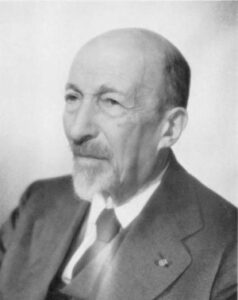
HAIFA, Israel — Jacques Solomon Hadamard, a prominent French mathematician, was born on December 8, 1865, in Versailles to a Jewish family. In 1867 he and his family moved to Paris. His father was a teacher at the lyceum, his mother gave private lessons on the piano, and therefore at an early age Jacques learned to play the violin. Subsequently, he liked to muse with Einstein.
Hadamard loved to read and studied quite well at the lyceum, having many diplomas in a variety of subjects, but he did not like arithmetic. However, in seventh grade, Hadamard had a new math teacher, of whom he said: “[The new teacher] evoked in me my first, still childlike sense of the beauty of scientific truths.”
As a child, Hadamard loved to study languages, was the winner of the contest of connoisseurs of Greek and Latin languages and was a lifelong fan of botany, collected ferns. Jacques Hadamard received his secondary education at the Lycée Louis the Great. For some time, he studied at the Polytechnic School. In 1890 he graduated from the Higher Normal School and began teaching. Already at the age of sixteen, he published his first scientific work. In 1892, Jacques Hadamard became a doctor of science.
In 1892 Hadamard married Louise-Anne Trenelle, and they had three sons and two daughters. Two of Hadamard’s older sons died on the fronts of the First World War, the third was killed in the Second World War.
From 1893, Hadamard worked for a time in Bordeaux, then in Paris: the Sorbonne (1900-1912), the Collège de France (1897-1935), the École Polytechnique (1912-1935) and the École Centrale des Arts et Crafts (1920-1935). He helped establish the Hebrew University of Jerusalem and was an honorary member of its board of trustees. After Henri Poincaré’s death, Hadamard took his place at the French Academy of Sciences (1912).
His main research was in number theory, analytic function theory, differential equations of mathematical physics, and mechanics. He developed the set theory. He owns seminal works in the theory of integer analytic functions. In the theory of differential equations, his work on Augustin Cauchy’s problem for hyperbolic equations is particularly important. In classical analysis and function theory, Hadamard’s inequality and his theorem on power series are well known. He formulated the notion of correctness of a problem in mathematical physics. He carried out works on calculus of variations (variational formula, Hadamard’s theorem). In mechanics he dealt with stability problems and the study of properties of trajectories of mechanical systems near the equilibrium position and problems of gas dynamics. Hadamard was also involved in school teaching and wrote a textbook on geometry.
Hadamard organized a mathematical seminar at the Collège de France that existed for 20 years. One of his students, Maurice René Fréchet, recalled: “Thanks to his erudition and ability to master any field, Hadamard extended the work of the seminar to all parts of mathematics…. Jacques Hadamard also listened to papers when he was over 90 years old. And how different the language must have seemed to him! It is difficult to understand already what a mathematician five or ten years younger does. Before Hadamard passed a number of concepts that do not correspond to the concepts of his youth, thanks to the knowledge he was able to establish connections and come to understand the essence of provable results and new ideas, which allowed him to put more questions, and at that very significant than any other listener”.
During the German occupation of France (1940-1945), Hadamard was in exile in the United States, where he worked as a professor at Yale University. At the end of the war, he returned to France.
Hadamard was interested in the process of birth of mathematical ideas, which was reflected in his well-known book The Psychology of Invention in the Mathematical Field (1959), which has undergone many reprints.
Hadamard’s cousin Lucie was the wife of Alfred Dreyfus, so he was particularly sensitive to the Dreyfus affair. His friend mathematician Paul Painlevé, who was twice Prime Minister of France, was at first convinced of Dreyfus’s guilt, but under the influence of Hadamard began to speak in his defense. He wrote: “Jacques Hadamard, a cousin of Dreyfus’s wife, once spoke to me about the 1894 military tribunal. For almost an hour Hadamard tried to convince me of Dreyfus’ innocence and finally, faced with my disbelief, tried his best to make me realize the intrinsic value of his arguments and his complete impartiality. Hadamard informed me that he did not know Dreyfus personally at all, that he had seen him only once in his life, that he did not like his face, and that his conviction of Dreyfus’s innocence was based only on facts.”
Hadamard remained involved in human rights activism, took an active part in the Human Rights League founded by Emile Zola, opposed nationalist prejudices and supported leftist movements in France in the 1930s, but did not join any political party. At his 60tj birthday ceremony in 1958, he said, “The League continues to exist because it affirms the priority of moral values and even now, whenever the law is broken and injustice and arbitrariness triumph, I declare: the Dreyfus affair is not dead!” Sensing the enormity of the injustices committed “in the name of the public interest,” Hadamard spent his life speaking out against antisemitism.
Hadamard died in Paris on October 17, 1963, at the age of 97. In 1965, marking the centenary of Hadamard’s birth, his colleague, the renowned French mathematician Paul Montel, said: “The brilliance of Jacques Hadamard’s great mathematical discoveries sometimes dazzles his admirers and prevents them from appreciating the extent of his intellectual wealth and his moral greatness. He resembles one of those high mountain peaks which, to know them well, one must climb all their slopes. He enjoyed what Anatole France called the silent feasts of the intellect. He was passionately interested in and contributed to the many creations of the human mind.”
*
Alex Gordon is professor emeritus of physics at the University of Haifa and at Oranim, the Academic College of Education, and the author of 11 books