By Eileen Wingard
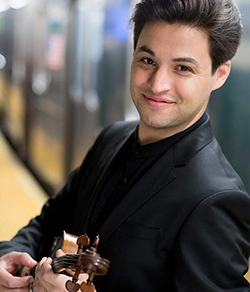
LA JOLLA, California — Israeli violinist Asi Matathias came on stage with his piano collaborator, Matthew Graybil, for their September 11 recital at the Lawrence Family JCC, calmly tucked his violin under his chin, and after a brief piano introduction, launched into the Vitali Chaconne, projecting the opening four bar theme with firm bow strokes and warm, engaging sound. The variations that followed were carefully delineated and imbued with colorful contrasts.
There were no histrionics or choreography in his playing, only sincere, concentrated musical beauty, performed with the confidence of a seasoned artist. Matathias injected these qualities into all four movements of the Cesar Franck Sonata which followed.
His performance reminded me of the first time I heard the Franck Sonata, at a recital in Los Angeles by the Polish-born Jewish violinist, the founder of Israel’s Philharmonic Orchestra, Bronislaw Huberman. It was in 1946, a decade after Huberman founded what became the IPO and this was one of his last recitals before his death the following year. The beautiful interplay of violin and piano, especially in the canonic last movement, still remains vivid in my memory. Matathias and Graybil’s performance brought back the memory of that Huberman rendition.
Following intermission, the artists returned to play three delightful Romances by the great pianist, Clara Schumann, wife of the more famous composer, Robert Schumann. These three vignettes illustrated his wife’s formidable creative powers as a gifted composer.
The program concluded with the virtuosic Saint-Saen Violin Sonata in D minor. This four-movement work demands the greatest degree of technical prowess and the two performers proved ample to the task. For any violin students in the audience, the last movement was an excellent lesson in spiccato bowing, as Matathias controlled his rapidly bouncing bow with the subtlest of wrist movements.
The standing ovation and long applause brought the artists back to the stage for an encore, a Brahms Lied, transcribed for violin by the great 20th century violinist, Jascha Heifetz.
Matathias delivered a few closing words, acknowledging the difficult times we are living in and hoping that music can bring us solace.
Matathias, who made his debut at age 14 with the Israel Philharmonic under the direction of Zubin Mehta, was recently in Israel playing two concerts with the IPO. In one, he performed the Mendelssohn Violin Concerto, in the other he did Vivaldi’s Four Seasons followed by Piazzolla’s Four Seasons of Buenos Aires. After San Diego, he is scheduled to play the Bruch G minor Concerto with the Dubrovnik Symphony, then will return to Israel to solo with the Haifa Symphony in a Violin Concerto by Joseph Kaminski, one of the violinists whom Bronislaw Huberman rescued to become concertmaster of the orchestra he founded.
Asi and Matthew met while Asi was studying with Pinchas Zuckerman in New York. They have been playing together for the past eight years and their excellent ensemble and careful balance testifies to their years of collaboration.
Graybil received his Bachelor and Master degrees from the Juilliard School, where he studied with Jerome Lowenthal. He has been praised by the New Yorker as, “An exceptional young artist,” and this recital confirmed the report in the Beijing Weekly about Asi Matathias’ performance, “the audience was enraptured by his playing.”
*
Eileen Wingard, a retired violinist with the San Diego Symphony Orchestra, is a freelance writer specializing in coverage of the arts.
I was at the performance and agree: the closing showed how Asi’s music itself delivered the drama.
Kol”hakavod, Asi.